
|
2003 Tax Help Archives |

| Home >
Tax Help Archives > 2003 > Publications > Publication 515
|
|
||||||||||||||||||||||||||||||||||||||||||||||||||||||||||||||||||||||||||||||||||||||||||||||||||||||||||||||||||||||||||||||||||||||||||||||||||||||||||||||||||||||||||||||||||||||||||||||||||||||||||||||||||||||||||||||||||||||||||||||||||||||||||||||||||||||||||||||||||||||||||||||||||||||||||||||||||||||||||||||||||||||||||||||||||||||||||||||||||||||||
You may, however, rely on documentary evidence as establishing an account holder's claim of a reduced rate of withholding under a treaty if any of the following apply.
A financial institution that receives documentation from a payee through a nonqualified intermediary, a flow-through entity, or a U.S. branch of a foreign bank or insurance company subject to U.S. or state regulatory supervision has reason to know that the documentary evidence is unreliable or incorrect if a reasonably prudent person in the financial institution's position would question the claims made. This standard requires, but is not limited to, compliance with the following rules. Withholding statement.
You must review the withholding statement provided with Form W–8IMY and may not rely on information in the statement to the extent the information does not support the claims made for a payee. You may not treat a payee as a foreign person if a U.S. address is provided for the payee. You may not treat a person as a resident of a country with which the United States has an income tax treaty if the address for the person is outside the treaty country. You may, however, treat a payee as a foreign person and may treat a foreign person as a resident of a treaty country if a reasonable explanation is provided, in writing, by the nonqualified intermediary, flow-through entity, or U.S. branch. Withholding certificate.
If you receive a Form W–8 for a payee in association with a Form W–8IMY, you must review each Form W–8 and verify that the information is consistent with the information on the withholding statement. If there is a discrepancy, you may rely on the Form W–8, if valid, and instruct the nonqualified intermediary, flow-through entity, or U.S. branch to correct the withholding statement, or, alternatively, you may apply the presumption rules, discussed later, to the payee. Documentary evidence.
If you receive documentary evidence for a payee in association with a Form W–8IMY, you must review the documentary evidence provided by the nonqualified intermediary, flow-through entity or U.S. branch to determine that there is no obvious indication that the payee is a U.S. person subject to Form 1099 reporting or that the documentary evidence does not establish the identity of the person who provided the documentation (for example, the documentary evidence does not appear to be an identification document). If you cannot reliably associate a payment with valid documentation, you must apply certain presumption rules or you may be liable for tax, interest, and penalties. If you comply with the presumption rules, you are not liable for tax, interest, and penalties even if the rate of withholding that should have been applied based on the payee's actual status is different from that presumed. The presumption rules apply to determine the status of the person you pay as a U.S. or foreign person and other relevant characteristics, such as whether the payee is a beneficial owner or intermediary, and whether the payee is an individual, corporation, partnership, or trust. You are not permitted to apply a reduced rate of NRA withholding based on a payee's presumed status if documentation is required to establish a reduced rate of withholding. For example, if the payee of interest is presumed to be a foreign person, you may not apply the portfolio interest exception or a reduced rate of withholding under a tax treaty since both exceptions require documentation. If you rely on your actual knowledge about a payee's status and withhold an amount less than that required under the presumption rules or do not report a payment that is subject to reporting under the presumption rules, you may be liable for tax, interest, and penalties. You should, however, rely on your actual knowledge if doing so results in withholding an amount greater than would apply under the presumption rules or in reporting an amount that would not be subject to reporting under the presumption rules. The presumption rules, in the absence of documentation, for the subject matter are discussed in the regulation section indicated on Chart A. Income Subject to NRA Withholding This section explains how to determine if a payment is subject to NRA withholding. A payment is subject to NRA withholding if it is from sources within the United States, and it is either:
In addition, a payment is subject to NRA withholding if withholding is specifically required, even though it may not constitute U.S. source income or FDAP income. For example, corporate distributions may be subject to NRA withholding even though a portion of the distribution may be a return of capital or capital gain not otherwise subject to NRA withholding. Amounts not subject to NRA withholding.
The following amounts are not subject to NRA withholding.
Generally, income is from U.S. sources if it is paid by domestic corporations, U.S. citizens or resident aliens, or entities formed under the laws of the United States or a state. Income is also from U.S. sources if the property that produces the income is located in the United States or the services for which the income is paid were performed in the United States. A payment is treated as being from sources within the United States if the source of the payment cannot be determined at the time of payment, such as fees for personal services paid before the services have been performed. In this situation, you are required to withhold the amount necessary to assure that the tax withheld will not be less than 30% of U.S. source income. Or, you may make a reasonable estimate of the amount from U.S. sources and put a corresponding portion of the amount due in escrow until the amount from U.S. sources can be determined, at which time withholding becomes due. Other source rules are summarized in Chart B and explained in detail in the separate discussions under Withholding on Specific Income, later. Chart B. Summary of Source Rules for FDAP Income
Personal service income.
If the income is for personal services performed in the United States, it is from U.S. sources. The place where the services are performed determines the source of the income, regardless of where the contract was made, the place of payment, or the residence of the payer. However, under certain circumstances, payment for personal services performed in the United States is not considered income from sources within the United States. For information on this exception, see the discussion, Pay for dependent personal services under Pay for Personal Services Performed, later. If the income is for personal services performed partly in the United States and partly outside the United States, you must make an accurate allocation of income for services performed in the United States. In most cases, you make this allocation on a time basis. That is, U.S. source income is the amount that results from multiplying the total amount of pay by the following fraction:
Example. Jean Blanc, a citizen and resident of Canada, is employed as a professional hockey player by a U.S. hockey club. Under Jean's contract, he received $150,000 for 242 days of play during the year. This includes days spent at pre-season training camp, days during the regular season, and playoff game days. Of the 242 days, 194 days were spent performing services in the United States and 48 days performing services in Canada. The amount of U.S. source income is $120,248 ((194 ÷ 242) × $150,000). Territorial limits.
Wages received for services rendered inside the territorial limits of the United States and wages of an alien seaman earned on a voyage along the coast of the United States are regarded as from sources in the United States. Wages or salaries for personal services performed in a mine or on an oil or gas well located or being developed on the continental shelf of the United States are treated as from sources in the United States. Income from the performance of services directly related to the use of a vessel or aircraft is treated as derived entirely from sources in the United States if the use begins and ends in the United States. This income is subject to NRA withholding if it is not effectively connected with a U.S. trade or business. If the use either begins or ends in the United States, see Transportation income, later. Crew members.
Income from the performance of services by a nonresident alien in connection with the individual's temporary presence in the United States as a regular member of the crew of a foreign vessel engaged in transportation between the United States and a foreign country or a U.S. possession is not income from U.S. sources. Scholarships, fellowships, and grants.
Scholarships, fellowships, and grants are sourced according to the residence of the payer. Those made by entities created or domiciled in the United States are generally treated as income from sources within the United States. However, see Activities outside the United States, next. Those made by entities created or domiciled in a foreign country are treated as income from foreign sources. Activities outside the United States.
A scholarship, fellowship, grant, targeted grant, or an achievement award received by a nonresident alien for activities conducted outside the United States is treated as foreign source income. Pension payments.
The source of pension payments is determined by the portion of the distribution that constitutes the compensation element (employer contributions) and the portion that constitutes the earnings element (the investment income). The compensation element is sourced the same as compensation from the performance of personal services. The portion attributable to services performed in the United States is U.S. source income, and the portion attributable to services performed outside the United States is foreign source income. The earnings portion of a pension payment is U.S. source income if the trust is a U.S. trust. Fixed or Determinable Annual or Periodical Income (FDAP) FDAP income is all income except:
The following items are examples of FDAP income.
Installment payments.
Income can be FDAP income whether it is paid in a series of repeated payments or in a single lump sum. For example, $5,000 in royalty income would be FDAP income whether paid in 10 payments of $500 each or in one payment of $5,000. Insurance proceeds.
Income derived by an insured nonresident alien from U.S. sources upon the surrender of, or at the maturity of, a life insurance policy, is FDAP income and is subject to NRA withholding. The proceeds are income to the extent they exceed the cost of the policy. However, certain payments received under a life insurance contract on the life of a terminally or chronically ill individual before death (accelerated death benefits) may not be subject to tax. This also applies to certain payments received for the sale or assignment of any portion of the death benefit under contract to a viatical settlement provider. See Publication 525, Taxable and Nontaxable Income, for more information. Racing purses.
Racing purses are FDAP income and racetrack operators must withhold 30% on any purse paid to a nonresident alien racehorse owner in the absence of definite information contained in a statement filed together with a Form W–8BEN that the owner has not raced, or does not intend to enter, a horse in another race in the United States during the tax year. If available information indicates that the racehorse owner has raced a horse in another race in the United States during the tax year, then the statement and Form W–8BEN filed for that year are ineffective. The owner may be exempt from withholding of tax at 30% on the purses if the owner gives you Form W-8ECI, which provides that the income is effectively connected with the conduct of a U.S. trade or business and that the income is includible in the owner's gross income. Covenant not to compete.
Payment received for a promise not to compete is FDAP income. Its source is the place where the promisor forfeited his or her right to act. Amounts paid to a nonresident alien for his or her promise not to compete in the United States are subject to NRA withholding. Signing on.
A fee paid to a professional athlete, such as a soccer or hockey player for “signing on” with the effect of preventing any other team from negotiating with the player and preventing the player from negotiating with any other team is pay for a covenant not to compete. The source is the place where the right to play is given up. If a league is made up of both foreign and U.S. teams, the fee is from sources partly in and partly outside the United States. The part of the fee that is from U.S. sources is subject to NRA withholding. If there is no reasonable basis for an allocation of the fee, the entire sign-on fee is income from the United States and is subject to NRA withholding. Withholding on Specific Income Different kinds of income are subject to different withholding requirements. Generally, when a foreign person engages in a trade or business in the United States, all income from sources within the United States other than fixed or determinable annual or periodical (FDAP) income, discussed earlier, is considered effectively connected with a U.S. business. FDAP income may or may not be effectively connected with a U.S. business. For example, effectively connected income includes rents from real property if the alien chooses to treat that income as effectively connected with a U.S. trade or business. The factors to be considered in establishing whether FDAP income and similar amounts are effectively connected with a U.S. trade or business include:
Income from securities.
There is a special rule determining whether income from securities is effectively connected with the active conduct of a U.S. banking, financing, or similar business. If the foreign person's U.S. office actively and materially participates in soliciting, negotiating, or performing other activities required to arrange the acquisition of securities, the U.S. source interest or dividend income from the securities (or gain or loss from their sale or exchange) is attributable to the U.S. office and is effectively connected income. Withholding exemption.
Generally, you do not need to withhold tax on income if you receive a Form W–8ECI on which a foreign payee represents that:
This withholding exemption applies to income for services performed by a foreign partnership or foreign corporation (unless item (4) below applies to the corporation). The exemption does not apply, however, to:
Notional principal contract income.
Payment of an amount attributable to a notional principal contract is not subject to NRA withholding regardless of whether a Form W–8ECI is provided. However, income from a notional principal contract is subject to reporting on Form 1042–S if it is effectively connected with the conduct of a trade or business in the United States. You must treat the income as effectively connected with a U.S. trade or business if you pay the income to, or to the account of, a qualified business unit (a branch) of a foreign person located in the United States, or a qualified business unit located outside the United States and you know, or have reason to know, the income is effectively connected with the conduct of a U.S. trade or business. You do not need to treat notional principal contract income as effectively connected if you receive a Form W–8BEN that represents that the income is not effectively connected with the conduct of a U.S. trade or business or if the payee provides a representation in a master agreement or in the confirmation on the particular notional principal contract transaction that the payee is a U.S. person or a non-U.S. branch of a foreign person. Income paid to U.S. branch of foreign bank or insurance company.
A payment to a U.S. branch of a foreign bank or a foreign insurance company that is subject to U.S. regulation by the Federal Reserve or state insurance authorities is presumed to be effectively connected with the conduct of a trade or business in the United States unless the branch provides a Form W–8BEN or Form W–8IMY for the income. If a U.S. branch of a foreign bank or insurance company receives income that the payer did not withhold upon because of the presumption that the income was effectively connected with the U.S. branch's trade or business, the U.S. branch is required to withhold on the income if it is in fact not effectively connected with the conduct of its trade or business in the United States. Withholding is required whether the payment was collected on behalf of other persons or on behalf of another branch of the same entity. Income Not Effectively Connected This section discusses the specific types of income that are subject to NRA withholding. The income codes contained in this section correspond to the income codes used on Form 1042–S (discussed later), and in most cases, on Tables 1 and 2 found at the end of this publication. You must withhold tax at the statutory rates shown in Chart C unless a reduced rate or exemption under a tax treaty applies. For U.S. source gross income that is not effectively connected with a U.S. trade or business, the rate is usually 30%. Generally, you must withhold the tax at the time you pay the income to the foreign person. See When to withhold, earlier. Chart C. Withholding Tax Rates(Note: You must withhold tax at the following rates on payments of income unless a reduced rate or exemption is authorized under a tax treaty. The President may apply higher tax rates on income paid to residents or corporations of foreign countries that impose burdensome or discriminatory taxes on U.S. persons.)
Interest from U.S. sources paid to foreign payees is subject to NRA withholding. When making a payment on an interest bearing obligation, you must withhold on the gross amount of stated interest payable on the interest payment date, even if the payment or a portion of the payment may be a return of capital rather than interest. A substitute interest payment made to the transferor of a security in a securities lending transaction or a sale-repurchase transaction is treated the same as the interest on the transferred security. Interest paid by U.S. obligors—general (Income Code 1).
With specific exceptions, such as portfolio interest, you must withhold on interest paid or credited on bonds, debentures, notes, open account indebtedness, governmental obligations, certain deferred payment arrangements (as provided in section 483 of the Internal Revenue Code) or other evidences of indebtedness of U.S. obligors. U.S. obligors include the U.S. Government or its agencies or instrumentalities, any U.S. citizen or resident, any U.S. corporation, and any U.S. partnership. If, in a sale of a corporation's property, payment of the bonds or other obligations of the corporation is assumed by the buyer, that buyer, whether an individual, partnership, or corporation, must deduct and withhold the taxes that would be required to be withheld by the selling corporation as if there had been no sale or transfer. Also, if interest coupons are in default, the tax must be withheld on the gross amount of interest whether or not the payment is a return of capital or the payment of income. A resident alien paying interest on a margin account maintained with a foreign brokerage firm must withhold from the interest whether the interest is paid directly or constructively. Interest on bonds of a U.S. corporation paid to a foreign corporation not engaged in a trade or business in the United States is subject to NRA withholding even if the interest is guaranteed by a foreign corporation that made payment outside the United States. Domestic corporations must withhold on interest credited to foreign subsidiaries or foreign parents. Original issue discount (Income Code 30).
Original issue discount paid on the redemption of an obligation is subject to NRA withholding. Original issue discount paid as part of the purchase price of an obligation sold or exchanged, other than in a redemption, is not subject to NRA withholding unless the purchase is part of a plan the principal purpose of which is to avoid tax and the withholding agent has actual knowledge or reason to know of the plan. Withholding is required by a person other than the issuer of an obligation (or the issuer's agent) only if the obligation is issued after December 31, 2000. The original issue discount subject to NRA withholding is the taxable amount of original issue discount. The taxable amount is the original issue discount that accrued while the obligation was held by the foreign beneficial owner up to the time the obligation was sold or exchanged or a payment was made, reduced by any original issue discount that was previously taxed. If a payment was made, the tax due on the original issue discount may not exceed the payment reduced by the tax imposed on the portion of the payment that is qualified stated interest. If you cannot determine the taxable amount, you must withhold on the entire amount of original issue discount accrued from the date of issue until the date of redemption (or sale or exchange, if subject to NRA withholding) determined on the basis of the most recently published Publication 1212, List of Original Issue Discount Instruments. For more information on original issue discount, see Publication 550, Investment Income and Expenses. Reduced Rates of
Certain interest is subject to a reduced rate of, or exemption from, withholding. Portfolio interest.
Interest and original issue discount that qualifies as portfolio interest is not subject to NRA withholding. To qualify as portfolio interest, the interest must be otherwise subject to NRA withholding, must be paid on obligations issued after July 18, 1984, and must meet certain other requirements. Obligations not in registered form.
Interest on an obligation that is not in registered form (bearer obligation) is portfolio interest if the obligation is foreign-targeted. A bearer obligation is foreign-targeted if:
Documentation is not required for interest on bearer obligations to qualify as portfolio interest. In some cases, however, you may need documentation for purposes of Form 1099 reporting and backup withholding. Obligations in registered form.
Portfolio interest includes interest paid on an obligation that is in registered form, and for which you have received documentation that the beneficial owner of the obligation is not a United States person. If the registered obligation is not targeted to foreign markets, you must receive documentation on which you may rely to treat the payee as a foreign person that is the beneficial owner of the interest. The documentation required is a valid Form W–8BEN (a valid Form W–8EXP from an entity that completes the Form W–8EXP for other purposes is also acceptable) or, if allowable, valid documentary evidence. See Documentation, earlier. A registered obligation is targeted to foreign markets if it is sold (or resold in connection with its original issuance) only to foreign persons or to foreign branches of U. S. financial institutions in accordance with procedures similar to those provided under section 1.163–5(c)(2)(i) of the regulations. However, the procedure that requires the obligation to be offered for sale (or resale) only outside the United States does not apply if the registered obligation is offered for sale through a public auction. Also, the procedure that requires the obligation to be delivered outside the United States does not apply if the obligation is considered registered because it may be transferred only through a book entry system and the obligation is offered for sale through a public auction. The documentation needed depends on whether the interest is paid to a financial institution, a member of a clearing organization, or to some other foreign person. Interest that does not qualify as portfolio interest.
Payments to certain persons and payments of contingent interest do not qualify as portfolio interest. You must withhold at the statutory rate on such payments unless some other exception, such as a treaty provision applies. Ten-percent owners.
Interest paid to a foreign person that owns 10% or more of the total combined voting power of all classes of stock of a corporation, or 10% or more of the capital or profits interest in a partnership, that issued the obligation on which interest is paid is not portfolio interest. Generally, the constructive ownership of stock rules apply in determining if a person is a 10% shareholder of a corporation. Banks.
Except in the case of interest paid on an obligation of the United States, interest paid to a bank on an extension of credit made pursuant to a loan agreement entered into in the ordinary course of the bank's trade or business does not qualify as portfolio interest. Controlled foreign corporations.
Interest paid to a controlled foreign corporation from a person related to the controlled foreign corporation is not portfolio interest. Contingent interest.
Portfolio interest generally does not include contingent interest. Contingent interest is interest that is determined by reference to any of the following.
The term “related person” is defined in section 871(h)(4)(B) of the Internal Revenue Code. The contingent interest rule does not apply to any interest paid or accrued on any indebtedness with a fixed term that was issued:
Interest on real property mortgages (Income Code 2).
Certain treaties (see Table 1) permit a reduced rate or exemption for interest paid or credited on real property mortgages. This is interest paid on any type of debt instrument that is secured by a mortgage or deed of trust on real property located in the United States, regardless of whether the mortgagor (or grantor) is a U.S. citizen or a U.S. business entity. Interest paid to controlling foreign corporations (Income Code 3).
Certain treaties (see Table 1) permit a reduced rate or exemption for interest paid by a domestic corporation to a controlling foreign corporation. The interest may be on any type of debt including open or unsecured accounts payable, notes, certificates, bonds, or other evidences of indebtedness. A controlling foreign corporation is a corporation of the treaty country that controls, directly or indirectly, more than 50% of the entire voting power of the paying corporation. Interest paid by foreign corporations (Income Code 4).
If a foreign corporation is engaged in a U.S. trade or business, any interest paid by the foreign corporation's trade or business in the United States (branch interest) is subject to NRA withholding as if paid by a domestic corporation (without considering the “payer having income from abroad” exception). As a result, the interest paid to foreign payees is generally subject to NRA withholding. In addition, if “allocable interest” exceeds the branch interest paid, the excess interest is also subject to tax and reported on the foreign corporation's income tax return, Form 1120–F. See Instructions for Form 1120–F for more information. If there is no treaty provision that reduces the rate of withholding on branch interest, you must withhold tax at the statutory rate of 30% on the interest paid by a foreign corporation's U.S. trade or business. In general, payees of interest from a U.S. trade or business of a foreign corporation are entitled to reduced rates of, or exemption from, tax under a treaty in the same manner and subject to the same conditions as if they had received the interest from a domestic corporation. However, a foreign corporation that receives interest paid by a U.S. trade or business of a foreign corporation must also be a qualified resident of its country of residence to be entitled to benefits under that country's tax treaty. If the foreign corporation is a resident of a country that has entered into an income tax treaty since 1987 that contains a limitation on benefits article, the foreign corporation need only satisfy the limitation on benefits article in that treaty to qualify for a reduced rate of tax. Alternatively, a payee may be entitled to treaty benefits under the payor's treaty if there is a provision in that treaty that applies specifically to interest paid by the payor foreign corporation. This provision may exempt all or a part of this interest. Some treaties provide for an exemption regardless of the payee's residence or citizenship, while others provide for an exemption according to the payee's status as a resident or citizen of the payor's country. A foreign corporation that pays interest must be a qualified resident (under section 884 of the Internal Revenue Code) of its country of residence for the payor's treaty to exempt payments from tax by the foreign corporation. However, if the foreign corporation is a resident of a country that has entered into an income tax treaty since 1987 that contains a limitation on benefits article, the foreign corporation need only satisfy the limitation on benefits article in that treaty to qualify for the exemption. Interest on deposits (Income Code 29).
Foreign persons are not subject to withholding on interest that is not connected with a U.S. trade or business if it is from:
Deposits include certificates of deposit, open account time deposits, Eurodollar certificates of deposit, and other deposit arrangements. The deposit interest exception does not require a Form W–8BEN. However, a Form W–8BEN may be required for purposes of Form 1099 reporting and backup withholding. You may have to file Form 1042–S to report certain payments of interest on deposits. Interest from foreign business arrangements.
In general, interest received from a resident alien individual or a domestic corporation is not subject to NRA withholding if at least 80% of the payer's gross income from all sources has been from active foreign business for the 3 tax years of the payer before the year in which the interest is paid, or for the applicable part of those 3 years. Active foreign business income is gross income which is:
However, limits apply if the recipient is considered to be a related person (see section 861(c) of the Internal Revenue Code). A foreign beneficial owner does not need to provide a Form W–8 or documentary evidence for this exception. However, documentation may be required for purposes of Form 1099 reporting and backup withholding. Sales of bonds between interest dates.
Amounts paid as part of the purchase price of an obligation sold or exchanged between interest payment dates is not subject to NRA withholding. This does not apply if the sale or exchange is part of a plan the principal purpose of which is to avoid tax and you have actual knowledge or reason to know of the plan. The exemption from NRA withholding applies even if you do not have any documentation from the payee. However, documentation may be required for purposes of Form 1099 reporting and backup withholding. Short-term obligations.
Interest and original issue discount paid on an obligation that was issued at a discount and that is payable 183 days or less from the date of its original issue (without regard to the period held by the taxpayer) is not subject to NRA withholding. This exemption applies even if you do not have any documentation from the payee. However, documentation may be required for purposes of Form 1099 reporting and backup withholding. Income from U.S. Savings Bonds of residents of the Ryukyu Islands or the Trust Territory of the Pacific Islands.
Interest from a Series E, Series EE, Series H, or Series HH U.S. Savings Bond is not subject to NRA withholding if the nonresident alien individual acquired the bond while a resident of the Ryukyu Islands or the Trust Territory of the Pacific Islands. The following types of dividends paid to foreign payees are generally subject to NRA withholding. A substitute dividend payment made to the transferor of a security in a securities lending transaction or a sale-repurchase transaction is treated the same as a distribution on the transferred security. Dividends paid by U.S. corporations — general (Income Code 6).
This category includes all distributions of domestic corporations (other than dividends qualifying for direct dividend rate—Income Code 7). A corporation making a distribution with respect to its stock or any intermediary making a payment of such a distribution, is required to withhold on the entire amount of the distribution. However, a distributing corporation or intermediary may elect to not withhold on the part of the distribution that:
The election is made by actually reducing the amount of withholding at the time the distribution is paid. Dividends paid by a domestic corporation (an “80/20” company).
Generally, a percentage of any dividend paid by a domestic corporation that received at least 80% of its gross income from the active conduct of a foreign business for a testing period is not subject to NRA withholding. The testing period is the 3 tax years before the year in which the dividends are declared, or shorter period if the corporation was not in existence for 3 years. The percentage is found by dividing the corporation's foreign gross income for the testing period by the corporation's total gross income for that period. Main business in Puerto Rico or the Virgin Islands.
Dividends paid by a domestic corporation that generally conducts its main business activities in Puerto Rico or the Virgin Islands and that has chosen the Puerto Rico economic activity credit or the possession tax credit are not subject to NRA withholding. Consent dividends.
If you receive a Form 972, Consent of Shareholder To Include Specific Amount in Gross Income, from a nonresident alien individual or other foreign shareholder who agrees to treat the amount as a taxable dividend, you must pay and report on Form 1042 and Form 1042–S any withholding tax you would have withheld if the dividend had been actually paid. Dividends qualifying for direct dividend rate (Income Code 7).
A treaty may reduce the rate of withholding on dividends from that which generally applies under the treaty if the shareholder owns a certain percentage of the voting stock of the corporation. Generally, this preferential rate applies only if the shareholder directly owns the required percentage, although some treaties permit the percentage to be met by direct or indirect ownership. The preferential rate may apply to the payment of a deemed dividend under section 304(a)(1) of the Internal Revenue Code. Under some treaties, the preferential rate for dividends qualifying for the direct dividend rate applies only if no more than a certain percentage of the paying corporation's gross income for a certain period consists of dividends and interest other than dividends and interest from subsidiaries or from the active conduct of a banking, financing, or insurance business. A foreign person claiming the direct dividend rate should complete line 10 of Form W–8BEN regarding special rates and conditions. Consent dividends.
If you receive a Form 972 from a foreign shareholder qualifying for the direct dividend rate, you must pay and report on Form 1042 and Form 1042–S any withholding tax you would have withheld if the dividend had been actually paid. Dividends paid by foreign corporations (Income Code 8).
Dividends paid by a foreign corporation are generally subject to NRA withholding if 25% or more of its gross income is effectively connected (or treated as effectively connected) with a U.S. trade or business for the 3 tax years (or shorter period) before the year in which the dividends are paid. Taxes should be withheld in the same ratio that the effectively connected gross income bears to the total gross income of the foreign corporation. If less than 25% of the corporation's gross income is effectively connected with a U.S. trade or business, then the dividends are not subject to NRA withholding. The payment to a foreign corporation by a foreign corporation of a deemed dividend under section 304(a)(1) of the Internal Revenue Code is subject to NRA withholding except to the extent it can be clearly determined to be from foreign sources. Corporation subject to branch profits tax.
If a foreign corporation is subject to branch profits tax for any tax year, withholding is not required on any dividends paid by the corporation out of its earnings and profits for that tax year. Dividends may be subject to NRA withholding if they are attributable to any earnings and profits when the branch profits tax is prohibited by a tax treaty. A foreign person may claim a treaty benefit on dividends paid by a foreign corporation to the extent the dividends are paid out of earnings and profits in a year in which the foreign corporation was not subject to the branch profits tax. However, you may apply a reduced rate of withholding under an income tax treaty only under rules similar to the rules that apply to treaty benefits claimed on branch interest paid by a foreign corporation. You should check the specific treaty provision. You generally do not need to withhold on gains from the sale of real or personal property because it is not FDAP income. However, see U.S. Real Property Interest, later. Capital gains (Income Code 9).
You must withhold at 30%, or if applicable, a reduced treaty rate, on the gross amount of the following items:
If you do not know the amount of the gain, you must withhold an amount necessary to assure that the tax withheld will not be less than 30% of the recognized gain. The amount to be withheld, however, must not be more than 30% of the amount payable because of the transaction. Unless you have reason to believe otherwise, you may rely upon the written statement of the person entitled to the income as to the amount of gain. The Form W-8 or documentary evidence must show the beneficial owner's basis in the property giving rise to the gain. Tax treaties.
Many tax treaties exempt certain types of gains from U.S. income tax. The conditions for allowing the exemptions vary under each treaty. For example, under some treaties, a nonresident alien individual may not be present in the United States for more than a specified period for the exemption to apply. Be sure to carefully check the provision of the treaty that applies before allowing an exemption from withholding. In general, you must withhold tax on the payment of royalties from sources in the United States. However, certain types of royalties are given reduced rates or exemptions under some tax treaties. Accordingly, these different types of royalties are treated as separate categories for withholding purposes. Industrial royalties (Income Code 10).
This category of income includes royalties for the use of, or the right to use, patents, trademarks, secret processes and formulas, goodwill, franchises, “know-how,” and similar rights. It also may include rents for the use or lease of personal property. Under certain tax treaties, different rates may apply to royalties for information concerning industrial, commercial, and scientific know-how. Motion picture or television copyright royalties (Income Code 11).
This category refers to royalties paid for the use of motion picture and television copyrights. Other royalties (e.g., copyright, recording, publishing) (Income Code 12).
This category refers to the royalties paid for the use of copyrights on books, periodicals, articles, etc., except motion picture and television copyrights. Real Property Income and
You must withhold tax on income (such as rents and royalties) from real property located in the United States and held for the production of income, unless the foreign payee elects to treat this income as effectively connected with a U.S. trade or business. If the foreign payee chooses to treat this income as effectively connected, the payee must give you Form W–8ECI (discussed earlier). This real property income includes royalties from mines, wells, or other natural deposits, as well as ordinary rents for the use of real property. For withholding that applies to the disposition of U.S. real property interests, see U.S. Real Property Interest, later. Pensions, Annuities, and Alimony (Income Code 14) The following rules apply to withholding on pensions, annuities, and alimony of foreign payees. Pensions and annuities.
Generally, you must withhold tax on the gross amount of pensions and annuities that you pay that are from sources within the United States. However, most tax treaties provide that private pensions and annuities are exempt from withholding. In the absence of a treaty exemption, you must withhold at the statutory rate of 30% on the entire distribution that is from sources within the United States. You may, however, apply withholding at graduated rates to the portion of a distribution that arises from the performance of services in the United States after December 31, 1986, provided you receive Form W–8ECI and can determine the portion of the distribution that constitutes income effectively connected with the conduct of a trade or business in the United States. The withholding rules that apply to payments to foreign persons generally take precedence over any other withholding rules that would apply to distributions from qualified plans and other qualified retirement arrangements. No withholding.
Do not withhold tax on an annuity payment to a nonresident alien if at the time of the first payment from the plan, 90% or more of the employees eligible for benefits under the plan are citizens or residents of the United States and the payment is:
If the payment otherwise qualifies under these rules, but less than 90% of the employees eligible for benefits are citizens or residents of the United States, you still need not withhold tax on the payment if:
The foreign person entitled to the payments must provide you with a Form W–8BEN that contains the TIN of the foreign person. Alimony payments.
Generally, alimony payments made by U.S. residents to nonresident aliens are taxable and subject to NRA withholding whether the recipients are residing abroad or are temporarily present in the United States. Many tax treaties, however, provide for an exemption from withholding for alimony payments. These treaties are shown in Table 1, by a footnote reference under Income code number 14. Alimony payments made to a nonresident alien by a U.S. ancillary administrator of a nonresident alien estate are from foreign sources and are not subject to withholding. Scholarships and Fellowship
A scholarship or fellowship grant is an amount given to an individual for study, training, or research, and which does not constitute compensation for personal services. Whether a fellowship grant from U.S. sources is subject to NRA withholding depends on the nature of the payments and whether the recipient is a candidate for a degree. Candidate for a degree.
Do not withhold on a qualified scholarship from U.S. sources granted and paid to a candidate for a degree. A qualified scholarship means any amount paid to an individual as a scholarship or fellowship grant to the extent that, in accordance with the conditions of the grant, the amount is to be used for the following expenses:
The payment of a qualified scholarship to a nonresident alien is not reportable and is not subject to NRA withholding. However, the portion of a scholarship or fellowship paid to a nonresident alien which does not constitute a qualified scholarship is reportable on Form 1042–S and is subject to NRA withholding. For example, those portions of a scholarship devoted to travel, room, and board are subject to NRA withholding and are reported on Form 1042–S. The withholding rate is 14% on taxable scholarship and fellowship grants paid to nonresident aliens temporarily present in the United States in “F,” “J,” “M,” or “Q” nonimmigrant status. Payments made to nonresident alien individuals in any other immigration status are subject to 30% withholding. Nondegree candidate.
If the person receiving the scholarship or fellowship grant is not a candidate for a degree, and is present in the United States in “F,” “J,” “M,” or “Q” nonimmigrant status, you must withhold tax at 14% on the total amount of the grant that is from U.S. sources if the following requirements are met.
If the grant does not meet both (1) and (2) above, you must withhold at 30% on the amount of the grant that is from U.S. sources. Alternate withholding procedure.
You may choose to treat the taxable part of a U.S. source grant or scholarship as wages. The student or grantee must have been admitted into the United States on an “F,” “J,” “M,” or “Q” visa. The student or grantee will know that you are using this alternate withholding procedure when you ask for a Form W–4. The student or grantee must complete Form W–4 annually following the instructions given here and forward it to you, the payer of the scholarship, or your designated withholding agent. You may rely on the information on Form W–4 unless you know or have reason to know it is incorrect. You must file a Form 1042–S (discussed later) for each student or grantee who gives you, or your withholding agent, a Form W–4. Each student or grantee who files a Form W–4 must file an annual U.S. income tax return to be allowed the exemptions and deductions claimed on that form. If the individual is in the United States during more than one tax year, he or she must attach a statement to the annual Form W–4 indicating that the individual has filed a U.S. income tax return for the previous year. If he or she has not been in the United States long enough to have to file a return, the individual must attach a statement to the Form W–4 saying that a timely U.S. income tax return will be filed. A prorated portion of allowable personal exemptions based on the projected number of days he or she will be in this country is allowed. This is figured by multiplying the daily exemption amount ($8.36 for 2003) by the number of days the student or grantee expects to be in the United States during the year. The prorated exemption amount should be shown on line A of the Personal Allowances Worksheet that comes with Form W–4. Generally, zero (–0–) should be shown on line B of the worksheet. But, a student or grantee who qualifies under Article 21(2) of the United States—India Income Tax Treaty can enter the standard deduction if he or she does not claim away-from-home expenses or other itemized deductions (discussed later). Generally, zero (-0-) should be shown on lines C and D of the worksheet. But, an additional daily exemption amount may be allowed for the spouse and each dependent if the student or grantee is:
These additional amounts should be entered on lines C and D, as appropriate. As lines E, F, and G of the worksheet do not apply to nonresident aliens subject to this procedure, there should be no entries on those lines. The nonresident alien student or grantee may deduct away-from-home expenses (meals, lodging, and transportation) on Form W–4 if he or she expects to be away from his or her tax home for 1 year or less. The amount of the claimed expenses should be the anticipated actual amount, if known. If the amount of the expenses is not known at the time the Form W–4 is filed with you, the current per diem allowance in effect for participants in the Career Education Program under the Federal Travel Regulations may be claimed on Form W–4. The allowable amount is $18.00 per day. The actual expenses or the per diem allowance should be shown on line A of the worksheet in addition to the personal exemption amount. The student or grantee can claim other expenses that will be deductible on Form 1040NR. These include educator expenses, student loan interest, certain state and local income taxes, charitable contributions, casualty losses, and moving expenses. He or she should include these anticipated amounts on line A of the worksheet. The student or grantee can also enter on line A of the worksheet, the part of the grant or scholarship that is tax exempt under the statute or a tax treaty. Lines A through D of the Personal Allowances Worksheet are added and the total should be shown on line H. The payer of the grant or scholarship must review the Form W–4 to make sure all the necessary and required information is provided. If the withholding agent knows or has reason to know that the amounts shown on the Form W–4 may be false, the withholding agent must reject the Form W–4 and withhold at the appropriate statutory rate (14% or 30%). However, if the only incorrect information is that the student or grantee's stay in the United States has extended beyond 12 months, the withholding agent may withhold under these rules, but without a deduction for away-from-home expenses. After receipt and acceptance of the Form W–4, the payer must withhold at the graduated rates in Publication 15 (Circular E) as if the grant or scholarship income were wages. The gross amount of the income is reduced by the total amount of exemptions and deductions on the Form W–4 and the withholding tax is figured on the rest. When completing Form 1042–S for the student or grantee, enter the taxable part (gross amount less qualified scholarship) of the scholarship or fellowship grant in box 2, enter the withholding allowance amount from line H of the Personal Allowances Worksheet of Form W–4 in box 3, and show the net of these two amounts in box 4. Pay for services rendered.
Pay for services rendered as an employee by an alien who also is the recipient of a scholarship or fellowship grant usually is subject to graduated withholding according to the rules discussed later in Wages Paid to Employees — Graduated Withholding. This includes taxable amounts an individual who is a candidate for a degree receives for teaching, doing research, and carrying out other part-time employment required as a condition for receiving the scholarship or fellowship grant. Grants given to students, trainees, or researchers which require the performance of personal services as a necessary condition for disbursing the grant do not qualify as scholarship or fellowship grants. Instead, they are compensation for personal services considered to be wages. It does not matter what term is used to describe the grant (for example, stipend, scholarship, fellowship, etc.).
Withholding agents who pay grants that are in fact wages must report such grants on Forms 941 and W–2 and withhold income tax on them at the graduated rates. Withholding agents may not allow tax treaty exemptions that apply to scholarships and fellowships to be applied to grants which are really wages. It is the responsibility of the withholding agent to determine whether a grant is “wages” or a “scholarship or fellowship,” and to report and withhold on the grant accordingly. An alien student, trainee, or researcher may not claim a scholarship or fellowship treaty exemption against income which has been reported to him on Form W–2 as wages. Per diem paid by the U.S. Government.
Per diem for subsistence paid by the U.S. Government (directly or by contract) to a nonresident alien engaged in a training program in the United States under the Mutual Security Act of 1954 (grants funded by the U.S. Agency for International Development) are not subject to 14% or 30% withholding. This is true even if the alien is subject to income tax on those amounts. Tax treaties.
Many treaties contain exemptions from U.S. taxation for scholarships and fellowships. Although usually found in the student articles of the tax treaties, many of these exemptions also apply to research grants received by researchers who are not students. Table 2 of this publication shows a line entry entitled “Scholarship or fellowship grant” for those treaties which have such an exemption. The treaty provision usually exempts the entire scholarship or fellowship amount, regardless of whether the grant is a “qualified scholarship” under U.S. law. An alien student, trainee, or researcher may claim a treaty exemption for a scholarship or fellowship by submitting Form W–8BEN to the payer of the grant. However, a scholarship or fellowship recipient who receives both wages and a scholarship or fellowship from the same institution can claim treaty exemptions on both kinds of income on Form 8233. The scholarship or fellowship recipient who is claiming a treaty exemption must provide you with his or her TIN on Form W–8BEN or on Form 8233 or you cannot allow the treaty exemption. A Form W–7, showing that a TIN has been applied for, can be filed with a Form 8233. Nonresident alien who becomes a resident alien.
Generally, only a nonresident alien individual may use the terms of a tax treaty to reduce or eliminate U.S. tax on income from a scholarship or fellowship grant. A student (including a trainee or business apprentice) or researcher who has become a resident alien for U.S. tax purposes may be able to claim benefits under a tax treaty that apply to reduce or eliminate U.S. tax on scholarship or fellowship grant income. Most treaties contain a provision known as a “saving clause.” An exception to the saving clause may permit an exemption from tax to continue for scholarship or fellowship grant income even after the recipient has otherwise become a U.S. resident alien for tax purposes. In this situation, the individual must give you a Form W–9 and an attachment that includes all the following information.
Example. Article 20 of the U.S.—China income tax treaty allows an exemption from tax for scholarship income received by a Chinese student temporarily present in the United States. Under the Internal Revenue Code, a student may become a resident alien for tax purposes if his or her stay in the United States exceeds 5 calendar years. However, the treaty allows the provisions of Article 20 to continue to apply even after the Chinese student becomes a resident alien of the United States. Other Grants, Prizes, and Awards Other grants, prizes, and awards made by grantors which reside in the United States are treated as income from sources within the United States. Those made for activities conducted outside the United States or by grantors which reside outside the United States are treated as income from foreign sources. These provisions do not apply to salaries or other pay for services. Grant.
The purpose of a grant must be to achieve a specific objective, produce a report or other similar product, or improve or enhance a literary, artistic, musical, scientific, teaching, or other similar capacity, skill, or talent of the grantee. A grant must also be an amount which does not qualify as a scholarship or fellowship. The grantor must not intend the amount to be given to the grantee for the purpose of aiding the grantee to perform study, training, or research. Prizes and awards.
Prizes and awards are amounts received primarily in recognition of religious, charitable, scientific, educational, artistic, literary, or civic achievement, or are received as the result of entering a contest. A prize or award is taxable to the recipient unless all of the following conditions are met:
Targeted grants and achievement awards.
Targeted grants and achievement awards received by nonresident aliens for activities conducted outside the United States are treated as income from foreign sources. Targeted grants and achievement awards are issued by exempt organizations or by the United States (or one of its instruments or agencies), a state (or a political subdivision of a state), or the District of Columbia for an activity (or past activity in the case of an achievement award) undertaken in the public interest. Pay for Personal
This section explains the rules for withholding tax from pay for personal services. You generally must withhold tax at the 30% rate on compensation you pay to a nonresident alien individual for labor or personal services performed in the United States, unless that pay is specifically exempted from withholding or subject to graduated withholding. This rule applies regardless of your place of residence, the place where the contract for service was made, or the place of payment. Illegal aliens.
Foreign workers who are illegal aliens are subject to U.S. taxes in spite of their illegal status. U.S. employers or payers who hire illegal aliens may be subject to various fines, penalties, and sanctions imposed by the Immigration and Naturalization Service (INS). If such employers or payers choose to hire illegal aliens, the payments made to those aliens are subject to the same tax withholding and reporting obligations that apply to other classes of aliens. Illegal aliens who are nonresident aliens and who receive income from performing independent personal services are subject to 30% withholding unless exempt under some provision of law or a tax treaty. Illegal aliens who are resident aliens and who receive income from performing dependent personal services are subject to the same reporting and withholding obligations which apply to U.S. citizens who receive the same kind of income. Form 8233,
Exemption From Withholding on Compensation for Independent (and Certain Dependent) Personal Services of a Nonresident Alien Individual, is used by a nonresident alien individual to claim a tax treaty exemption from withholding on some or all compensation paid for:
Persons providing independent personal services can use Form 8233 to claim the personal exemption amount. Form W–4,
Employee's Withholding Allowance Certificate, is used by a person providing dependent personal services to claim the personal exemption amount, but not a tax treaty exemption. Nonresident alien individuals are subject to special instructions for completing the Form W–4. See the discussion under Wages Paid to Employees—Graduated Withholding, later. Pay for independent personal services (Income Code 16).
Independent personal services (a term commonly used in tax treaties) are personal services performed by an independent nonresident alien contractor as contrasted with those performed by an employee. This category of pay includes payments for professional services, such as fees of an attorney, physician, or accountant made directly to the person performing the services. It also includes honoraria paid by colleges and universities to visiting teachers, lecturers, and researchers. Pay for independent personal services is subject to NRA withholding and reporting as follows. 30% rate.
You must withhold at the statutory rate of 30% on all payments unless the alien enters into a withholding agreement or receives a final payment exemption (discussed later). The amount of pay subject to 30% withholding may be reduced by the personal exemption amount ($3,050 for 2003) if the alien gives you a properly completed Form 8233. A nonresident alien is allowed only one personal exemption. However, individuals who are residents of Canada, Mexico, Japan, or South Korea, or are U.S. nationals (defined below) are generally entitled to the same exemptions as U.S. citizens. Students and business apprentices covered by Article 21(2) of the United States—India Income Tax Treaty may claim an additional exemption for their spouse if a joint return is not filed, and if the spouse has no gross income for the year and is not the dependent of another taxpayer. They may also claim additional exemptions for children who reside with them in the United States at any time during the year, but only if the dependents are U.S. citizens or nationals or residents of the United States, Canada, or Mexico. They may not claim exemptions for dependents who are admitted to the United States on “F–2,” “J–2,” or “M–2” visas unless such dependents have become resident aliens. Each allowable exemption must be prorated according to the number of days during the tax year during which the alien performs services in the United States. Multiply the number of these days by $8.36 (the daily exemption amount for 2003) to figure the prorated amount. Residents of Japan and South Korea must make a further proration of their additional exemptions based on their gross income effectively connected with a U.S. trade or business. The rules for this proration are discussed in detail in Publication 519. A U.S. national is an individual who owes his sole allegiance to the United States, but who is not a U.S. citizen. Such an individual is usually a citizen of American Samoa, or a Northern Mariana Islander who chose to become a U.S. national. Example 1.
Hans Schmidt, who is a resident of Germany, worked (not as an employee) for a U.S. company in the United States for 100 days during 2003 before returning to his country. He earned $6,000 for the services performed (not considered wages) in the United States. Hans is married and has three dependent children. His wife did not work and had no income subject to U.S. tax. Hans is allowed $836 as a deduction against the payments for his personal services performed in the United States (100 days × $8.36). Tax must be withheld at 30% on the rest of his earnings, $5,164 ($6,000 - $836). Example 2.
If, in Example 1, Hans were a resident of Canada or Mexico or a national of the United States, working under contract with a domestic corporation, $4,180 (100 days × $8.36 per day for each of five exemptions) would be allowed against the payments for personal services performed in the United States. Tax must be withheld at 30% on the rest of his earnings, $1,820 ($6,000 - $4,180) . Withholding agreements.
Pay for personal services of a nonresident alien who is engaged during the tax year in the conduct of a U.S. trade or business may be wholly or partially exempted from withholding at the statutory rate if an agreement has been reached between the Commissioner or his delegate and the alien individual as to the amount of withholding required. This agreement will be effective for payments covered by the agreement that are made after the agreement is executed by all parties. The alien individual must agree to timely file an income tax return for the current tax year. Final payment exemption.
The final payment of compensation for independent personal services may be wholly or partially exempt from withholding at the statutory rate. This exemption does not apply to wages paid to an employee. The nonresident alien must have been engaged during the tax year in the conduct of a U.S. trade or business. This exemption is available only once during an alien individual's tax year. It applies to the last payment of compensation, other than wages, for personal services rendered in the United States that the individual expects to receive from any withholding agent during the tax year. To obtain the final payment exemption, the nonresident alien, or the alien's agent, must file the forms and provide the information required by the Commissioner or his delegate. This information includes, but is not limited to, the following items.
The alien individual must give a statement, signed and verified by a declaration that it is made under the penalties of perjury, that all the information provided is true, and that to his or her knowledge no relevant information has been omitted. If satisfied with the information provided, the Commissioner or his delegate will determine the amount of the alien individual's tentative income tax for the tax year on gross income effectively connected with the conduct of a U.S. trade or business. Ordinary and necessary business expenses may be taken into account if proved to the satisfaction of the Commissioner or his delegate. The Commissioner or his delegate will provide the individual with a letter to you, the withholding agent, stating the amount of the final payment of compensation for personal services that is exempt from withholding, and the amount that would otherwise be withheld that may be paid to the individual due to the exemption. The amount of pay exempt from withholding cannot be more than $5,000. The alien individual must give two copies of the letter to you and must also attach a copy of the letter to his or her income tax return for the tax year for which the exemption is effective. Travel expenses.
If you pay or reimburse the travel expenses of a nonresident alien, the payments are not reportable to the IRS and are not subject to NRA withholding if the payments are made under an accountable plan as described in section 1.62–2 of the regulations. This treatment applies only to that portion of a payment that represents the payment of travel and lodging expenses and not to that portion that represents compensation for independent personal services. Tax treaties.
Under most tax treaties, pay for independent personal services performed in the United States is exempt from U.S. income tax only if the independent nonresident alien contractor performs the services during a period of temporary presence in the United States (usually not more than 183 days) and is a resident of the treaty country. Independent nonresident alien contractors use Form 8233 to claim an exemption from withholding under a tax treaty. For more information, see Form 8233, earlier. Often, you must withhold under the statutory rules on payments made to a treaty country resident contractor for services performed in the United States. This is because the factors on which the treaty exemption is based may not be determinable until after the close of the tax year. The treaty country resident contractor must then file a U.S. income tax return (Form 1040NR) to recover any overwithheld tax and to provide the IRS with proof that he or she is entitled to a treaty exemption. Wages Paid to Employees—
Salaries, wages, or any other pay for personal services (referred to collectively as wages) paid to nonresident alien employees are subject to graduated withholding in the same way as for U.S. citizens and residents if the wages are effectively connected with the conduct of a U.S. trade or business. Any wages paid to a nonresident alien individual for personal services performed as an employee for an employer are generally exempt from the 30% withholding if the wages are subject to graduated withholding. Also exempt from the 30% withholding is pay for personal services performed as an employee for an employer if it is effectively connected with the conduct of a U.S. trade or business and is specifically excepted from wages. See Pay that is not wages, later. Employer-employee relationship.
For pay for personal services to qualify as wages, there must be an employer-employee relationship. Under the common law rules, every individual who performs services subject to the will and control of an employer, both as to what shall be done and how it shall be done, is an employee. It does not matter that the employer allows the employee considerable discretion and freedom of action, as long as the employer has the legal right to control both the method and the result of the services. If an employer-employee relationship exists, it does not matter what the parties call the relationship. It does not matter if the employee is called a partner, coadventurer, agent, or independent contractor. It does not matter how the pay is measured, how the individual is paid, or what the payments are called. Nor does it matter whether the individual works full-time or part-time. The existence of the employer-employee relationship under the usual common law rules will be determined, in doubtful cases, by an examination of the facts of each case. Employee.
An employee generally includes any individual who performs services if the relationship between the individual and the person for whom the services are performed is the legal relationship of employer and employee. This includes an individual who receives a supplemental unemployment pay benefit that is treated as wages. No distinction is made between classes of employees.
Superintendents, managers, and other supervisory personnel are employees. Generally, an officer of a corporation is an employee, but a director acting in this capacity is not. An officer who does not perform any services, or only minor services, and neither receives nor is entitled to receive any pay is not considered an employee. Employer.
An employer is any person or organization for whom an individual performs or has performed any service, of whatever nature, as an employee. The term “employer” includes not only individuals and organizations in a trade or business, but organizations exempt from income tax, such as religious and charitable organizations, educational institutions, clubs, social organizations, and societies. It also includes the governments of the United States, the states, Puerto Rico, and the District of Columbia, as well as their agencies, instrumentalities, and political subdivisions. Two special definitions of employer that may have considerable application to nonresident aliens are:
For example, if a trust pays wages, such as certain types of pensions, supplemental unemployment pay, or retired pay, and the person for whom the services were performed has no legal control over the payment of the wages, the trust is the employer. These special definitions have no effect upon the relationship between an alien employee and the actual employer when determining whether the pay received is considered to be wages. If an employer-employee relationship exists, the employer ordinarily must withhold the income tax from wage payments by using the percentage method or wage-bracket tables as shown in Publication 15, (Circular E). Pay that is not wages.
Employment for which the pay is not considered wages (for graduated income tax withholding) includes, but is not limited to, the following items.
Services performed outside the United States.
Compensation paid to a nonresident alien (other than a resident of Puerto Rico, discussed later) for services performed outside the United States is not considered wages and is not subject to graduated withholding or 30% withholding. Withholding exemptions.
The amount of wages subject to graduated withholding may be reduced by the personal exemption amount ($3,050 for 2003). The personal exemptions allowed in figuring wages subject to graduated withholding are the same as those discussed earlier under Pay for independent personal services, except that an employee must claim them on Form W–4. Special instructions for Form W–4.
A nonresident alien subject to wage withholding must give the employer a completed Form W–4 to enable the employer to figure how much income tax to withhold. In completing the form, nonresident aliens should use the following instructions instead of the instructions on Form W–4.
These instructions restrict a nonresident alien's filing status, generally limit the number of allowable exemptions, and require additional tax to be withheld because a nonresident alien cannot claim the standard deduction. Students and business apprentices from India.
Students and business apprentices who are eligible for the benefits of Article 21(2) of the United States—India Income Tax Treaty can claim additional withholding allowances on line 5 for the standard deduction and their spouses. In addition, they can claim an additional withholding allowance for each dependent who has become a resident alien. Furthermore, they do not have to request additional withholding on line 6 of Form W–4. Reporting requirements for wages and withheld taxes paid to nonresident aliens.
The employer must report the amount of wages and deposits of withheld income and social security and Medicare taxes by filing Form 941. Household employers should see Publication 926, Household Employer's Tax Guide, for information on reporting and paying employment taxes on wages paid to household employees. Form W–2.
The employer must also report on Form W–2 the wages subject to NRA withholding and the withheld taxes. You must give copies of this form to the employee. Wages exempt from tax under a tax treaty are reported on Form 1042–S and not in block 1 of Form W–2. Wages exempt under a tax treaty may still be reported in the state and local wages blocks of Form W–2 if such wages are subject to state and local taxation. For more information, see the instructions for these forms. Trust fund recovery penalty.
If you are a person responsible for withholding, accounting for, or depositing or paying employment taxes, and willfully fail to do so, you can be held liable for a penalty equal to the full amount of the unpaid trust fund tax, plus interest. A responsible person for this purpose can be an officer of a corporation, a partner, a sole proprietor, or an employee of any form of business. A trustee or agent with authority over the funds of the business can also be held responsible for the penalty. “Willfully” in this case means voluntarily, consciously, and intentionally. You are acting willfully if you pay other expenses of the business instead of the withholding taxes. Federal unemployment tax (FUTA).
The employer must pay FUTA and file Form 940 or 940–EZ, Employer's Annual Federal Unemployment (FUTA) Tax Return. Only the employer pays this tax; it is not deducted from the employee's wages. In certain cases, wages paid to students and railroad and agricultural workers are exempt from FUTA tax. For more information, see the instructions for these forms. Wages paid to nonresident alien students, teachers, researchers, trainees, and other nonresident aliens in “F–1,” “J–1,” “M–1,” or “Q” nonimmigrant status are not subject to FUTA tax. Pay for dependent personal services (Income Code 17).
Dependent personal services are personal services performed in the United States by a nonresident alien individual as an employee rather than as an independent contractor. Pay for dependent personal services is subject to NRA withholding and reporting as follows. Graduated rates.
Ordinarily, you must withhold on pay (wages) for dependent personal services using graduated rates. The nonresident alien must complete Form W–4 as discussed earlier under Special instructions for Form W–4, and you must report wages and income tax withheld on Form W–2. However, the nonresident alien may be exempt from tax or withholding of tax if any of the following four exceptions applies. Exception 1.
Compensation paid for labor or personal services performed in the United States is deemed not to be income from sources within the United States and is exempt from U.S. income tax if:
If the total pay is more than $3,000, the entire amount is income from sources in the United States and is subject to U.S. tax. Also, compensation paid for labor or services performed in the United States by a nonresident alien in connection with the individual's temporary presence in the United States as a regular member of the crew of a foreign vessel engaged in transportation between the United States and a foreign country or a U.S. possession is not income from sources within the United States. Exception 2.
Compensation paid by a foreign employer to a nonresident alien for the period the alien is temporarily present in the United States on an “F,”“J,” or “Q” visa is exempt from U.S. income tax. For this purpose, a foreign employer means:
You can exempt the payment from withholding if you can reliably associate the payment with a Form W–8BEN containing the taxpayer identification number of the payee. Exception 3.
Compensation paid to certain residents of Canada or Mexico who enter or leave the United States at frequent intervals is not subject to withholding. These aliens must either:
To qualify for the exemption from withholding during a tax year, a Canadian or Mexican resident must give the employer a statement with name, address, and identification number, and certifying that the resident:
The statement can be in any form, but it must be dated and signed by the employee, and must include a written declaration that it is made under penalties of perjury. Canadian and Mexican residents employed entirely within the United States.
Neither the transportation service exception nor the international projects exception applies to the pay of a resident of Canada or Mexico who is employed entirely within the United States and who commutes from a home in Canada or Mexico to work in the United States. If an individual works at a fixed point or points in the United States (such as a factory, store, office, or designated area or areas), the wages for services performed as an employee for an employer are subject to graduated withholding. Exception 4.
Compensation paid for services performed in Puerto Rico by a nonresident alien who is a resident of Puerto Rico for an employer (other than the United States or one of its agencies) is not subject to withholding. Compensation paid for either of the following types of services is not subject to withholding if the alien does not expect to be a resident of Puerto Rico during the entire tax year.
To qualify for the exemption from withholding for any tax year, the employee must give the employer a statement showing the employee's name and address and certifying that the employee:
The statement must be signed and dated by the employee and contain a written declaration that it is made under penalties of perjury. Tax treaties.
Pay for dependent personal services under some tax treaties is exempt from U.S. income tax only if both the employer and the employee are treaty country residents and the nonresident alien employee performs the services while temporarily living in the United States (usually for not more than 183 days). Other treaties provide for exemption from U.S. tax on pay for dependent personal services if the employer is any foreign resident and the employee is a treaty country resident and the nonresident alien employee performs the services while temporarily in the United States. Pay for teaching (Income Code 18).
This category is given a separate income code number because many tax treaties provide at least partial exemption from withholding and from U.S. tax. Pay for teaching means payments to a nonresident alien professor, teacher, or researcher by a U.S. university or other accredited educational institution for teaching or research work at the institution. Graduated rates.
Graduated withholding of income tax usually applies to all wages, salaries, and other pay for teaching and research paid by a U.S. educational institution during the period the nonresident alien is teaching or performing research at the institution. A nonresident alien temporarily in the United States on an “F–1,”“J–1,”“M–1,” or “Q–1” visa is not subject to social security and Medicare taxes on pay for services performed to carry out the purpose for which the alien was admitted to the United States. Social security and Medicare taxes should not be withheld or paid on this amount. However, if an alien is considered a resident alien, as discussed earlier, that pay is subject to social security and Medicare taxes even though the alien is still in one of the nonimmigrant statuses mentioned above. This rule also applies to FUTA (unemployment) taxes paid by the employer. Teachers, researchers, and other employees temporarily present in the United States on other nonresident visas or in refugee, or asylee immigration status are fully liable for social security and Medicare taxes unless an exemption applies from one of the totalization agreements in force between the United States and several other nations.
The Social Security Administration publishes the complete texts and explanatory pamphlets of the totalization agreements which are available by calling 1–800–772–1213 or by visiting the Social Security Administration web site at: www.ssa.gov/international/inter_intro.html. Tax treaties.
Under most tax treaties, pay for teaching or research is exempt from U.S. income tax and from withholding for a specified period of time when paid to a professor, teacher, or researcher, who was a resident of the treaty country immediately prior to entry into the United States and who is not a citizen of the United States (see Table 2). The U.S. educational institution paying the compensation must report the amount of compensation paid each year which is exempt from tax under a tax treaty on Form 1042–S. The employer should also report the compensation in the state and local wages blocks of Form W–2 if the wages are subject to state and local taxes, or in the social security and Medicare wages blocks of Form W–2 if the wages are subject to social security and Medicare taxes. Claimants must give you either Form W–8BEN or 8233, as applicable, to obtain these treaty benefits. Pay during studying and training (Income Code 19).
This category refers to pay (as contrasted with remittances, allowances, or other forms of scholarships or fellowship grants—see Scholarships and Fellowship Grants, earlier) for personal services performed while a nonresident alien is temporarily in the United States as a student, trainee, or apprentice, or while acquiring technical, professional, or business experience. Graduated rates.
Wages, salaries, or other compensation paid to a nonresident alien student, trainee, or apprentice for labor or personal services performed in the United States are subject to graduated withholding. A nonresident alien temporarily in the United States on an “F–1,”“J–1,”“M–1,” or “Q–1” visa is not subject to social security and Medicare taxes on pay for services performed to carry out the purpose for which the alien was admitted to the United States. Social security and Medicare taxes should not be withheld or paid on this amount. This exemption from social security and Medicare taxes also applies to employment performed under Curricular Practical Training and Optional Practical Training, on or off campus, by foreign students in “F–1,” “J–1,” “M–1” or “Q” status as long as the employment is authorized by the Immigration and Naturalization Service. However, if an alien is considered a resident alien, as discussed earlier, that pay is subject to social security and Medicare taxes even though the alien is still in one of the nonimmigrant statuses mentioned above. This rule also applies to FUTA (unemployment) taxes paid by the employer. Any student who is enrolled and regularly attending classes at a school may be exempt from social security, Medicare, and FUTA taxes on pay for services performed for that school. See Publication 15 (Circular E). Tax treaties.
Many tax treaties provide an exemption from U.S. income tax and from withholding on compensation paid to nonresident alien students or trainees during training in the United States for a limited period. In addition, some treaties provide an exemption from tax and withholding for compensation paid by the U.S. Government or its contractor to a nonresident alien student or trainee who is temporarily present in the United States as a participant in a program sponsored by the U.S. Government (see Table 2). However, a withholding agent who is a U.S. resident, a U.S. Government agency, or its contractor must report the amount of pay on Form 1042–S. Claimants must give you either Form W-8BEN or 8233, as applicable, to obtain these treaty benefits. Artists and Athletes
Because many tax treaties contain a provision for pay to artists and athletes, a separate category is assigned these payments for withholding purposes. This category includes payments made for performances by public entertainers (such as theater, motion picture, radio, or television artists, or musicians) or athletes. Withholding rate.
You must withhold tax at a 30% rate on payments to artists and athletes for services performed as independent contractors. See Pay for independent personal services, earlier, for more information. You must withhold tax at graduated rates on payments to artists and athletes for services performed as employees. See Pay for dependent personal services, earlier, for more information. However, in any situation where the nature of the relationship between the payor of the income and the artist or athlete is not ascertainable, you should withhold at a rate of 30%. Central withholding agreements.
Nonresident alien entertainers or athletes performing or participating in athletic events in the United States may be able to enter into a withholding agreement with the IRS for reduced withholding provided certain requirements are met. Under no circumstances will a withholding agreement reduce taxes withheld to less than the alien's anticipated income tax liability. Nonresident alien entertainers or athletes requesting a central withholding agreement must provide the following information.
When the IRS approves the request, the Associate Chief Counsel (International) will prepare a withholding agreement. The agreement must be signed by each withholding agent, each nonresident alien covered by the agreement, and the Commissioner or his delegate. Generally, each withholding agent must agree to withhold income tax from payments made to the nonresident alien; to pay over the withheld tax to the U.S. Treasury on the dates and in the amounts specified in the agreement; and to have the IRS apply the payments of withheld tax to the withholding agent's Form 1042 account. Each withholding agent will have to file Form 1042 and Form 1042–S for each tax year in which income is paid to a nonresident alien covered by the withholding agreement. The IRS will credit the withheld tax payments, posted to the withholding agent's Form 1042 account, in accordance with the Form 1042–S. Each nonresident alien covered by the withholding agreement must agree to file Form 1040NR or, if he or she qualifies, Form 1040NR–EZ.
A request for a central withholding agreement should be sent to the following address at least 90 days before the agreement is to take effect: Compliance Area Director, Area 15
Tax treaties.
Under many tax treaties, compensation paid to public entertainers or athletes for services performed in the United States is exempt from U.S. income tax only when the alien is present for a limited period of time and the pay is within limits provided in the tax treaty (see Table 2). Employees and independent contractors may claim an exemption from withholding under a tax treaty by filing Form 8233. Often, however, you will have to withhold at the statutory rates on the total payments to the entertainer or athlete. This is because the exemption may be based upon factors that cannot be determined until after the end of the year. For the discussion of Income Codes 24, 25, and 26, see U.S. Real Property Interest, later. For the discussion of Income Code 27, see Publicly Traded Partnerships, later. Gambling winnings (Income Code 28).
In general, nonresident aliens are subject to NRA withholding at 30% on the gross proceeds from gambling won in the United States if that income is not effectively connected with a U.S. trade or business and is not exempted by treaty. The tax withheld and winnings are reportable on Forms 1042 and 1042–S. No tax is imposed on nonbusiness gambling income a nonresident alien wins playing blackjack, baccarat, craps, roulette, or big-6 wheel in the United States. A Form W–8BEN is not required to obtain the exemption from withholding, but a Form W–8BEN may be required for purposes of Form 1099 reporting and backup withholding. Gambling income that is not subject to NRA withholding is not subject to reporting on Form 1042–S. Nonresident aliens are taxed at graduated rates on net gambling income won in the U.S. that is effectively connected with a U.S. trade or business. Tax treaties.
Gambling income of residents (as defined by treaty) of the following foreign countries is not taxable by the United States: Austria, Czech Republic, Denmark, Finland, France, Germany, Hungary, Ireland, Italy, Latvia, Lithuania, Luxembourg, Netherlands, Russian Federation, Slovak Republic, Slovenia, South Africa, Spain, Sweden, Tunisia, Turkey, Ukraine, and the United Kingdom. Claimants must give you a Form W–8BEN (with a TIN) to claim treaty benefits on gambling income that is not effectively connected with a U.S. trade or business. See U.S. Taxpayer Identification Numbers, later, for when you can accept a Form W-8BEN without a TIN. Transportation income.
U.S. source gross transportation income is generally not subject to NRA withholding. Transportation income is income from the use of a vessel or aircraft, whether owned, hired, or leased, or from the performance of services directly related to the use of a vessel or aircraft. U.S. source gross transportation income includes 50% of all transportation income from transportation that either begins or ends in the United States. For personal service income other than income derived from, or in connection with, a vessel, the use must be between the United States and a U.S. possession. The recipient of U.S. source gross transportation income must pay tax at the rate of 4% unless the income is effectively connected with the conduct of a U.S. trade or business. If the income is effectively connected with a U.S. trade or business, it is taxed on a net basis at a graduated rate of tax. Other income (Income Code 50).
Use this category to report U.S. source FDAP income that is not reportable under any of the other income categories. Examples of income that may be reportable under this category are commissions, insurance proceeds, patronage distributions, prizes, and racing purses. As discussed earlier under Income Subject to NRA Withholding, every kind of FDAP income from U.S. sources that is not effectively connected with a U.S. trade or business is subject to NRA withholding unless the income is specifically exempt under the Code or a tax treaty. You generally must withhold at the 30% rate on this income. Foreign Governments and Certain Other Foreign Organizations Investment income earned by a foreign government is not included in the gross income of the foreign government and is not subject to U.S. withholding tax. Investment income means income from investments in the United States in stocks, bonds, or other domestic securities, financial instruments held in the execution of governmental financial or monetary policy, and interest on money deposited by a foreign government in banks in the United States. A foreign government must provide a Form W–8EXP or, in the case of a payment made outside the United States to an offshore account, documentary evidence to obtain this exemption. Investment income that is paid to a foreign government is subject to reporting on Form 1042–S. Income (including investment income) received by a foreign government from the conduct of a commercial activity or from sources other than those stated above, is subject to NRA withholding. In addition, income received from a controlled commercial entity (including gain from the disposition of any interest in a controlled commercial entity) and income received by a controlled commercial entity is subject to NRA withholding. A government of a U.S. possession is exempt from U.S. tax on all U.S. source income. This income is not subject to NRA withholding. These governments should use Form W–8EXP to get this exemption. International organizations are exempt from U.S. tax on all U.S. source income. This income is not subject to NRA withholding. International organizations are not required to provide a Form W–8 or documentary evidence to receive the exemption if the name of the payee is one that is designated as an international organization by executive order. A foreign organization that is a tax exempt organization under section 501(c) of the Internal Revenue Code is not subject to a withholding tax on amounts that are not income includible under section 512 of the Internal Revenue Code as unrelated business taxable income. However, if a foreign organization is a foreign private foundation, it is subject to a 4% withholding tax on all U.S. source investment income. For a foreign tax-exempt organization to claim an exemption from withholding because of its tax exempt status under section 501(c), or to claim withholding at a 4% rate, it must provide you with a Form W–8EXP. However, if a foreign organization is claiming an exemption from withholding under an income tax treaty, or the income is unrelated business taxable income, the organization must provide a Form W–8BEN or W-8ECI. Income paid to foreign tax-exempt organizations are subject to reporting on Form 1042–S. U.S. Taxpayer
As the withholding agent, you must generally request that the payee provide you with its U.S. taxpayer identification number (TIN). You must include the payee's TIN on forms, statements, and other tax documents. The payee's TIN may be any of the following.
A TIN must be on a withholding certificate if the beneficial owner is claiming any of the following.
In addition, a TIN must be on a withholding certificate from a person claiming to be any of the following.
Exceptions to TIN requirement.
A foreign person does not have to provide a U.S. TIN to claim a reduced rate of withholding under a tax treaty if the requirements for the following exceptions are met.
Unexpected payment.
A Form W-8BEN or a Form 8233 provided by a nonresident alien to get treaty benefits does not need a U.S. TIN if you, the withholding agent, meet all the following requirements.
An acceptance agent is a person who, under a written agreement with the IRS, is authorized to assist alien individuals get ITINs. For information on the application procedures for becoming an acceptance agent, see Revenue procedure 96–52 in Cumulative Bulletin 1996–2. A payment is unexpected if you or the beneficial owner could not have reasonably anticipated the payment during a time when an ITIN could be obtained. This could be due to the nature of the payment or the circumstances in which the payment is made. A payment is not considered unexpected solely because the amount of the payment is not fixed. Example. Mary, a citizen and resident of Ireland, visits the United States and wins $5,000 playing a slot machine in a casino. Under the treaty with Ireland, the winnings are not subject to U.S. tax. Mary claims the treaty benefits by providing a Form W-8BEN to the casino upon winning the at the slot machine. However, she does not have an ITIN. The casino is an acceptance agent that can request an ITIN on an expedited basis. Situation 1. Assume that Mary won the money on Sunday. Since the IRS does not issue ITINs on Sunday, the casino can pay $5,000 to Mary without withholding U.S. tax. The casino must, on the following Monday, fax a completed Form W-7 for Mary, including the required certification, to the IRS for an expedited ITIN. Situation 2. Assume that Mary won the money on Monday. To pay the winnings without withholding U.S. tax, the casino must apply for and get an ITIN for Mary because an expedited ITIN is available from the IRS at the time of the payment. This section discusses the rules for depositing income tax withheld on FDAP income. The deposit rules discussed here do not apply to the following items.
A deposit required for any period occurring in one calendar year must be made separately from a deposit for any period occurring in another calendar year. A deposit of this tax must be made separately from a deposit of any other type of tax. The amount of tax you are required to withhold determines the frequency of your deposits. The following rules show how often deposits must be made.
You are considered to meet the deposit requirements in (3) if:
Electronic deposit requirement.
You must use the Electronic Federal Tax Payment System (EFTPS) to make electronic deposits of all depository tax liabilities you incur after 2002, if you meet either of the following conditions.
If you do not meet these conditions, you may choose to make electronic deposits. To participate in EFTPS, you must first enroll. To receive an enrollment form, call 1–800–945–8400 or 1–800–555–4477 or download it at www.irs.gov. You can also get Publication 966, Now a Full range of Electronic Choices to Pay ALL Your Federal Taxes, for more information. Federal tax deposit coupons.
If you do not make electronic deposits, you must deposit the income tax withheld on fixed or determinable annual or periodic income using Form 8109, Federal Tax Deposit Coupon, according to the instructions provided with the form. If you do not have your coupons when a deposit is due, contact your local IRS office. To eliminate possible late payment penalty charges, be prepared to show that the payment was mailed by the second day before the due date.
Deposits made by foreign corporations. If you use a Form 8109, show the “Amount of Deposit” in U.S. dollars. Send the completed coupon with a bank draft in U.S. dollars to : Financial Agent
Obtaining coupon book.
A preinscribed book of Federal Tax Deposit Coupons (Form 8109) automatically will be sent to you after you apply for an employer identification number. Apply by completing Form SS–4, available from the IRS. If you have not received the coupon book, you should contact your local IRS office.
Record of deposit. Before making a deposit, enter the amount of payment on the coupon and in your records. The coupon will not be returned to you, but will be used to credit your tax account as identified by your employer identification number. Penalty for failure to make deposits on time.
If you fail to make a required deposit within the time prescribed, a penalty is imposed on the underpayment (the excess of the required deposit over any actual timely deposit for a period). You can avoid the penalty if you can show that the failure to deposit was for reasonable cause and not because of willful neglect. Also, the IRS may waive the penalty if certain requirements are met. Penalty rate.
If the deposit is:
However, if the deposit is not made within 10 days after the IRS issues the first notice demanding payment, the penalty is 15%. If you owe a penalty for failing to deposit tax for more than one deposit period, and you make a deposit, your deposit is applied to the most recent period to which the deposit relates unless you designate the deposit period or periods to which your deposit is to be applied. You can make this designation only during a 90 day period that begins on the date of the penalty notice. The notice contains instructions on how to make this designation. Adjustment for Overwithholding What to do if you overwithheld tax depends on when you discover the overwithholding. Overwithholding discovered by March 15 of following calendar year.
If you discover that you overwithheld tax by March 15 of the following calendar year, you may use the undeposited amount of tax to make any necessary adjustments between you and the recipient of the income. However, if the undeposited amount is not enough to make any adjustments, or if you discover the overwithholding after the entire amount of tax has been deposited, you can use either the reimbursement or the set-off procedure to adjust the overwithholding.
If March 15 is a Saturday, Sunday, or legal holiday, the next business day is the final date for these actions. Reimbursement procedure.
Under the reimbursement procedure, you repay the beneficial owner or payee the amount overwithheld. You use your own funds for this repayment. You must make the repayment by March 15 of the year after the calendar year in which the amount was overwithheld. For example, if you overwithheld tax in 2003, you must repay the beneficial owner by March 15, 2004. You may reimburse yourself by reducing any subsequent deposits you make before the end of the year after the calendar year in which the amount was overwithheld. The reduction cannot be more than the amount you actually repaid. If you will reduce a deposit due in that later year, you must show the total tax withheld and the amount actually repaid on a timely filed (not including extensions) Form 1042–S for the calendar year in which the amount was overwithheld. You must state on a timely filed (not including extensions) Form 1042 that you are claiming a credit. Example.
James Smith is a resident of the United Kingdom. In December 2003, domestic corporation M paid a dividend of $100 to James, at which time M corporation withheld $30 and paid the balance of $70 to him. On February 11, 2004, James gave M Corporation a valid Form W–8BEN. He advises M Corporation that under the income tax convention with the United Kingdom, only $15 tax should have been withheld from the dividend and requests repayment of the $15 overwithheld. Although M Corporation had already deposited the $30, the corporation repaid James $15 before the end of February. During 2003, M Corporation made no other payments from which tax had to be withheld. On its timely filed 2003 Form 1042, M Corporation reports $15 as its total tax liability and $30 as its total deposits. M Corporation requests that the $15 overpayment be credited to its 2004 Form 1042 rather than refunded. The Form 1042–S that M Corporation files for the dividend paid to James in 2003 must show a tax withheld of $30 in box 7 and $15 as an amount repaid in box 8. In June 2004, M Corporation made payments from which it withheld tax of $200. On July 15, 2004, M Corporation deposited $185, that is, $200 less the $15 credit claimed on its Form 1042 for 2003. M Corporation timely filed its Form 1042 for 2004, showing tax liability of $200, $185 deposited, and $15 credit from 2003. Set-off procedure.
Under the set-off procedure, you repay the beneficial owner or payee the amount overwithheld by reducing the amount you would have been required to withhold on later payments you make to that person. These later payments must be made before the earlier of:
On Form 1042 and Form 1042–S for the calendar year in which the amount was overwithheld, show the reduced amount as the amount required to be withheld. Overwithholding discovered at a later date.
If you discover after March 15 of the following calendar year that you overwithheld tax for the prior year, do not adjust the amount of tax reported on Forms 1042–S (and Form 1042) or on any deposit or payment for that prior year. Do not repay the beneficial owner or payee the amount overwithheld. In this situation, the recipient will have to file a U.S. income tax return ( Form 1040NR or Form 1040NR–EZ or Form 1120–F) or, if a tax return has already been filed, a claim for refund (amended Form 1040NR or 1120–F) to recover the amount overwithheld. Every withholding agent, whether U.S. or foreign, must file Forms 1042 and 1042–S to report payments of amounts subject to NRA withholding unless an exception applies. Do not use Forms 1042 and 1042–S to report tax withheld on the following:
The Forms 1042 and 1042–S must be filed by March 15 of the year following the calendar year in which the income subject to reporting was paid. If March 15 falls on a Saturday, Sunday, or legal holiday, the due date is the next business day. Form 1042.
Every U.S. and foreign withholding agent that is required to file a Form 1042–S must also file an annual return on Form 1042. You must file Form 1042 even if you were not required to withhold any income tax.
You must file Form 1042 with the:
Form 1042–S.
Every U.S. and foreign withholding agent must file a Form 1042–S for amounts subject to NRA withholding unless an exception applies. The form can be filed magnetically, electronically, or on paper. A separate Form 1042–S is required for each recipient of income to whom you made payments during the preceding calendar year regardless of whether you withheld or were required to withhold tax. You must use a separate Form 1042–S for each type of income that you paid to the same recipient. See Statements to recipients, later. You must furnish a Form 1042–S for each recipient even if you did not withhold tax because you repaid the tax withheld to the recipient or because the income payment was exempt from tax under the Internal Revenue Code or under a U.S. income tax treaty. You must get prior annual approval to use a substitute Form 1042–S unless it meets the requirements listed in Publication 1179, Rules and Specifications for Private Printing of Substitute Forms 1096, 1098, 1099, 5498, and W-2G and Form 1042–S. Get Publication 1179 for more information. Joint owners.
If all the owners provide documentation that permits them to receive the same reduced rate of withholding (for example, under an income tax treaty) you should apply the reduced rate of withholding. You are required, however, to report the payment on one Form 1042–S to the person whose status you rely upon to determine the withholding rate. If, however, any one of the owners requests its own Form 1042–S, you must furnish Form 1042–S to the person who requests it. If more than one Form 1042–S is issued for a single payment, the total amount paid and tax withheld reported on all Forms 1042–S cannot exceed the total amounts paid to joint owners. Magnetic media reporting.
Withholding agents or their agents generally must use magnetic or electronic media to file 250 or more Forms 1042–S with the IRS. You are encouraged to file electronically or magnetically even if you are not required to. A completed Form 4419, Application for Filing Information Returns Magnetically or Electronically, should be filed with the Martinsburg Computing Center at least 30 days before the due date of the return. Returns may not be filed magnetically or electronically until the application has been approved by the IRS. For information and instructions on filing Forms 1042–S on magnetic media, get Publication 1187, Specifications for Filing Form 1042–S, Foreign Person's U.S. Source Income Subject to Withholding Magnetically/ Electronically. Form 1042–T.
If Form 1042–S is filed on paper, it must be filed with Form 1042–T. You may need to file more than one Form 1042–T. See the instructions for that form for more information. Deposit interest paid to alien individuals who are residents of Canada.
If you pay deposit interest of $10 or more to a nonresident alien individual who resides in Canada and is not a U.S. citizen, you may have to report it on Form 1042–S. This reporting requirement generally applies to interest that a) is on a deposit maintained at a bank's office in the United States, and b) is not effectively connected with a trade or business within the United States. However, this reporting requirement does not apply to interest paid on certain bearer certificates of deposit as described in section 1.6049–8(b) of the regulations if you pay that interest outside the United States. How to report.
Although you only have to report on Form 1042–S the deposit interest paid to residents of Canada who are not U.S. citizens, you can comply by reporting payments to all foreign persons receiving bank deposit interest, if that way is easier for you. Determining residency.
You determine whether a payee is a Canadian resident based on the permanent residence address required to be provided on the Form W–8BEN. If you have actual knowledge that the payee is a U.S. person, you must report the payment on Form 1099–INT. Statements to recipients.
You must furnish a statement to each recipient for whom you are filing a Form 1042–S (or magnetic media report) by the due date for filing Forms 1042 and 1042–S with the IRS. You may use a copy of the official Form 1042–S for this purpose. Or, you may provide recipients with the information together with, or on, other (commercial) statements or notices. These statements must clearly identify the type of income (as described on the official form), the amount of tax withheld, the withholding rate (including 0% if exempt), and the country involved. You may include more than one type of income on the copies of the Form 1042–S that you provide to the recipient of the income. You may not, however, include more than one income line on the copy of the form filed with the IRS. Extension of time to file.
You may request an extension of time to file Form 1042 by filing Form 2758, Application for Extension of Time to File Certain Excise, Income, Information, and Other Returns. You may request an extension of time to file Form 1042–S by filing Form 8809, Request for Extension of Time to File Information Returns. You should send Forms 2758 and 8809 far enough in advance of the due date of Forms 1042 and 1042–S to allow the IRS time to consider your application and to reply before the due date of the return. Penalties.
The penalty for not filing Form 1042 when due (including extensions) is usually 5% of the unpaid tax for each month or part of a month the return is late, but not more than 25% of the unpaid tax. A penalty may be imposed for failure to file Form 1042–S when due (including extensions) or for failure to provide complete and correct information. The amount of the penalty depends on when you file a correct Form 1042–S. The penalty for each Form 1042–S is:
A small business is a business that has average annual gross receipts of not more than $5 million for the most recent 3 tax years (or for the period of its existence, if shorter) ending before the calendar year in which the Forms 1042–S are due. If you fail to provide a complete and correct statement to each recipient, a penalty of $50 for each failure may be imposed. The maximum penalty is $100,000 per year. If you intentionally disregard the requirement to report correct information, the penalty for each Form 1042–S (or statement to recipient) is the greater of $100 or 10% of the total amount of the items that must be reported, with no maximum penalty. Failure to file on magnetic media.
If you are required to file on magnetic media but you fail to do so, and you do not have an approved waiver, you may be subject to a penalty of $50 per form for failure to file Form 1042–S on magnetic media unless you show reasonable cause. The penalty applies separately to original and corrected returns. Partnership Withholding on Effectively Connected Income A partnership (foreign or domestic) that has income effectively connected with a U.S. trade or business (or income treated as effectively connected) must pay a withholding tax on the effectively connected taxable income that is allocable to its foreign partners. A publicly traded partnership must withhold tax on actual distributions of effectively connected income, unless it chooses to withhold under these rules. See Publicly Traded Partnerships, later. This withholding tax does not apply to income that is not effectively connected with the partnership's U.S. trade or business. That income is subject to NRA withholding tax, as discussed earlier in this publication. The partnership, or a withholding agent for the partnership, must pay the withholding tax. A partnership that must pay the withholding tax but fails to do so, may be liable for the payment of the tax and any penalties and interest. The partnership must determine whether a partner is a foreign partner. A foreign partner can be a nonresident alien individual, foreign corporation, foreign partnership, or foreign estate or trust. A partnership may rely on a partner's certification of nonforeign status and assume that a partner is not a foreign partner if the partner provides a certification to the partnership that:
Sample certifications are contained in section 5.04 of Revenue Procedure 89–31, in Cumulative Bulletin 1989–1. The partnership must keep the certification 5 years after the last tax year in which the partnership relied on it. Unless the partnership knows that the certification is incorrect, it may rely on it until one of the following happens.
Widely held and publicly traded partnerships.
A partnership with more than 200 partners or a publicly traded partnership may rely on statements received on Form W–9 in lieu of the above certification. It may also rely on a certification from a nominee that a partner owning a partnership interest through the nominee is not a foreign partner. In this situation, the nominee may rely on a partner's certification of nonforeign status as described earlier, or it may rely on Form W–9. The amount a partnership must withhold is based on its effectively connected taxable income that is allocable to its foreign partners for the partnership's tax year. The foreign partner's distributive share of the partnership's gross effectively connected income is reduced by the partner's distributive share of partnership deductions for the year. For information on effectively connected income and how to figure a partner's distributive share of income and deductions, see the Instructions for Forms 8804, 8805, and 8813. A partnership must make installment payments of withholding tax on its foreign partners' share of effectively connected taxable income whether or not distributions are made during the partnership's tax year. Tax rate.
The withholding tax rate on a partner's share of effectively connected income is 35% for a partner taxed as a corporation and 38.6% for all other partners, such as individuals, partnerships, trusts, and estates. Amount of installment payment.
The amount of a partnership's installment payment is the sum of the installment payments for each of its foreign partners. The amount of each foreign partner's installment payment of withholding tax can be figured by using the worksheet in the Instructions for Forms 8804, 8805, and 8813.
Date payments are due. Payments of withholding tax must be made during the partnership's tax year in which the effectively connected taxable income is derived. A partnership must pay the IRS a portion of the annual withholding tax for its foreign partners by the 15th day of the 4th, 6th, 9th, and 12th months of its tax year for U.S. income tax purposes. Any additional amounts due are to be paid with Form 8804, the annual partnership withholding tax return. A foreign partner's share of withholding tax paid by a partnership is treated as distributed to the partner on the earliest of:
Real property gains.
If a domestic partnership disposes of a U.S. real property interest, the gain is treated as effectively connected income and the partnership or withholding agent must withhold following the rules discussed here. A domestic partnership's compliance with these rules satisfies the requirements for withholding on the disposition of U.S. real property interests (discussed later). This also applies to publicly traded partnerships that elect to withhold based on effectively connected income instead of on actual distributions as discussed later. Three forms are required for reporting and paying over tax withheld on effectively connected income allocable to foreign partners. Form 8804,
Annual Return for Partnership Withholding Tax (Section 1446). The withholding tax liability of the partnership for its tax year is reported on Form 8804. Form 8804 is also a transmittal form for Forms 8805. Any additional withholding tax owed for the partnership's tax year is paid (in U.S. currency) with Form 8804. A Form 8805 for each foreign partner must be attached to Form 8804, whether or not any withholding tax was paid.
File Form 8804 by the 15th day of the 4th month after the close of the partnership's tax year. However, a partnership made up of all nonresident alien partners has until the 15th day of the 6th month after the close of the partnership's tax year to file. If you need more time to file Form 8804, you may file Form 2758 to request an extension. Form 2758 does not extend the time to pay the tax. Form 8805,
Foreign Partner's Information Statement of Section 1446 Withholding Tax. Form 8805 is used to show the amount of effectively connected taxable income and any withholding tax payments allocable to a foreign partner for the partnership's tax year. At the end of the partnership's tax year, Form 8805 must be sent to each foreign partner whether or not any withholding tax is paid. It should be delivered to the foreign partner by the due date of the partnership return (including extensions). A copy of Form 8805 for each foreign partner must also be attached to Form 8804 when it is filed. A copy of Form 8805 must be attached to the foreign partner's U.S. income tax return to take a credit on its Form 1040NR or Form 1120–F. Form 8813,
Partnership Withholding Tax Payment Voucher (Section 1446). This form is used to make payments of withheld tax to the United States Treasury. Payments must be made in U.S. currency by the payment dates (see Date payments are due, earlier). Penalties.
A penalty may be imposed for failure to file Form 8804 when due (including extensions). It is the same as the penalty for not filing Form 1042 discussed earlier under Returns Required. A penalty may be imposed for failure to file Form 8805 when due (including extensions) or for failure to provide complete and correct information. The amount of the penalty depends on when you file a correct Form 8805. The penalty for each Form 8805 is:
A small business is a business that has average annual gross receipts of not more than $5 million for the most recent 3 tax years (or for the period of its existence, if shorter) ending before the calendar year in which the Forms 8805 are due. If you fail to provide a complete and correct Form 8805 to each partner, a penalty of $50 for each failure may be imposed. The maximum penalty is $100,000 per year. If you intentionally disregard the requirement to report correct information, the penalty for each Form 8805 is the greater of $100 or 10% of the total amount of the items that must be reported, with no maximum penalty. Identification numbers.
A partnership that has not been assigned a U.S. TIN must obtain one. If a number has not been assigned by the due date of the first withholding tax payment, the partnership should enter the date the number was applied for on Form 8813 when making its payment. As soon as the partnership receives its TIN, it must immediately provide that number to the IRS. To ensure proper crediting of the withholding tax when reporting to the IRS, the partnership must include each partner's U.S. TIN on Form 8805. If there are partners in the partnership without identification numbers, the partnership should inform them of the need to get a number. See U.S. Taxpayer Identification Numbers, earlier. A publicly traded partnership that has effectively connected income, gain, or loss must pay withholding tax on any distributions of that income made to its foreign partners. A publicly traded partnership must use Forms 1042 and 1042–S ( Income Code 27) to report withholding from distributions. The rate of withholding is 38.6%. A publicly traded partnership is any partnership an interest in which is regularly traded on an established securities market or is readily tradable on a secondary market. These rules do not apply to a publicly traded partnership treated as a corporation under section 7704 of the Internal Revenue Code. Foreign partner.
The partnership determines whether a partner is a foreign partner using the rules discussed earlier under Foreign Partner. Election to withhold on effectively connected taxable income.
A publicly traded partnership can elect to withhold on its effectively connected taxable income allocable to foreign partners instead of on its actual distributions. The partnership makes this election by filing Forms 8804, 8805, and 8813 and by complying with the payment and reporting requirements for those forms, as discussed earlier. The election must be made by the date on which Form 8804 is due for the partnership's first tax year. The partnership must attach a statement to the Form 8804 indicating it is making the election. Once the election has been made, it can be revoked only with the consent of the IRS. Distributions subject to NRA withholding.
If the election to withhold on effectively connected taxable income is not made, the partnership must withhold tax on any actual distributions of money or property to foreign partners. In the case of a partnership that receives a partnership distribution from another partnership (a tiered partnership), the distribution also includes the tax withheld from that distribution. If the distribution is in property other than money, the partnership cannot release the property until it has enough funds to pay over the withholding tax. A publicly traded partnership that complies with these withholding requirements satisfies the requirements discussed later under U.S. Real Property Interest. Distributions subject to withholding include:
Excluded amounts.
Partnership distributions are first considered to be paid out of the following types of income in the order listed. To the extent the partnership has this type of income, it is excluded from the distributions subject to withholding discussed in this section.
For more information about the withholding requirements for publicly traded partnerships, see Revenue Procedure 89–31 in Cumulative Bulletin 1989–1. The disposition of a U.S. real property interest by a foreign person (the transferor) is subject to income tax withholding. If you are the tranferee, you must find out if the transferor is a foreign person. If the transferor is a foreign person and you fail to withhold, you may be held liable for the tax. A foreign person is a nonresident alien individual, foreign corporation that has not made an election under section 897(i) of the Internal Revenue Code to be treated as a domestic corporation, foreign partnership, foreign trust, or foreign estate. It does not include a resident alien individual. The term transferor means any foreign person that disposes of a U.S. real property interest by sale, exchange, gift, or any other transfer. A transfer includes distributions to shareholders of a corporation, partners of a partnership, and beneficiaries of a trust or estate. The term transferee means any person, foreign or domestic, that acquires a U.S. real property interest by purchase, exchange, gift, or any other transfer. The term U.S. real property interest means an interest, other than as a creditor, in real property (including an interest in a mine, well, or other natural deposit) located in the United States or the Virgin Islands, as well as certain personal property that is associated with the use of real property (such as farming machinery). It also means any interest, other than as a creditor, in any domestic corporation unless it is established that the corporation was at no time a U.S. real property holding corporation during the shorter of the period during which the interest was held, or the 5-year period ending on the date of disposition. If on the date of disposition, the corporation did not hold any U.S. real property interests, and all the interests held at any time during the shorter of the applicable periods were disposed of in transactions in which the full amount of any gain was recognized, then an interest in the corporation is not a U.S. real property interest. Amount to withhold.
The transferee must deduct and withhold a tax equal to 10% (or other amount) of the total amount realized on the disposition (for example, 10% of the purchase price). The amount realized by the transferor is the sum of:
Foreign corporations.
A foreign corporation that distributes a U.S. real property interest must withhold a tax equal to 35% of the gain it recognizes on the distribution to its shareholders. Domestic corporations.
A domestic corporation must withhold a tax equal to 10% of the fair market value of the property distributed to a foreign shareholder if:
U.S. real property holding corporations.
Distributions from a domestic corporation that is a U.S. real property holding corporation (USRPHC) is generally subject to NRA withholding and withholding under the U.S. real property interest provisions. This also applies to a corporation that was a USRPHC at any time during the shorter of the period during which the U.S. real property interest was held, or the 5-year period ending on the date of disposition. A USRPHC can satisfy both withholding provisions if it withholds under one of the following procedures.
The same procedure must be used for all distributions made during the year. A different procedure may be used each year. Partnerships.
If a domestic partnership that is not publicly traded disposes of a U.S. real property interest at a gain, the gain is treated as effectively connected income and is subject to the rules explained earlier under Partnership Withholding on Effectively Connected Income. A publicly traded partnership that disposes of a U.S. real property interest must withhold tax on distributions to foreign partners, unless it elects to withhold based on effectively connected taxable income allocable to foreign partners as discussed earlier under Publicly Traded Partnerships. Trusts and estates.
You are a withholding agent if you are a trustee, fiduciary, or executor of a trust or estate having one or more foreign beneficiaries. You must establish a U.S. real property interest account. You enter in the account all gains and losses realized during the taxable year of the trust or estate from dispositions of U.S. real property interests. You must withhold 35% on any distribution to a foreign beneficiary that is attributable to the balance in the real property interest account on the day of the distribution. A distribution from a trust or estate to a beneficiary (foreign or domestic) will be treated as attributable first to any balance in the U.S. real property interest account and then to other amounts. A trust with more than 100 beneficiaries may elect to withhold from each distribution 35% of the amount attributable to the foreign beneficiary's proportionate share of the current balance of the trust's real property interest account. This election does not apply to publicly traded trusts or real estate investment trusts (REITs). For more information about this election, see section 1.1445–5(c) of the regulations. Publicly traded trusts and REITs must withhold on distributions of U.S. real property interests to foreign persons. The withholding rate is 35%. For more information, see section 1.1445–8 of the regulations. Additional information. For additional information on the withholding rules that apply to corporations, trusts, estates, and REITs, see section 1445 of the Internal Revenue Code and the related regulations. For additional information on the withholding rules that apply to partnerships, see the previous discussion.
You may also write to the:
Exceptions.
You do not have to withhold if any of the following apply.
Certifications.
The certifications in items (3) and (4) are not effective if you have actual knowledge, or receive a notice from an agent, that they are false. If you are required by regulations to furnish a copy of the certification to the IRS and you fail to do so in the time and manner prescribed, the certifications are not effective. Liability of agents.
If you receive either of the certifications discussed in item (3) or (4) and the transferor's agent or your agent (the transferee's agent) has actual knowledge that the certification is false, or in the case of (3), that the corporation is a foreign corporation, the agent must notify you, or the agent will be held liable for the tax. The agent's liability is limited to the amount of compensation the agent gets from the transaction. An agent is any person who represents the transferor or transferee in any negotiation with another person (or another person's agent) relating to the transaction, or in settling the transaction. A person is not treated as an agent if the person only performs one or more of the following acts related to the transaction:
Transferees must use Forms 8288 and 8288–A to report and pay over any tax withheld on the acquisition of U.S. real property interests. These forms must also be used by corporations, partnerships, estates, and trusts that must withhold tax on distributions and other transactions involving U.S. real property interests. For partnerships disposing of U.S. real property interests, the manner of reporting and paying over the tax withheld is the same as discussed earlier under Partnership Withholding on Effectively Connected Income. For publicly traded trusts and real estate investment trusts, you must use Forms 1042 and 1042–S for reporting and paying over tax withheld on distributions from dispositions of U.S. real property interests. Use Income Codes 24, 25, and 26 on Form 1042–S for transactions involving these entities. Form 8288,
U.S. Withholding Tax Return for Dispositions by Foreign Persons of U.S. Real Property Interests. The tax withheld on the acquisition of a U.S. real property interest from a foreign person is reported and paid over using Form 8288. Form 8288 also serves as the transmittal form for copies A and B of Form 8288–A.
Generally, you must file Form 8288 by the 20th day after the date of the transfer. If an application for a withholding certificate (discussed later) is submitted to the IRS before or on the date of a transfer and the application is still pending with the IRS on the date of transfer, the correct withholding tax must be withheld, but does not have to be reported and paid over immediately. The amount withheld (or lesser amount as determined by the IRS) must be reported and paid over within 20 days following the day on which a copy of the withholding certificate or notice of denial is mailed by the IRS. If the principal purpose of applying for a withholding certificate is to delay paying over the withheld tax, the transferee will be subject to interest and penalties. The interest and penalties will be assessed for the period beginning on the 21st day after the date of transfer and ending on the day the payment is made. Form 8288–A, Statement of Withholding on Dispositions by Foreign Persons of U.S. Real Property Interests.
The withholding agent must prepare a Form 8288–A for each person from whom tax has been withheld. Attach copies A and B of Form 8288–A to Form 8288. IRS will stamp Copy B and send it to the person subject to withholding. Keep Copy C for your records. The person subject to withholding must file a tax return and attach Form 8288–A to receive credit for any tax withheld. Form 1099–S,
Proceeds From Real Estate Transactions. Generally, the real estate broker or other person responsible for closing the transaction must report the sale of the property to the IRS using Form 1099–S. For more information about Form 1099–S, see the Instructions for Form 1099–S and the General Instructions for Forms 1099, 1098, 5498, and W–2G. The amount that must be withheld from the disposition of a U.S. real property interest can be adjusted by a withholding certificate issued by the IRS. The transferee, the transferee's agent, or the transferor may request a withholding certificate. The IRS will generally act on these requests within 90 days after receipt of a complete application. A withholding certificate may be issued due to:
Categories.
Applications for withholding certificates are divided into six basic categories. This categorizing provides for specific information that is needed to process the applications. The six categories are:
Use Form 8288–B, Application for Withholding Certificate for Dispositions by Foreign Persons of U.S. Real Property Interests, to apply for a withholding certificate under categories (1), (2), and (3). Do not use Form 8288–B for applications under categories (4), (5), and (6). For these categories follow the instructions given later. The application must be signed by the individual, or a duly authorized agent (with a copy of the power of attorney, such as Form 2848, attached), a responsible officer in the case of a corporation, a general partner in the case of a partnership, or a trustee, executor, or equivalent fiduciary in the case of a trust or estate. The person signing the application must verify under penalties of perjury that all representations are true, correct, and complete to that person's knowledge and belief. If the application is based in whole or in part on information provided by another party to the transaction, that information must be supported by a written verification signed under penalties of perjury by that party and attached to the application.
The application must be sent to: Internal Revenue Service Center
All applications for withholding certificates must use the following format. The information must be provided in paragraphs labeled to correspond with the numbers and letters set forth below. If the information requested does not apply, place “N/A” in the relevant space.
Category (4) applications.
If the application is based on an agreement for the payment of tax, the application must include:
Either the transferee or the transferor may enter into an agreement for the payment of tax. The agreement is a contract between the IRS and any other person and consists of two necessary elements. Those elements are:
For more information on the agreement for the payment of tax, including a sample agreement, see section 5 of Revenue Procedure 2000–35. Revenue Procedure 2000–35 is in Cumulative Bulletin 2000–2. There are four major types of security acceptable to the IRS. They are:
The IRS may, in unusual circumstances and at its discretion, accept any additional form of security that it finds to be adequate. For more information on acceptable security instruments, including sample forms of these instruments, see section 6 of Revenue Procedure 2000–35. Category (5) applications.
A blanket withholding certificate may be issued if the transferor holding the U.S. real property interests provides an irrevocable letter of credit or a guarantee and enters into a tax payment and security agreement with the IRS. A blanket withholding certificate excuses withholding concerning multiple dispositions of those property interests by the transferor or the transferor's legal representative during a period of no more than 12 months. For more information, see section 9 of Revenue Procedure 2000–35. Agreement for payment of tax with nonconforming security.
An applicant seeking to enter into an agreement for the payment of tax but wanting to provide a nonconforming type of security must include the following in the application:
Other nonstandard applications.
An application for a withholding certificate not previously described must explain in detail the proposed basis for the issuance of the certificate and set forth the reasons justifying the issuance of a certificate on that basis.
Availability of records. The applicant must make available to the IRS, within the time prescribed, all information required to verify that representations relied upon in accepting the agreement are accurate, and that the obligations assumed by the applicant will be performed pursuant to the agreement. Failure to provide requested information promptly will usually result in rejection of the application, unless the IRS grants an extension of the target date. An applicant for a withholding certificate may amend an otherwise complete application by sending an amending statement to the Commissioner or his delegate. There is no particular form required, but the amending statement must provide the following information:
The statement must be signed and accompanied by a penalties of perjury statement (discussed earlier under Format for Applications). If an amending statement is provided, the time in which the IRS must act upon the application is extended by 30 days. If the amending statement substantially changes the original application, the time for acting upon the application is extended by 60 days. If an amending statement is received after the withholding certificate has been signed by the Commissioner or his delegate but has not been mailed to the applicant, the IRS will have a 90-day extension of time in which to act. The United States has income tax treaties (or conventions) with a number of foreign countries under which residents (sometimes limited to citizens) of those countries are taxed at a reduced rate or are exempt from U.S. income taxes on certain income received from within the United States. Income that is exempt under a treaty is not subject to withholding at source under the statutory rules discussed in this publication. Table 2
lists the different types of personal service income that are entitled to an exemption from, or reduction in, withholding. Table 3
shows where the full text of each treaty and protocol may be found in the Cumulative Bulletins if it has been published.
These tables are not meant to be a complete guide to all provisions of every income tax treaty. For detailed information, you must consult the provisions of the tax treaty that apply to the country of the nonresident alien to whom you are making payment. You can obtain the full text of these treaties on the Internet at www.irs.gov. 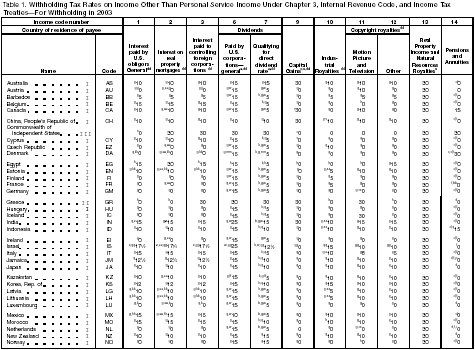 Table 1 page 1 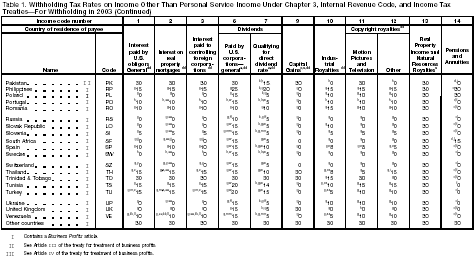 Table 1 page 2 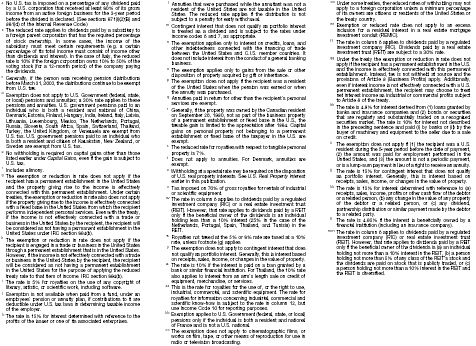 Table 1 footnotes 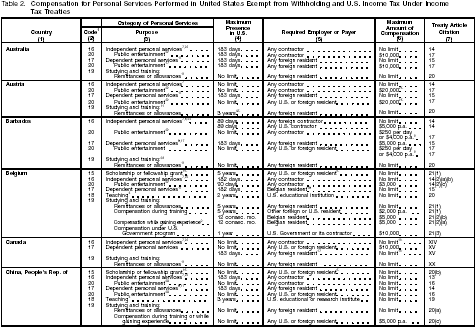 Table 2 page 1 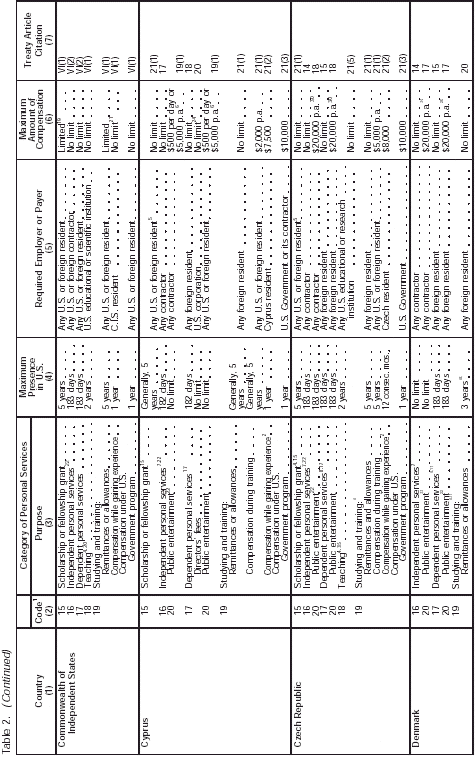 Table 2 page 2 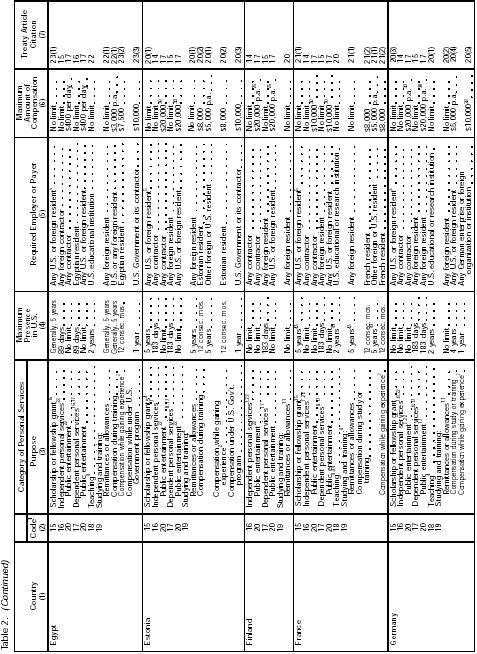 Table 2 page 3 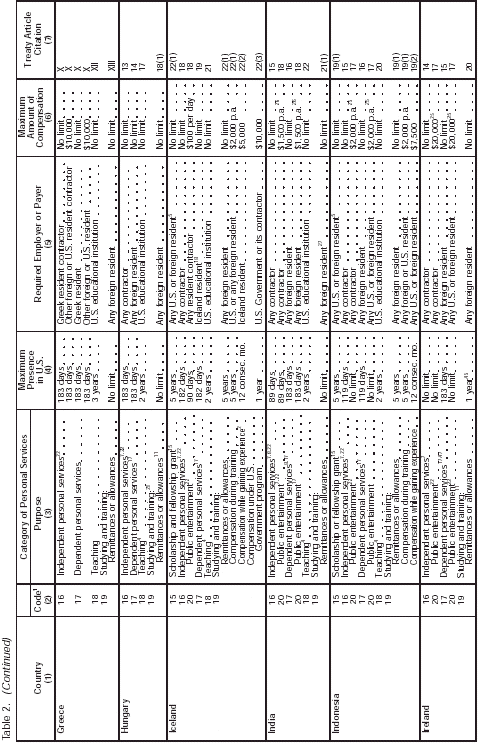 Table 2 page 4 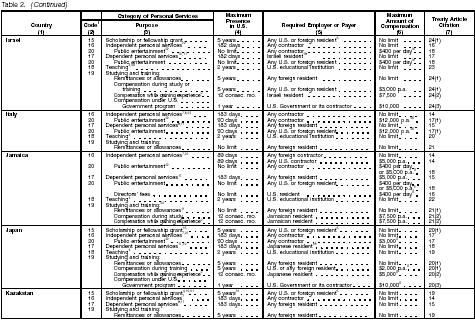 Table 2 page 5 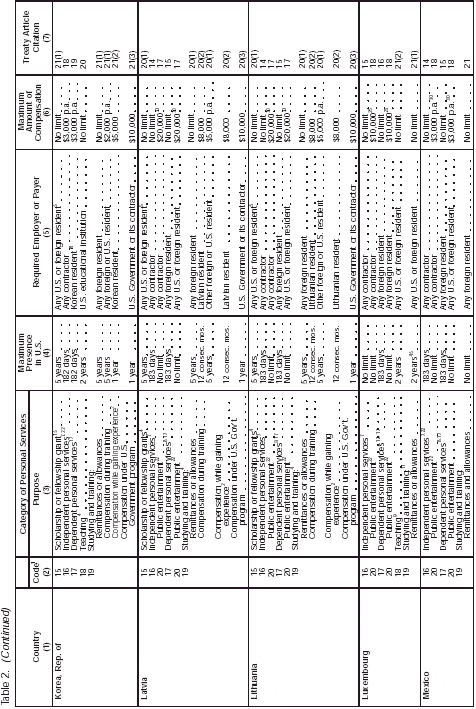 Table 2 page 6 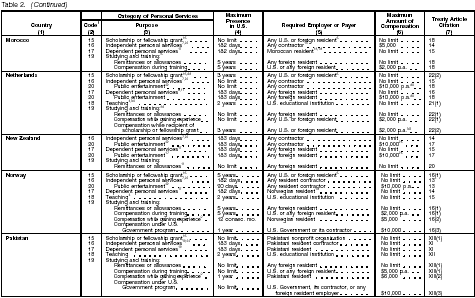 Table 2 page 7 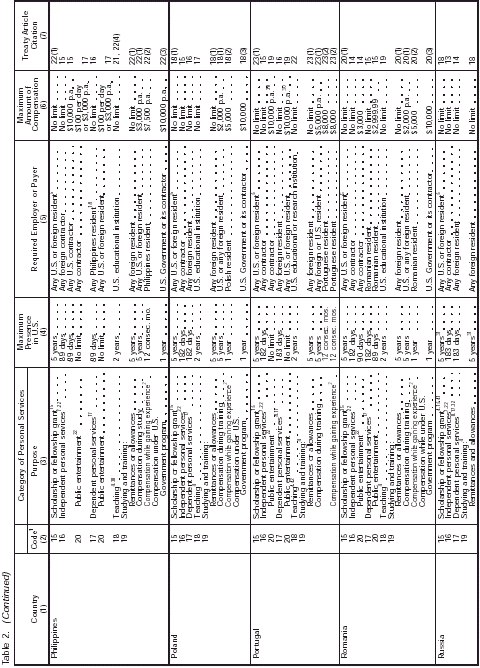 Table 2 page 8 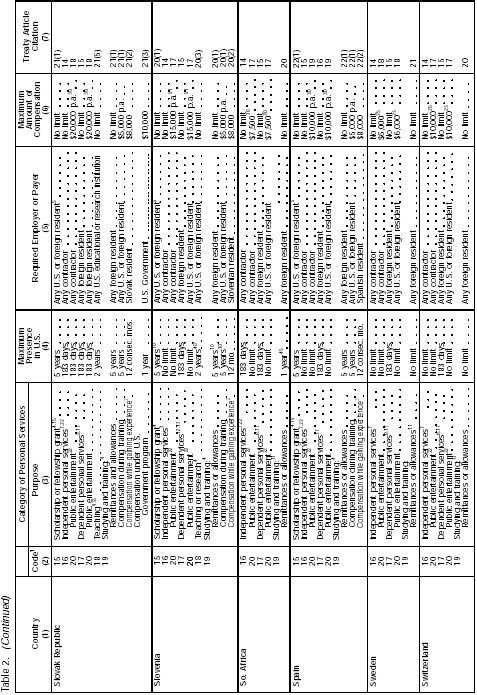 Table 2 page 9 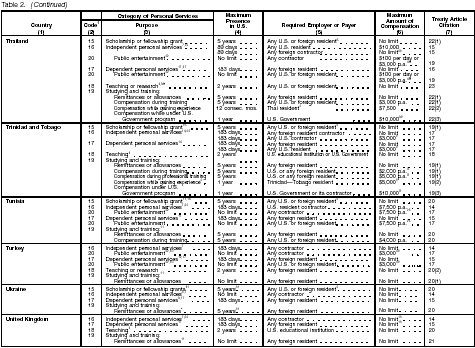 Table 2 page 10 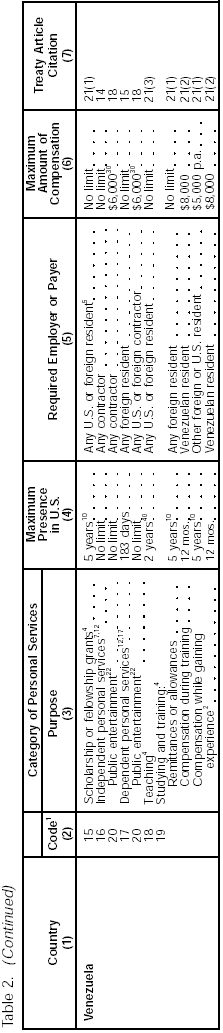 Table 2 page 11 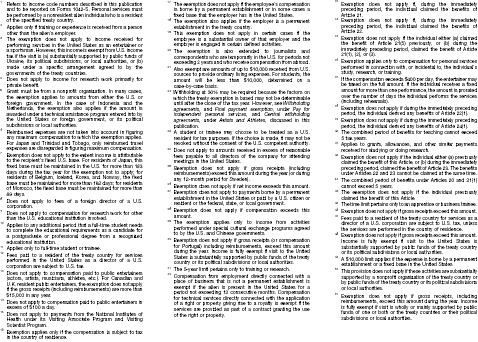 Table 2 footnotes
You can get help with unresolved tax issues, order free publications and forms, ask tax questions, and get more information from the IRS in several ways. By selecting the method that is best for you, you will have quick and easy access to tax help. Contacting your Taxpayer Advocate.
If you have attempted to deal with an IRS problem unsuccessfully, you should contact your Taxpayer Advocate. The Taxpayer Advocate represents your interests and concerns within the IRS by protecting your rights and resolving problems that have not been fixed through normal channels. While Taxpayer Advocates cannot change the tax law or make a technical tax decision, they can clear up problems that resulted from previous contacts and ensure that your case is given a complete and impartial review. To contact your Taxpayer Advocate:
For more information, see Publication 1546, The Taxpayer Advocate Service of the IRS. Free tax services.
To find out what services are available, get Publication 910, Guide to Free Tax Services. It contains a list of free tax publications and an index of tax topics. It also describes other free tax information services, including tax education and assistance programs and a list of TeleTax topics.
Personal computer. With your personal computer and modem, you can access the IRS on the Internet at www.irs.gov. While visiting our web site, you can:
You can also reach us with your computer using File Transfer Protocol at ftp.irs.gov.
TaxFax Service. Using the phone attached to your fax machine, you can receive forms and instructions by calling 703–368–9694. Follow the directions from the prompts. When you order forms, enter the catalog number for the form you need. The items you request will be faxed to you. For help with transmission problems, call the FedWorld Help Desk at 703–487–4608.
Phone. Many services are available by phone.
Walk-in. Many products and services are available on a walk-in basis.
Mail. You can send your order for forms, instructions, and publications to the Distribution Center nearest to you and receive a response within 10 workdays after your request is received. Find the address that applies to your part of the country.
CD-ROM for tax products. You can order IRS Publication 1796, Federal Tax Products on CD-ROM, and obtain:
The CD-ROM can be purchased from National Technical Information Service (NTIS) by calling 1–877–233–6767 or on the Internet at http://www.irs.gov/cdorders. The first release is available in early January and the final release is available in late February.
CD-ROM for small businesses. IRS Publication 3207, Small Business Resource Guide, is a must for every small business owner or any taxpayer about to start a business. This handy, interactive CD contains all the business tax forms, instructions and publications needed to successfully manage a business. In addition, the CD provides an abundance of other helpful information, such as how to prepare a business plan, finding financing for your business, and much more. The design of the CD makes finding information easy and quick and incorporates file formats and browsers that can be run on virtually any desktop or laptop computer. It is available in March. You can get a free copy by calling 1-800-829-3676 or by visiting the website at www.irs.gov/smallbiz. Publications Index | 2003 Tax Help Archives | Tax Help Archives | Home © 2005, UncleFed.com
|
|
||||||||||||||||||||||||||||||||||||||||||||||||||||||||||||||||||||||||||||||||||||||||||||||||||||||||||||||||||||||||||||||||||||||||||||||||||||||||||||||||||||||||||||||||||||||||||||||||||||||||||||||||||||||||||||||||||||||||||||||||||||||||||||||||||||||||||||||||||||||||||||||||||||||||||||||||||||||||||||||||||||||||||||||||||||||||||||||||||||||||


