
|
2003 Tax Help Archives |

| Home >
Tax Help Archives > 2003 > Publications > Publication 15
|
|
|||||||||||||||||||||||||||||||||||||||||||||||||||||||||||||||||||||||||||||||||||||||||||||||||||||||||||||||
If you have attempted to deal with an IRS problem unsuccessfully, you should contact the Taxpayer Advocate. The Taxpayer Advocate independently represents your interests and concerns within the IRS by protecting your rights and resolving problems that have not been fixed through normal channels. While Taxpayer Advocates cannot change the tax law or make a technical tax decision, they can clear up problems that resulted from previous contacts and ensure that your case is given a complete and impartial review. Your assigned personal advocate will listen to your point of view and will work with you to address your concerns. You can expect the advocate to provide:
When contacting the Taxpayer Advocate, you should provide the following information:
You may contact a Taxpayer Advocate online at www.irs.gov/advocate or by calling a toll-free number, 1-877-777-4778. Persons who have access to TTY/TDD equipment may call 1-800-829-4059 and ask for Taxpayer Advocate assistance. If you prefer, you may call, write, or fax the Taxpayer Advocate office in your area. See Pub. 1546, The Taxpayer Advocate Service of the IRS, for a list of addresses and fax numbers. Filing Addresses.
Generally, your filing address for Forms 940, 940-EZ, 941, 943, and 945 depends on the location of your residence or principal place of business and whether or not you included a payment with your return. There are separate filing addresses for these returns if you are an exempt organization or government entity. If you are located in the United States and do not include a payment with your return, you should file at either the Cincinnati or Ogden Service Centers. File Form CT-1 (for railroad retirement taxes) at the Cincinnati Service Center. See Form CT-1 for details on where to file. This publication explains your tax responsibilities as an employer. It explains the requirements for withholding, depositing, reporting, and paying employment taxes. It explains the forms that you must give to your employees, those that your employees must give to you, and those that you must send to the IRS and SSA. This guide also has tax tables that you need to figure the taxes to withhold from each employee for 2004. Additional employment tax information is available in Pub. 15-A, Employer's Supplemental Tax Guide. Pub. 15-A includes specialized information supplementing the basic employment tax information provided in this publication. Pub. 15-B, Employer's Tax Guide to Fringe Benefits, contains information about the employment tax treatment and valuation of various types of noncash compensation. Most employers must withhold (except FUTA), deposit, report, and pay the following employment taxes—
There are exceptions to these requirements. See section 15, Special Rules for Various Types of Services and Payments. Railroad retirement taxes are explained in the Instructions for Form CT-1. Federal Government employers.
The information in this guide applies to Federal agencies except for the rules requiring deposit of Federal taxes only at Federal Reserve banks or through the FedTax option of the Government On-Line Accounting Link Systems (GOALS). See the Treasury Financial Manual (I TFM 3-4000) for more information. State and local government employers.
Payments to employees for services in the employ of state and local government employers are generally subject to Federal income tax withholding but not Federal unemployment (FUTA) tax. In addition, wages, with certain exceptions, are subject to social security and Medicare taxes. See section 15 for more information on the exceptions. You can get information on reporting and social security coverage from your local IRS office. If you have any questions about coverage under a section 218 (Social Security Act) agreement, contact the appropriate state official. To find your State Social Security Administrator, contact the National Conference of State Social Security Administrators website at www.ncsssa.org. Comments and Suggestions.
We welcome your comments about this publication and your suggestions for future editions. You can email us at *[email protected]. Please put “Publications Comment” on the subject line. You can write to us at the following address:
Internal Revenue Service
We respond to many letters by telephone. Therefore, it would be helpful if you would include your daytime phone number, including the area code, in your correspondence. 1. Employer Identification Number (EIN) If you are required to report employment taxes or give tax statements to employees or annuitants, you need an EIN. The EIN is a nine-digit number that the IRS issues. The digits are arranged as follows: 00-0000000. It is used to identify the tax accounts of employers and certain others who have no employees. Use your EIN on all of the items that you send to the IRS and SSA. For more information, get Pub. 1635, Understanding Your EIN. If you do not have an EIN, request one on Form SS-4, Application for Employer Identification Number. Form SS-4 has information on how to apply for an EIN by mail, fax, or by telephone. You may also apply for an EIN online by visiting the IRS website at www.irs.gov/smallbiz. You should have only one EIN. If you have more than one and are not sure which one to use, please check with the Internal Revenue Service office where you file your return. Give the numbers that you have, the name and address to which each was assigned, and the address of your main place of business. The IRS will tell you which number to use. If you took over another employer's business, do not use that employer's EIN. If you do not have your own EIN by the time a return is due, write “Applied For” and the date that you applied for it in the space shown for the number. See Depositing without an EIN on page 21 if you must make a tax deposit and you do not have an EIN. Generally, employees are defined either under common law or under special statutes for certain situations. Employee status under common law.
Generally, a worker who performs services for you is your employee if you can control what will be done and how it will be done. This is so even when you give the employee freedom of action. What matters is that you have the right to control the details of how the services are performed. See Pub. 15-A, Employer's Supplemental Tax Guide, for more information on how to determine whether an individual providing services is an independent contractor or an employee. Generally, people in business for themselves are not employees. For example, doctors, lawyers, veterinarians, construction contractors, and others in an independent trade in which they offer their services to the public are usually not employees. However, if the business is incorporated, corporate officers who work in the business are employees. If an employer-employee relationship exists, it does not matter what it is called. The employee may be called an agent or independent contractor. It also does not matter how payments are measured or paid, what they are called, or if the employee works full or part time. Statutory employees.
If someone who works for you is not an employee under the common law rules discussed above, do not withhold Federal income tax from his or her pay. Although the following persons may not be common law employees, they may be considered employees by statute for social security, Medicare, and FUTA tax purposes under certain conditions.
See Pub. 15-A for details on statutory employees. Statutory nonemployees.
Direct sellers and qualified real estate agents are by law considered nonemployees. They are instead treated as self-employed for all Federal tax purposes, including income and employment taxes. See Pub. 15-A for details. Treating employees as nonemployees.
You will be liable for social security and Medicare taxes and withheld income tax if you do not deduct and withhold them because you treat an employee as a nonemployee. See Internal Revenue Code section 3509 for details. Relief provisions.
If you have a reasonable basis for not treating a worker as an employee, you may be relieved from having to pay employment taxes for that worker. To get this relief, you must file all required information returns (Form 1099-MISC) on a basis consistent with your treatment of the worker. You (or your predecessor) must not have treated any worker holding a substantially similar position as an employee for any periods beginning after 1977. IRS help.
If you want the IRS to determine whether a worker is an employee, file Form SS-8, Determination of Worker Status for Purposes of Federal Employment Taxes and Income Tax Withholding. Child employed by parents.
Payments for the services of a child under age 18 who works for his or her parent in a trade or business are not subject to social security and Medicare taxes if the trade or business is a sole proprietorship or a partnership in which each partner is a parent of the child. If these services are for work other than in a trade or business, such as domestic work in the parent's private home, they are not subject to social security and Medicare taxes until the child reaches age 21. However, see Covered services of a child or spouse later. Payments for the services of a child under age 21 who works for his or her parent whether or not in a trade or business are not subject to Federal unemployment (FUTA) tax. Although not subject to FUTA tax, the wages of a child may be subject to income tax withholding. One spouse employed by another.
The wages for the services of an individual who works for his or her spouse in a trade or business are subject to income tax withholding and social security and Medicare taxes, but not to FUTA tax. However, the services of one spouse employed by another in other than a trade or business, such as domestic service in a private home, are not subject to social security, Medicare, and FUTA taxes. Covered services of a child or spouse.
The wages for the services of a child or spouse are subject to income tax withholding as well as social security, Medicare, and FUTA taxes if he or she works for:
Parent employed by child.
The wages for the services of a parent employed by his or her child in a trade or business are subject to income tax withholding and social security and Medicare taxes. Social security and Medicare taxes do not apply to wages paid to a parent for services not in a trade or business, but they do apply to domestic services if:
Wages paid to a parent employed by his or her child are not subject to FUTA tax, regardless of the type of services provided.
4. Employee's Social Security Number (SSN) You are required to get each employee's name and SSN and to enter them on Form W-2. (This requirement also applies to resident and nonresident alien employees.) You should ask your employee to show you his or her social security card. The employee may show the card if it is available. You may, but are not required to, photocopy the social security card if the employee provides it. If you do not provide the correct employee name and SSN on Form W-2, you may owe a penalty unless you have reasonable cause. See Pub. 1586, Reasonable Cause Regulations and Requirements for Missing and Incorrect Name/TINs. Any employee without a social security card can get one by completing Form SS-5, Application for a Social Security Card and submitting the necessary documentation. You can get this form at any Social Security Administration (SSA) office or by calling 1-800-772-1213. Form SS-5 can also be obtained from the SSA website at www.socialsecurity.gov. The employee must complete and sign Form SS-5; it cannot be filed by the employer. If your employee applied for an SSN but does not have it when you must file Form W-2, enter “Applied For” on the form. When the employee receives the SSN, file Copy A of Form W-2c, Corrected Wage and Tax Statement, with SSA to show the employee's SSN. Advise your employee to correct the SSN on his or her original Form W-2. Note:Record the name and number of each employee exactly as they are shown on the employee's social security card. If the employee's name is not correct as shown on the card (for example, because of marriage or divorce), the employee should request a new card from the SSA. Continue to use the old name until the employee shows you the new social security card with the new name. If your employee was given a new social security card following an adjustment to his or her resident status that shows a different name or SSN, file a Form W-2c for the most current year only. IRS individual taxpayer identification numbers (ITINs) for aliens.
Do not accept an ITIN in place of an SSN for employee identification or for work. An ITIN is only available to resident and nonresident aliens who are not eligible for U.S. employment and need identification for other tax purposes. You can identify an ITIN because it is a 9-digit number, beginning with the number “9” and is formatted like an SSN (NNN-NN-NNNN).
An individual with an ITIN who later becomes eligible to work in the United States must obtain an SSN. Verification of social security numbers.
The Social Security Administration (SSA) offers employers and authorized reporting agents two methods for verifying employee SSNs. Both methods match employee names and SSNs.
5. Wages and Other Compensation Wages subject to Federal employment taxes include all pay that you give to an employee for services performed. The pay may be in cash or in other forms. It includes salaries, vacation allowances, bonuses, commissions, and fringe benefits. It does not matter how you measure or make the payments. Also, compensation paid to a former employee for services performed while still employed is wages subject to employment taxes. See section 6 for a discussion of tips and section 7 for a discussion of supplemental wages. Also, see section 15 for exceptions to the general rules for wages. Pub. 15-A, Employer's Supplemental Tax Guide, provides additional information on wages and other compensation. Pub. 15-B, Employer's Tax Guide to Fringe Benefits, provides information on other forms of compensation, including:
Employee business expense reimbursements.
A reimbursement or allowance arrangement is a system by which you substantiate and pay the advances, reimbursements, and charges for your employees' business expenses. How you report a reimbursement or allowance amount depends on whether you have an accountable or a nonaccountable plan. If a single payment includes both wages and an expense reimbursement, you must specify the amount of the reimbursement. These rules apply to all ordinary and necessary employee business expenses that would otherwise qualify for a deduction by the employee. Accountable plan.
To be an accountable plan, your reimbursement or allowance arrangement must require your employees to meet all three of the following rules:
Amounts paid under an accountable plan are not wages and are not subject to income tax withholding and payment of social security, Medicare, and Federal unemployment (FUTA) taxes. If the expenses covered by this arrangement are not substantiated (or amounts in excess of expenses are not returned within a reasonable period of time), the amount paid under the arrangement in excess of the substantiated expenses is treated as paid under a nonaccountable plan. This amount is subject to income tax withholding and payment of social security, Medicare, and FUTA taxes for the first payroll period following the end of the reasonable period. A reasonable period of time depends on the facts and circumstances. Generally, it is considered reasonable if your employees receive their advance within 30 days of the time that they incur the expenses, adequately account for the expenses within 60 days after the expenses were paid or incurred, and return any amounts in excess of expenses within 120 days after the expenses were paid or incurred. Also, it is considered reasonable if you give your employees a periodic statement (at least quarterly) that asks them to either return or adequately account for outstanding amounts and they do so within 120 days. Nonaccountable plan.
Payments to your employee for travel and other necessary expenses of your business under a nonaccountable plan are wages and are treated as supplemental wages and subject to income tax withholding and payment of social security, Medicare, and FUTA taxes. Your payments are treated as paid under a nonaccountable plan if:
See section 7 for more information on supplemental wages. Per diem or other fixed allowance.
You may reimburse your employees by travel days, miles, or some other fixed allowance. In these cases, your employee is considered to have accounted to you if your reimbursement does not exceed rates established by the Federal Government. The 2003 standard mileage rate for auto expenses was 36.0 cents per mile. The rate for 2004 is 37.5 cents per mile. The government per diem rates for meals and lodging in the continental United States are listed in Pub. 1542, Per Diem Rates. Other than the amount of these expenses, your employees' business expenses must be substantiated (for example, the business purpose of the travel or the number of business miles driven). If the per diem or allowance paid exceeds the amounts specified, you must report the excess amount as wages. This excess amount is subject to income tax withholding and payment of social security, Medicare, and FUTA taxes. Show the amount equal to the specified amount (i.e., the nontaxable portion) in box 12 of Form W-2 using code L. Wages not paid in money.
If in the course of your trade or business you pay your employees in a medium that is neither cash nor a readily negotiable instrument, such as a check, you are said to pay them “in kind.” Payments in kind may be in the form of goods, lodging, food, clothing, or services. Generally, the fair market value of such payments at the time that they are provided is subject to income tax withholding and social security, Medicare, and FUTA taxes. However, noncash payments for household work, agricultural labor, and service not in the employer's trade or business are exempt from social security, Medicare, and FUTA taxes. Withhold income tax on these payments only if you and the employee agree to do so. Nonetheless, noncash payments for agricultural labor, such as commodity wages, are treated as cash payments subject to employment taxes if the substance of the transaction is a cash payment. Moving expenses.
Reimbursed and employer-paid qualified moving expenses (those that would otherwise be deductible by the employee) are not includible in an employee's income unless you have knowledge that the employee deducted the expenses in a prior year. Reimbursed and employer-paid nonqualified moving expenses are includible in income and are subject to employment taxes and income tax withholding. For more information on moving expenses, see Pub. 521, Moving Expenses. Meals and lodging.
The value of meals is not taxable income and is not subject to income tax withholding and social security, Medicare, and FUTA taxes if the meals are furnished for the employer's convenience and on the employer's premises. The value of lodging is not subject to income tax withholding and social security, Medicare, and FUTA taxes if the lodging is furnished for the employer's convenience, on the employer's premises, and as a condition of employment. “For the convenience of the employer” means that you have a substantial business reason for providing the meals and lodging other than to provide additional compensation to the employee. For example, meals that you provide at the place of work so that an employee is available for emergencies during his or her lunch period are generally considered to be for your convenience. However, whether meals or lodging are provided for the convenience of the employer depends on all of the facts and circumstances. A written statement that the meals or lodging are for your convenience is not sufficient. 50% test.
If over 50% of the employees who are provided meals on an employer's business premises receive these meals for the convenience of the employer, all meals provided on the premises are treated as furnished for the convenience of the employer. If this 50% test is met, the value of the meals is excludable from income for all employees and is not subject to income tax withholding or employment taxes. For more information, see Pub. 15-B, Employer's Tax Guide to Fringe Benefits. Health insurance plans.
If you pay the cost of an accident or health insurance plan for your employees, that may include an employee's spouse and dependents, your payments are not wages and are not subject to social security, Medicare, and FUTA taxes, or income tax withholding. Generally, this exclusion also applies to qualified long-term care insurance contracts. However, the cost of health insurance benefits must be included in the wages of S corporation employees who own more than 2% of the S corporation (2% shareholders). Archer medical savings accounts.
Your contributions to an employee's medical savings account (Archer MSA) are not subject to social security, Medicare, or FUTA taxes, or income tax withholding if it is reasonable to believe at the time of payment of the contributions that they will be excludable from the income of the employee. To the extent that it is not reasonable to believe that they will be excludable, your contributions are subject to these taxes. Employee contributions to their Archer MSAs through a payroll deduction plan must be included in wages and are subject to social security, Medicare, and FUTA taxes, and income tax withholding. Medical care reimbursements.
Generally, medical care reimbursements paid for an employee under an employer's self-insured medical reimbursement plan are not wages and are not subject to social security, Medicare, and FUTA taxes, or income tax withholding. See Pub. 15-B for an exception for highly compensated employees. Fringe benefits.
You generally must include fringe benefits in an employee's gross income (but see Nontaxable fringe benefits next). The benefits are subject to income tax withholding and employment taxes. Fringe benefits include cars that you provide, flights on aircraft that you provide, free or discounted commercial flights, vacations, discounts on property or services, memberships in country clubs or other social clubs, and tickets to entertainment or sporting events. In general, the amount that you must include is the amount by which the fair market value of the benefits is more than the sum of what the employee paid for it plus any amount that the law excludes. There are other special rules that you and your employees may use to value certain fringe benefits. See Pub. 15-B for more information. Nontaxable fringe benefits.
Some fringe benefits are not taxable (or are minimally taxable) if certain conditions are met. See Pub. 15-B for details. Examples are:
However, do not exclude the following fringe benefits from the income of highly compensated employees unless the benefit is available to other employees on a nondiscriminatory basis.
When fringe benefits are treated as paid.
You may choose to treat certain noncash fringe benefits as paid by the pay period, by the quarter, or on any other basis that you choose as long as you treat the benefits as paid at least once a year. You do not have to make a formal choice of payment dates or notify the IRS of the dates that you choose. You do not have to make this choice for all employees. You may change methods as often as you like, as long as you treat all benefits provided in a calendar year as paid by December 31 of the calendar year. See Pub.15-B for more information, including a discussion of the special accounting rule for fringe benefits provided during November and December. Valuation of fringe benefits.
Generally, you must determine the value of fringe benefits no later than January 31 of the next year. Prior to January 31, you may reasonably estimate the value of the fringe benefits for purposes of withholding and depositing on time. Withholding on fringe benefits.
You may add the value of fringe benefits to regular wages for a payroll period and figure withholding taxes on the total, or you may withhold Federal income tax on the value of the fringe benefits at the flat 25% supplemental wage rate. You may choose not to withhold income tax on the value of an employee's personal use of a vehicle that you provide. You must, however, withhold social security and Medicare taxes on the use of the vehicle. See Pub. 15-B for more information on this election. Depositing taxes on fringe benefits.
Once you choose payment dates for fringe benefits (discussed above), you must deposit taxes in the same deposit period that you treat the fringe benefits as paid. To avoid a penalty, deposit the taxes following the general deposit rules for that deposit period. If you determine by January 31 that you overestimated the value of a fringe benefit at the time you withheld and deposited for it, you may claim a refund for the overpayment or have it applied to your next employment tax return (see Valuation of fringe benefits above). If you underestimated the value and deposited too little, you may be subject to a failure to deposit penalty. See section 11 for information on deposit penalties. If you deposited the required amount of taxes but withheld a lesser amount from the employee, you can recover from the employee the social security, Medicare, or income taxes that you deposited on his or her behalf, and included in the employee's Form W-2. However, you must recover the income taxes before April 1 of the following year. Sick pay.
In general, sick pay is any amount that you pay under a plan that you take part in to an employee who is unable to work because of sickness or injury. These amounts are sometimes paid by a third party, such as an insurance company or an employees' trust. In either case, these payments are subject to social security, Medicare, and FUTA taxes. Sick pay becomes exempt from these taxes after the end of six calendar months after the calendar month that the employee last worked for the employer. The payments are also subject to income tax. See Pub. 15-A for more information. Tips that your employee receives from customers are generally subject to withholding. Your employee must report cash tips to you by the 10th of the month after the month that the tips are received. The report should include tips that you paid over to the employee for charge customers and tips that the employee received directly from customers. No report is required for months when tips are less than $20. Your employee reports the tips on Form 4070, Employee's Report of Tips to Employer, or on a similar statement. The statement must be signed by the employee and must show the following:
Both Forms 4070 and 4070-A, Employee's Daily Record of Tips, are included in Pub. 1244, Employee's Daily Record of Tips and Report to Employer. You must collect income tax, employee social security tax, and employee Medicare tax on the employee's tips. You can collect these taxes from the employee's wages or from other funds that he or she makes available. (See Tips treated as supplemental wages in section 7 for further information.) Stop collecting the employee social security tax when his or her wages and tips for tax year 2004 reach $87,900; collect the income and employee Medicare taxes for the whole year on all wages and tips. You are responsible for the employer social security tax on wages and tips until the wages (including tips) reach the limit. You are responsible for the employer Medicare tax for the whole year on all wages and tips. File Form 941 to report withholding on tips. If, by the 10th of the month after the month that you received an employee's report on tips, you do not have enough employee funds available to deduct the employee tax, you no longer have to collect it. If there are not enough funds available, withhold taxes in the following order:
Show these tips and any uncollected social security and Medicare taxes on Form W-2 and on lines 6c, 6d, 7a, and 7b of Form 941. Report an adjustment on line 9 of Form 941 for the uncollected social security and Medicare taxes. Enter the amount of uncollected social security and Medicare taxes in box 12 of Form W-2 with codes A and B. (See section 13 and the Instructions for Forms W-2 and W-3.) If an employee reports to you in writing $20 or more of tips in a month, the tips are also subject to FUTA tax. Note:You are permitted to establish a system for electronic tip reporting by employees. See Regulations section 31.6053-1. Allocated tips.
If you operate a large food or beverage establishment, you must report allocated tips under certain circumstances. However, do not withhold income, social security, or Medicare taxes on allocated tips. A large food or beverage establishment is one that provides food or beverages for consumption on the premises, where tipping is customary, and where there were normally more than 10 employees on a typical business day during the preceding year. The tips may be allocated by one of three methods—hours worked, gross receipts, or good faith agreement. For information about these allocation methods, including the requirement to file Forms 8027 on magnetic media or electronically if 250 or more forms are filed, see the separate Instructions for Form 8027. Tip Rate Determination and Education Program.
Employers may participate in the Tip Rate Determination and Education Program. The program consists of two voluntary agreements developed to improve tip income reporting by helping taxpayers to understand and meet their tip reporting responsibilities. The two agreements are the Tip Rate Determination Agreement (TRDA) and the Tip Reporting Alternative Commitment (TRAC). To find out more about this program, or to identify the IRS Tip Coordinator for your state, call the IRS at 1-800-829-4933. To get more information about TRDA or TRAC agreements, access the IRS website at www.irs.gov and search for Market Segment Understanding (MSU) agreements. Supplemental wages are compensation paid in addition to an employee's regular wages. They include, but are not limited to, bonuses, commissions, overtime pay, payments for accumulated sick leave, severance pay, awards, prizes, back pay and retroactive pay increases for current employees, and payments for nondeductible moving expenses. Other payments subject to the supplemental wage rules include taxable fringe benefits and expense allowances paid under a nonaccountable plan. How you withhold on supplemental payments depends on whether the supplemental payment is identified as a separate payment from regular wages. Supplemental wages combined with regular wages.
If you pay supplemental wages with regular wages but do not specify the amount of each, withhold income tax as if the total were a single payment for a regular payroll period. Supplemental wages identified separately from regular wages.
If you pay supplemental wages separately (or combine them in a single payment and specify the amount of each), the income tax withholding method depends partly on whether you withhold income tax from your employee's regular wages:
Regardless of the method that you use to withhold income tax on supplemental wages, they are subject to social security, Medicare, and FUTA taxes. Example 1. You pay John Peters a base salary on the 1st of each month. He is single and claims one withholding allowance. In January of 2004, he is paid $1,000. Using the wage bracket tables, you withhold $54 from this amount. In February 2004, he receives salary of $1,000 plus a commission of $2,000, which you include in regular wages. You figure the withholding based on the total of $3,000. The correct withholding from the tables is $371. Example 2. You pay Sharon Warren a base salary on the 1st of each month. She is single and claims one allowance. Her May 1, 2004, pay is $2,000. Using the wage bracket tables, you withhold $202. On May 14, 2004, she receives a bonus of $2,000. Electing to use supplemental payment method 1-b, you:
Example 3. The facts are the same as in Example 2, except that you elect to use the flat rate method of withholding on the bonus. You withhold 25% of $2,000, or $500, from Sharon's bonus payment. Tips treated as supplemental wages.
Withhold income tax on tips from wages or from other funds that the employee makes available. If an employee receives regular wages and reports tips, figure income tax as if the tips were supplemental wages. If you have not withheld income tax from the regular wages, add the tips to the regular wages. Then withhold income tax on the total. If you withheld income tax from the regular wages, you can withhold on the tips by method 1-a or 1-b above. Vacation pay.
Vacation pay is subject to withholding as if it were a regular wage payment. When vacation pay is in addition to regular wages for the vacation period, treat it as a supplemental wage payment. If the vacation pay is for a time longer than your usual payroll period, spread it over the pay periods for which you pay it. Your payroll period is a period of service for which you usually pay wages. When you have a regular payroll period, withhold income tax for that time period even if your employee does not work the full period. When you do not have a regular payroll period, withhold the tax as if you paid wages for a daily or miscellaneous payroll period. Figure the number of days (including Sundays and holidays) in the period covered by the wage payment. If the wages are unrelated to a specific length of time (e.g., commissions paid on completion of a sale), count back the number of days from the payment period to the latest of:
When you pay an employee for a period of less than one week, and the employee signs a statement under penalties of perjury indicating that he or she is not working for any other employer during the same week for wages subject to withholding, figure withholding based on a weekly payroll period. If the employee later begins to work for another employer for wages subject to withholding, the employee must notify you within 10 days. You then figure withholding based on the daily or miscellaneous period. 9. Withholding From Employees' Wages To know how much income tax to withhold from employees' wages, you should have a Form W-4, Employee's Withholding Allowance Certificate, on file for each employee. Encourage your employees to file an updated Form W-4 for 2004, especially if they owed taxes or received a large refund when filing their 2003 tax return. Advise your employees to use the Withholding Calculator on the IRS website at www.irs.gov/individuals for help in determining how many withholding allowances to claim on their Form W-4. Ask all new employees to give you a signed Form W-4 when they start work. Make the form effective with the first wage payment. If a new employee does not give you a completed Form W-4, withhold income tax as if he or she is single, with no withholding allowances. You may establish a system to electronically receive Forms W-4 from your employees. See Regulations section 31.3402(f)(5)-1(c) for more information. A Form W-4 remains in effect until the employee gives you a new one. If an employee gives you a Form W-4 that replaces an existing Form W-4, begin withholding no later than the start of the first payroll period ending on or after the 30th day from the date when you received the replacement Form W-4. For exceptions, see Exemption from income tax withholding, Sending certain Forms W-4 to the IRS, and Invalid Forms W-4 later. The amount of any income tax withholding must be based on marital status and withholding allowances. Your employees may not base their withholding amounts on a fixed dollar amount or percentage. However, an employee may specify a dollar amount to be withheld in addition to the amount of withholding based on filing status and withholding allowances claimed on Form W-4. Employees may claim fewer withholding allowances than they are entitled to claim. They may wish to claim fewer allowances to ensure that they have enough withholding or to offset the tax on other sources of taxable income that are not subject to adequate withholding. Note:A Form W-4 that makes a change for the next calendar year will not take effect in the current calendar year. See Pub. 505, Tax Withholding and Estimated Tax, for detailed instructions for completing Form W-4. Along with Form W-4, you may wish to order Pub. 505 and Pub. 919, How Do I Adjust My Tax Withholding? for use by your employees. When you receive a new Form W-4 from an employee, do not adjust withholding for pay periods before the effective date of the new form. Also, do not accept any withholding or estimated tax payments from your employees in addition to withholding based on their Form W-4. If they require additional withholding, they should submit a new Form W-4 and, if necessary, pay estimated tax by filing Form 1040-ES, Estimated Tax for Individuals. Exemption from income tax withholding.
Generally, an employee may claim exemption from income tax withholding because he or she had no income tax liability last year and expects none this year. See the Form W-4 instructions for more information. However, the wages are still subject to social security and Medicare taxes. A Form W-4 claiming exemption from withholding is valid for only one calendar year. To continue to be exempt from withholding in the next year, an employee must file a new Form W-4 by February 15 of that year. If the employee does not give you a new Form W-4, withhold tax as if the employee is single with zero withholding allowances. Withholding on nonresident aliens.
In general, if you pay wages to nonresident aliens, you must withhold income tax, social security, and Medicare taxes as you would for a U.S. citizen. However, see Pub. 515, Withholding of Tax on Nonresident Aliens and Foreign Entities, for exceptions to these general rules. Form W-4.
When completing Form W-4, nonresident aliens are required to:
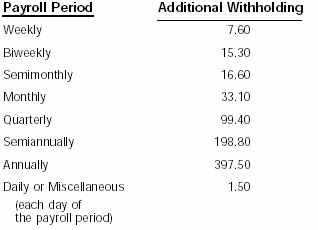 nonresident Note:Nonresident alien students from India are not subject to the additional income tax withholding requirement. Form 8233.
If a nonresident alien employee claims a tax treaty exemption from withholding, the employee must submit Form 8233, Exemption from Withholding or Compensation for Independent (and Certain Dependent) Personal Services of a Nonresident Alien Individual, with respect to the income exempt under the treaty, instead of Form W-4 (see Pub. 515 for details). Sending certain Forms W-4 to the IRS.
Generally, you must send to the IRS copies of certain Forms W-4 that you received during the quarter from employees still employed by you at the end of the quarter. Send copies of Form W-4 when the employee claims (a) more than 10 withholding allowances or (b) exemption from withholding and his or her wages would normally be more than $200 per week. Send the copies to the IRS office where you file your Form 941. You are not required to send any other Forms W-4 unless the IRS notifies you in writing to do so. Send in Forms W-4 that meet either of the above conditions each quarter with Form 941. Complete boxes 8 and 10 on any Forms W-4 that you send in. You may use box 9 to identify the office responsible for processing the employee's payroll information. Also send copies of any written statements from employees in support of the claims made on their Forms W-4. Send these statements even if the Forms W-4 are not in effect at the end of the quarter. You can send them to the IRS more often if you like. If you do so, include a cover letter giving your name, address, EIN, and the number of forms included. In certain cases, the IRS may notify you in writing that you must submit specified Forms W-4 more frequently, separate from your Form 941. Note:Please make sure that the copies of Form W-4 that you send to the IRS are clear and legible. If your Forms 941 are filed on magnetic media or electronically, this Form W-4 information also should be filed with the IRS on magnetic media or electronically. (See Filing Form W-4 on magnetic media or electronically below.) Magnetic media or electronic filers of Form 941 may send paper Forms W-4 to the IRS with a cover letter if they are unable to file them on magnetic media or electronically. If you file Form 941 by TeleFile, send your paper Forms W-4 to the IRS with a cover letter. Note:Any Form W-4 that you send to the IRS without a Form 941 should be mailed to the “Return Without A Payment” address on the back of Form 941. Base any employee income tax withholding on the Forms W-4 that you send in unless the IRS notifies you in writing to do otherwise. If the IRS notifies you about a particular employee, base his or her income tax withholding on the number of withholding allowances shown in the IRS notice. The employee will get a similar notice directly from the IRS. If the employee later gives you a new Form W-4, follow it only if: (a) exempt status is not claimed or (b) the number of withholding allowances is equal to or lower than the number in the IRS notice. Otherwise, disregard it and do not submit it to the IRS. Continue to follow the IRS notice. If the employee prepares a new Form W-4 explaining any difference with the IRS notice, he or she may either submit it to the IRS or to you. If submitted to you, send the Form W-4 and an explanation to the IRS office shown in the notice. Continue to withhold based on the notice until the IRS tells you to follow the new Form W-4. Filing Form W-4 on magnetic media or electronically.
Form W-4 information may be filed with the IRS on magnetic media or electronically. If you wish to file on magnetic media or electronically, you must submit Form 4419, Application for Filing Information Returns Electronically/Magnetically, to request authorization. See Pub. 1245, Specification for Filing Form W-4, Employee's Withholding Allowance Certificate, Magnetically or Electronically. To get more information about magnetic media or electronic filing, call the IRS Martinsburg Computing Center at 1-866-455-7438 (toll free) or 304-263-8700 (not toll free). Note:Any Forms W-4 with employee supporting statements that you are required to submit to the IRS must be submitted on paper. They cannot be submitted on magnetic media or electronically. Invalid Forms W-4.
Any unauthorized change or addition to Form W-4 makes it invalid. This includes taking out any language by which the employee certifies that the form is correct. A Form W-4 is also invalid if, by the date an employee gives it to you, he or she indicates in any way that it is false. An employee who files a false Form W-4 may be subject to a $500 penalty. When you get an invalid Form W-4, do not use it to figure withholding. Tell the employee that it is invalid and ask for another one. If the employee does not give you a valid one, withhold taxes as if the employee was single and claiming no withholding allowances. However, if you have an earlier Form W-4 for this worker that is valid, withhold as you did before. Amounts exempt from levy on wages, salary, and other income.
If you receive a Notice of Levy on Wages, Salary, and Other Income (Forms 668-W(c), or 668-W(c)(DO)), you must withhold amounts as described in the instructions for these forms. Pub. 1494, Table for Figuring Amount Exempt From Levy on Wages, Salary, and Other Income (Forms 668-W(c) and 668-W(c)(DO)) 2004, shows the exempt amount. If a levy issued in a prior year is still in effect and the taxpayer submits a new Statement of Exemptions and Filing Status, use the current year Pub. 1494 to compute the exempt amount. Social Security and Medicare Taxes The Federal Insurance Contributions Act (FICA) provides for a Federal system of old-age, survivors, disability, and hospital insurance. The old-age, survivors, and disability insurance part is financed by the social security tax. The hospital insurance part is financed by the Medicare tax. Each of these taxes is reported separately. Generally, you are required to withhold social security and Medicare taxes from your employees' wages and you must also pay a matching amount of these taxes. Certain types of wages and compensation are not subject to social security taxes (see sections 5 and 15 for details). Generally, employee wages are subject to social security and Medicare taxes regardless of the employee's age or whether he or she is receiving social security benefits. (If the employee reported tips, see section 6.) Tax rates and the social security wage base limit.
Social security and Medicare taxes have different rates and only the social security tax has a wage base limit. The wage base limit is the maximum wage that is subject to the tax for the year. Determine the amount of withholding for social security and Medicare taxes by multiplying each payment by the employee tax rate. There are no withholding allowances for social security and Medicare taxes. The employee tax rate for social security is 6.2% (amount withheld). The employer tax rate for social security is also 6.2% (12.4% total). The 2003 wage base limit was $87,000. For 2004, the wage base limit is $87,900. The employee tax rate for Medicare is 1.45% (amount withheld). The employer tax rate for Medicare tax is also 1.45% (2.9% total). There is no wage base limit for Medicare tax; all covered wages are subject to Medicare tax. Successor employer.
If you received all or most of the property used in the trade or business of another employer, or a unit of that employer's trade or business, you may include the wages that the other employer paid to your employees when you figure the annual wage base limit for social security. See Regulations section 31.3121(a)(1)-1(b) for more information. Also see Rev. Proc. 96-60 for the procedures used in filing returns in a predecessor-successor situation. You can find Rev. Proc. 96-60 on page 24 of Internal Revenue Bulletin 1996-53 at www.irs.gov/pub/irs-irbs/irb96-53.pdf. Example: Early in 2004, you bought all of the assets of a plumbing business from Mr. Martin. Mr. Brown, who had been employed by Mr. Martin and received $2,000 in wages before the date of purchase, continued to work for you. The wages that you paid to Mr. Brown are subject to social security taxes on the first $85,900 ($87,900 less $2,000). Medicare tax is due on all of the wages that you pay him during the calendar year. International social security agreements.
The United States has social security agreements with many countries that eliminate dual taxation and dual coverage. Compensation subject to social security and Medicare taxes may be exempt under one of these agreements. You can get more information and a list of agreement countries from SSA at www.socialsecurity.gov/international or see section 7 of Pub. 15-A, Employer's Supplemental Tax Guide. For income tax withholding and social security, Medicare, and Federal unemployment (FUTA) tax purposes, there are no differences among full-time employees, part-time employees, and employees hired for short periods. It does not matter whether the worker has another job or has the maximum amount of social security tax withheld by another employer. Income tax withholding may be figured the same way as for full-time workers. Or it may be figured by the part-year employment method explained in Pub. 15-A. 10. Advance Earned Income Credit (EIC) Payment An employee who is eligible for the earned income credit (EIC) and has a qualifying child is entitled to receive EIC payments with his or her pay during the year. To get these payments, the employee must provide to you a properly completed Form W-5, Earned Income Credit Advance Payment Certificate, using either the paper form or an approved electronic format. You are required to make advance EIC payments to employees who give you a completed and signed Form W-5. You may establish a system to electronically receive Forms W-5 from your employees. See Announcement 99-3 for information on electronic requirements for Form W-5. You can find Announcement 99-3 on page 15 of Internal Revenue Bulletin 1999-3 at www.irs.gov/pub/irs-irbs/irb99-03.pdf. Certain employees who do not have a qualifying child may be able to claim the EIC on their tax return. However, they cannot get advance EIC payments. For 2004, the advance payment can be as much as $1,563. The tables that begin on page 57 reflect that limit. Form W-5.
Form W-5 states the eligibility requirements for receiving advance EIC payments. On Form W-5, an employee states that he or she expects to be eligible to claim the EIC and shows whether he or she has another Form W-5 in effect with any other current employer. The employee also shows the following:
An employee may have only one certificate in effect with a current employer at one time. If an employee is married and his or her spouse also works, each spouse should file a separate Form W-5. Length of effective period.
Form W-5 is effective for the first payroll period ending on or after the date the employee gives you the form (or the first wage payment made without regard to a payroll period). It remains in effect until the end of the calendar year unless the employee revokes it or files another one. Eligible employees must file a new Form W-5 each year. Change of status.
If an employee gives you a signed Form W-5 and later becomes ineligible for advance EIC payments, he or she must revoke Form W-5 within 10 days after learning about the change of circumstances. The employee must give you a new Form W-5 stating that he or she is no longer eligible for or no longer wants advance EIC payments. If an employee's situation changes because his or her spouse files a Form W-5, the employee must file a new Form W-5 showing that his or her spouse has a Form W-5 in effect with an employer. This will reduce the maximum amount of advance payments that you can make to that employee. If an employee's spouse has filed a Form W-5 that is no longer in effect, the employee may file a new Form W-5 with you, but is not required to do so. A new form will certify that the spouse does not have a Form W-5 in effect and will increase the maximum amount of advance payments you can make to that employee. Invalid Form W-5.
The Form W-5 is invalid if it is incomplete, unsigned, or has an alteration or unauthorized addition. The form has been altered if any of the language has been deleted. Any writing added to the form other than the requested entries is an unauthorized addition. You should consider a Form W-5 invalid if an employee has made an oral or written statement that clearly shows the Form W-5 to be false. If you receive an invalid form, tell the employee that it is invalid as of the date that he or she made the oral or written statement. For advance EIC payment purposes, the invalid Form W-5 is considered void. You are not required to determine if a completed and signed Form W-5 is correct. However, you should contact the IRS if you have reason to believe that it contains an incorrect statement. How to figure the advance EIC payment.
To figure the amount of the advance EIC payment to include with the employee's pay, you must consider:
Note:If during the year you have paid an employee total wages of at least $30,338 ($31,338 if married filing jointly), you must stop making advance EIC payments to that employee for the rest of the year. Figure the amount of advance EIC to include in the employee's pay by using the tables that begin on page 57. There are separate tables for employees whose spouses have a Form W-5 in effect. See page 34 for instructions on using the advance EIC payment tables. The amount of advance EIC paid to an employee during 2004 cannot exceed $1,563. Paying the advance EIC to employees.
An advance EIC payment is not wages and is not subject to withholding of income, social security, or Medicare taxes. An advance EIC payment does not change the amount of income, social security, or Medicare taxes that you withhold from the employee's wages. You add the EIC payment to the employee's net pay for the pay period. At the end of the year, you show the total advance EIC payments in box 9 on Form W-2. Do not include this amount as wages in box 1. Employer's returns.
Show the total payments that you made to employees on the advance EIC line (line 12) of your Form 941. Subtract this amount from your total taxes on line 11 (see the separate Instructions for Form 941). Reduce the amounts reported on line 17 of Form 941 or on appropriate lines of Schedule B (Form 941), Employer's Record of Federal Tax Liability, by any advance EIC paid to your employees. Generally, employers will make the advance EIC payment from withheld income tax and employee and employer social security and Medicare taxes. These taxes are normally required to be paid over to the IRS either through Federal tax deposits or with employment tax returns. For purposes of deposit due dates, advance EIC payments are treated as deposits of these taxes on the day that you pay wages (including the advance EIC payment) to your employees. The payments are treated as deposits of these taxes in the following order: (1) income tax withholding, (2) withheld employee social security and Medicare taxes, and (3) the employer's share of social security and Medicare taxes. Example: You have 10 employees, each entitled to an advance EIC payment of $10. The total amount of advance EIC payments that you make for the payroll period is $100. The total amount of income tax withholding for the payroll period is $90. The total employee and employer social security and Medicare taxes for the payroll period is $122.60 ($61.30 each). You are considered to have made a deposit of $100 advance EIC payment on the day that you paid wages. The $100 is treated as if you deposited the $90 total income tax withholding and $10 of the employee social security and Medicare taxes. You remain liable for depositing the remaining $112.60 of the social security and Medicare taxes ($51.30 + $61.30 = $112.60). Advance EIC payments more than taxes due.
For any payroll period, if the total advance EIC payments are more than the total payroll taxes (withheld income tax and both employee and employer shares of social security and Medicare taxes), you may choose either to:
Example: You have 10 employees who are each entitled to an advance EIC payment of $10. The total amount of advance EIC payable for the payroll period is $100. The total employment tax for the payroll period is $90 (including income tax withholding and social security and Medicare taxes). The advance EIC payable is $10 more than the total employment tax. The $10 excess is 10% of the advance EIC payable ($100). You may—
U.S. territories.
If you are in American Samoa, the Commonwealth of the Northern Mariana Islands, Guam, or the U.S. Virgin Islands, consult your local tax office for information on the EIC. You cannot take advance EIC payments into account on Form 941-SS. You must notify employees who have no income tax withheld that they may be able to claim a tax refund because of the EIC. Although you do not have to notify employees who claim exemption from withholding on Form W-4, Employee's Withholding Allowance Certificate, about the EIC, you are encouraged to notify any employees whose wages for 2003 were less than $33,692 ($34,692 if married filing jointly) that they may be eligible to claim the credit for 2003. This is because eligible employees may get a refund of the amount of EIC that is more than the tax that they owe. You will meet this notification requirement if you issue to the employee IRS Form W-2 with the EIC notice on the back of Copy B, or a substitute Form W-2 with the same statement. You will also meet the requirement by providing Notice 797, Possible Federal Tax Refund Due to the Earned Income Credit (EIC), or your own statement that contains the same wording. If a substitute Form W-2 is given to the employee on time but does not have the required statement, you must notify the employee within one week of the date that the substitute Form W-2 is given. If Form W-2 is required but is not given on time, you must give the employee Notice 797 or your written statement by the date that Form W-2 is required to be given. If Form W-2 is not required, you must notify the employee by February 9, 2004. In general, you must deposit income tax withheld and both the employer and employee social security and Medicare taxes (minus any advance EIC payments) by mailing or delivering a check, money order, or cash to a financial institution that is an authorized depositary for Federal taxes. However, some taxpayers are required to deposit using the Electronic Federal Tax Deposit System (EFTPS). See How To Deposit on page 20 for information on electronic deposit requirements for 2004. Payment with return.
You may make a payment with Form 941 instead of depositing if:
Separate deposit requirements for nonpayroll (Form 945) tax liabilities.
Separate deposits are required for nonpayroll and payroll income tax withholding. Do not combine deposits for Forms 941 and 945 tax liabilities. Generally, the deposit rules for nonpayroll liabilities are the same as discussed below, except that the rules apply to an annual rather than a quarterly return period. Thus, the $2,500 threshold for the deposit requirement discussed above applies to Form 945 on an annual basis. See the separate Instructions for Form 945 for more information. There are two deposit schedules—monthly or semiweekly—for determining when you deposit social security, Medicare, and withheld income taxes. These schedules tell you when a deposit is due after a tax liability arises (e.g., when you have a payday). Prior to the beginning of each calendar year, you must determine which of the two deposit schedules that you are required to use. The deposit schedule that you must use is based on the total tax liability that you reported on Form 941 during a four-quarter lookback period discussed below. Your deposit schedule is not determined by how often you pay your employees or make deposits (see Application of Monthly and Semiweekly Schedules on page 19).
These rules do not apply to Federal unemployment (FUTA) tax. See section 14 for information on depositing FUTA tax. Lookback period.
Your deposit schedule for a calendar year is determined from the total taxes (i.e., not reduced by any advance EIC payments) reported on line 11 of your Forms 941 in a four-quarter lookback period. The lookback period begins July 1 and ends June 30 as shown in Table 1 below. If you reported $50,000 or less of taxes for the lookback period, you are a monthly schedule depositor; if you reported more than $50,000, you are a semiweekly schedule depositor.
Adjustments and the lookback rule.
Determine your tax liability for the four quarters in the lookback period based on the tax liability as originally reported on your Form 941. If you made adjustments to correct errors on previously filed Forms 941, these adjustments do not affect the amount of tax liability for purposes of the lookback rule. If you report adjustments on your current Form 941 to correct errors on prior Forms 941, include these adjustments as part of your tax liability for the current quarter. If you filed Form 843 to claim a refund for a prior period overpayment, your tax liability does not change for either the prior period or the current period for purposes of the lookback rule. Example: An employer originally reported a tax liability of $45,000 for the four quarters in the lookback period ending June 30, 2003. The employer discovered during January 2004 that the tax during one of the lookback period quarters was understated by $10,000 and corrected this error with an adjustment on the 2004 first quarter return. This employer is a monthly schedule depositor for 2004 because the lookback period tax liabilities are based on the amounts originally reported, and they were less than $50,000. The $10,000 adjustment is part of the 2004 first quarter tax liability. Deposit period.
The term deposit period refers to the period during which tax liabilities are accumulated for each required deposit due date. For monthly schedule depositors, the deposit period is a calendar month. The deposit periods for semiweekly schedule depositors are Wednesday through Friday and Saturday through Tuesday. You are a monthly schedule depositor for a calendar year if the total taxes on line 11 of Form 941 for the four quarters in your lookback period were $50,000 or less. Under the monthly deposit schedule, deposit Form 941 taxes on payments made during a month by the 15th day of the following month. See also Deposits on Banking Days Only later. Monthly schedule depositors should not file Form 941 on a monthly basis. Also, do not file Form 941-M, Employer's Monthly Federal Tax Return, unless you are instructed to do so by an IRS representative. New employers.
During the first calendar year of your business, your tax liability for each quarter in the lookback period is considered to be zero. Therefore, you are a monthly schedule depositor for the first calendar year of your business (but see the $100,000 Next-Day Deposit Rule on page 20). You are a semiweekly schedule depositor for a calendar year if the total taxes on line 11 of Form 941 during your lookback period were more than $50,000. Under the semiweekly deposit schedule, deposit Form 941 taxes for payments made on Wednesday, Thursday, and/or Friday by the following Wednesday. Deposit amounts accumulated for payments made on Saturday, Sunday, Monday, and/or Tuesday by the following Friday. See also Deposits on Banking Days Only later. Note:Semiweekly schedule depositors must complete Schedule B (Form 941), Employer's Record of Federal Tax Liability, and submit it with Form 941. 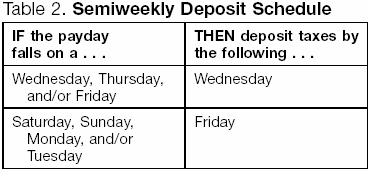 Table 2. Semiweekly Deposit Schedule Semiweekly deposit period spanning two quarters.
If you have more than one pay date during a semiweekly period and the pay dates fall in different calendar quarters, you will need to make separate deposits for the separate liabilities. For example, if you have a pay date on Wednesday, March 31, 2004 (first quarter), and another pay date on Friday, April 2, 2004 (second quarter), two separate deposits would be required even though the pay dates fall within the same semiweekly period. Both deposits would be due Wednesday, April 7, 2004 (three banking days from the end of the semiweekly deposit period). Example of Monthly and Semiweekly Schedules Rose Co. reported Form 941 taxes as follows:
Rose Co. is a monthly schedule depositor for 2003 because its tax liability for the four quarters in its lookback period (third quarter 2001 through second quarter 2002) was not more than $50,000. However, for 2004, Rose Co. is a semiweekly schedule depositor because the total taxes exceeded $50,000 for the four quarters in its lookback period (third quarter 2002 through second quarter 2003). If a deposit is required to be made on a day that is not a banking day, the deposit is considered timely if it is made by the close of the next banking day. In addition to Federal and state bank holidays, Saturdays and Sundays are treated as nonbanking days. For example, if a deposit is required to be made on a Friday and Friday is not a banking day, the deposit will be considered timely if it is made by the following Monday (if that Monday is a banking day). Semiweekly schedule depositors have at least three banking days to make a deposit. That is, if any of the three weekdays after the end of a semiweekly period is a banking holiday, you will have one additional banking day to deposit. For example, if a semiweekly schedule depositor accumulated taxes for payments made on Friday and the following Monday is not a banking day, the deposit normally due on Wednesday may be made on Thursday (allowing three banking days to make the deposit). Application of Monthly and Semiweekly Schedules The terms “monthly schedule depositor” and “semiweekly schedule depositor” do not refer to how often your business pays its employees or even how often you are required to make deposits. The terms identify which set of deposit rules that you must follow when an employment tax liability arises. The deposit rules are based on the dates when wages are paid (i.e., cash basis); not on when tax liabilities are accrued for accounting purposes. Monthly schedule example. Spruce Co. is a monthly schedule depositor with seasonal employees. It paid wages each Friday. During March it paid wages but did not pay any wages during April. Under the monthly deposit schedule, Spruce Co. must deposit the combined tax liabilities for the four March paydays by April 15. Spruce Co. does not have a deposit requirement for April (due by May 15) because no wages were paid and, therefore, it did not have a tax liability for April. Semiweekly schedule example. Green, Inc., which has a semiweekly deposit schedule, pays wages once each month on the last day of the month. Although Green, Inc. has a semiweekly deposit schedule, it will deposit just once a month because it pays wages only once a month. The deposit, however, will be made under the semiweekly deposit schedule as follows: Green, Inc.'s tax liability for the April 30, 2004 (Friday) payday must be deposited by May 5, 2004 (Wednesday). Under the semiweekly deposit schedule, liabilities for wages paid on Wednesday through Friday must be deposited by the following Wednesday. $100,000 Next-Day Deposit Rule If you accumulate a tax liability (reduced by any advance EIC payments) of $100,000 or more on any day during a deposit period, you must deposit the tax by the next banking day, whether you are a monthly or semiweekly schedule depositor. For purposes of the $100,000 rule, do not continue accumulating a tax liability after the end of a deposit period. For example, if a semiweekly schedule depositor has accumulated a liability of $95,000 on a Tuesday (of a Saturday-through-Tuesday deposit period) and accumulated a $10,000 liability on Wednesday, the $100,000 next-day deposit rule does not apply. Thus, $95,000 must be deposited by Friday and $10,000 must be deposited by the following Wednesday. However, once you accumulate at least $100,000 in a deposit period, stop accumulating at the end of that day and begin to accumulate anew on the next day. For example, Fir Co. is a semiweekly schedule depositor. On Monday, Fir Co. accumulates taxes of $110,000 and must deposit this amount on Tuesday, the next banking day. On Tuesday, Fir Co. accumulates additional taxes of $30,000. Because the $30,000 is not added to the previous $110,000 and is less than $100,000, Fir Co. must deposit the $30,000 by Friday (following the semiweekly deposit schedule).
If you are a monthly schedule depositor and accumulate a $100,000 tax liability on any day, you become a semiweekly schedule depositor on the next day and remain so for at least the rest of the calendar year and for the following calendar year. Example: Elm, Inc. started its business on April 1, 2004. On April 15, it paid wages for the first time and accumulated a tax liability of $40,000. On April 22, 2004, Elm, Inc. paid wages and accumulated a liability of $60,000, bringing its accumulated tax liability to $100,000. Because this was the first year of its business, the tax liability for its lookback period is considered to be zero, and it would be a monthly schedule depositor based on the lookback rules. However, since Elm, Inc. accumulated a $100,000 liability on April 22, it became a semiweekly schedule depositor on April 23. It will be a semiweekly schedule depositor for the remainder of 2004 and for 2005. Elm, Inc. is required to deposit the $100,000 by April 23, the next banking day. You are required to deposit 100% of your tax liability on or before the deposit due date. However, penalties will not be applied for depositing less than 100% if both of the following conditions are met:
The two methods of depositing employment taxes, including Form 945 taxes, are discussed below. See Payment with return on page 18 for exceptions explaining when taxes may be paid with the tax return instead of being deposited. Electronic deposit requirement.
You must make electronic deposits of all depository taxes (such as employment tax, excise tax, and corporate income tax) using the Electronic Federal Tax Payment System (EFTPS) in 2004 if:
If you are required to use EFTPS and fail to do so, you may be subject to a 10% penalty. EFTPS is a free service provided by the Department of Treasury. If you are not required to use EFTPS, you may participate voluntarily. To get more information or to enroll in EFTPS, call 1-800-555-4477 or 1-800-945-8400. You can also visit the EFTPS website at www.eftps.gov. New employers that have a Federal tax obligation will be pre-enrolled in EFTPS. Call the toll-free number located in your Employer Identification Number (EIN) Package to activate your enrollment and begin making your tax deposit payments. Depositing on time.
For deposits made by EFTPS to be on time, you must initiate the transaction at least one business day before the date that the deposit is due. Deposit record. For your records an Electronic Funds Transfer (EFT) Trace Number will be provided with each successful payment that can be used as a receipt or to trace the payment. Making deposits with FTD coupons.
If you are not making deposits by EFTPS, use Form 8109, Federal Tax Deposit Coupon, to make the deposits at an authorized financial institution. For new employers, if you would like to receive a Federal Tax Deposit (FTD) coupon booklet, call 1-800-829-4933. Allow 5 to 6 weeks for delivery. The IRS will keep track of the number of FTD coupons that you use and automatically will send you additional coupons when you need them. If you do not receive your resupply of FTD coupons, call 1-800-829-4933. You can have the FTD coupon books sent to a branch office, tax preparer, or service bureau that is making your deposits by showing that address on Form 8109-C, FTD Address Change, which is in the FTD coupon book. (Filing Form 8109-C will not change your address of record; it will change only the address where the FTD coupons are mailed.) The FTD coupons will be preprinted with your name, address, and EIN. They have entry boxes for indicating the type of tax and the tax period for which the deposit is made. It is very important to clearly mark the correct type of tax and tax period on each FTD coupon. This information is used by the IRS to credit your account. If you have branch offices depositing taxes, give them FTD coupons and complete instructions so that they can deposit the taxes when due. Please use only your FTD coupons. If you use anyone else's FTD coupon, you may be subject to a failure to deposit penalty. This is because your account will be underpaid by the amount of the deposit credited to the other person's account. See Deposit Penalties below for penalty amounts. How to deposit with an FTD coupon.
Mail or deliver each FTD coupon and a single payment covering the taxes to be deposited to an authorized depositary. An authorized depositary is a financial institution (e.g., a commercial bank) that is authorized to accept Federal tax deposits. Follow the instructions in the FTD coupon book. Make your check or money order payable to the depositary. To help ensure proper crediting of your account, include your EIN, the type of tax (e.g., Form 941), and the tax period to which the payment applies on your check or money order. Authorized depositaries must accept cash, a postal money order drawn to the order of the depositary, or a check or draft drawn on and to the order of the depositary. You may deposit taxes with a check drawn on another financial institution only if the depositary is willing to accept that form of payment. Be sure that the financial institution where you make deposits is an authorized depositary. Deposits made at an unauthorized institution may be subject to the failure to deposit penalty. If you prefer, you may mail your coupon and payment to: Financial Agent, Federal Tax Deposit Processing, P.O. Box 970030, St. Louis, MO 63197. Make your check or money order payable to Financial Agent. Depositing on time.
The IRS determines whether deposits are on time by the date that they are received by an authorized depositary. To be considered timely, the funds must be available to the depositary on the deposit due date before the institution's daily cutoff deadline. Contact your local depositary for information concerning check clearance and cutoff schedules. However, a deposit received by the authorized depositary after the due date will be considered timely if the taxpayer establishes that it was mailed in the United States at least two days before the due date. Note:If you are required to deposit any taxes more than once a month, any deposit of $20,000 or more must be received by the authorized depositary by its due date to be timely. See section 7502(e)(3). Depositing without an EIN.
If you have applied for an EIN but have not received it and you must make a deposit, make the deposit with the IRS. Do not make the deposit at an authorized depositary. Make it payable to the “United States Treasury” and show on it your name (as shown on Form SS-4), address, kind of tax, period covered, and date you applied for an EIN. Send your deposit with an explanation to your local IRS office or the service center where you will file Form 941. The service center addresses are on the back of Form 941 and are also available on the IRS website at www.irs.gov. Do not use Form 8109-B, Federal Tax Deposit Coupon, in this situation. Depositing without Form 8109.
If you have an EIN but do not have a preprinted Form 8109, you may use Form 8109-B to make deposits. Form 8109-B is an over-the-counter FTD coupon that is not preprinted with your identifying information. You may get this form by calling 1-800-829-4933. Be sure to have your EIN ready when you call. You will not be able to obtain Form 8109-B by calling 1-800-TAX-FORM. Use Form 8109-B to make deposits only if—
Deposit record.
For your records, a stub is provided with each FTD coupon in the coupon book. The FTD coupon itself will not be returned. It is used to credit your account. Your check, bank receipt, or money order is your receipt. How to claim credit for overpayments.
If you deposited more than the right amount of taxes for a quarter, you can choose on Form 941 for that quarter to have the overpayment refunded or applied as a credit to your next return. Do not ask the depositary or EFTPS to request a refund from the IRS for you. Penalties may apply if you do not make required deposits on time, if you make deposits for less than the required amount, or if you do not use EFTPS when required. The penalties do not apply if any failure to make a proper and timely deposit was due to reasonable cause and not to willful neglect. For amounts not properly or timely deposited, the penalty rates are:
Note:Late deposit penalty amounts are determined using calendar days, starting from the due date of the liability. Order in which deposits are applied.
Deposits generally are applied to the most recent tax liability within the quarter. If you receive a failure-to-deposit penalty notice, you may designate how your payment is to be applied in order to minimize the amount of the penalty. Follow the instructions on the penalty notice that you received. For more information on designating deposits, see Rev. Proc. 2001-58. You can find Rev. Proc. 2001-58 on page 579 of Internal Revenue Bulletin 2001-50 at www.irs.gov/pub/irs-irbs/irb01-50.pdf. Example: Cedar, Inc. is required to make a deposit of $1,000 on June 15 and $1,500 on July 15. It does not make the deposit on June 15. On July 15, Cedar, Inc. deposits $2,000. Under the deposits rule, which applies deposits to the most recent tax liability, $1,500 of the deposit is applied to the July 15 deposit and the remaining $500 is applied to the June deposit. Accordingly, $500 of the June 15 liability remains undeposited. The penalty on this underdeposit will apply as explained above. Trust fund recovery penalty.
If income, social security, and Medicare taxes that must be withheld are not withheld or are not deposited or paid to the United States Treasury, the trust fund recovery penalty may apply. The penalty is the full amount of the unpaid trust fund tax. This penalty may apply to you if these unpaid taxes cannot be immediately collected from the employer or business. The trust fund recovery penalty may be imposed on all persons who are determined by the IRS to be responsible for collecting, accounting for, and paying over these taxes, and who acted willfully in not doing so. A responsible person can be an officer or employee of a corporation, a partner or employee of a partnership, an accountant, a volunteer director/trustee, or an employee of a sole proprietorship. A responsible person also may include one who signs checks for the business or otherwise has authority to cause the spending of business funds. Willfully means voluntarily, consciously, and intentionally. A responsible person acts willfully if the person knows that the required actions are not taking place. Separate accounting when deposits are not made or withheld taxes are not paid.
Separate accounting may be required if you do not pay over withheld employee social security, Medicare, or income taxes; deposit required taxes; make required payments; or file tax returns. In this case, you would receive written notice from the IRS requiring you to deposit taxes into a special trust account for the U.S. Government. You would also have to file monthly tax returns on Form 941-M, Employer's Monthly Federal Tax Return. Each quarter, all employers who pay wages subject to income tax withholding (including withholding on sick pay and supplemental unemployment benefits) or social security and Medicare taxes must file Form 941, Employer's Quarterly Federal Tax Return, by the last day of the month that follows the end of the quarter. See the Calendar on page 2. However, the following exceptions apply:
Form 941 e-file.
The Form 941 e-file program allows a taxpayer to electronically file Form 941 using a personal computer, modem, and commercial tax preparation software. Contact the IRS at 1-800-829-4933 or visit the IRS website at www.irs.gov/efile for more information. See Pub. 1855, Technical Specifications Guide for the Electronic Filing of Form 941, Employee's Quarterly Federal Tax Return, for technical specifications. 941TeleFile.
You may be able to file Form 941 and pay any balance due by phone. If you received 941TeleFile materials with your Form 941 Package, check page TEL-1 of the 941TeleFile Instructions to see if you qualify for this method of filing. If you have questions related to filing Form 941 using 941TeleFile, call 1-800-829-4933. This phone number is for 941TeleFile information only and is not the number used to file the return.
Electronic and magnetic tape filing by reporting agents.
Reporting agents filing Forms 941 for groups of taxpayers can file them electronically or on magnetic tape. See Reporting Agents in section 7 of Pub. 15-A, Employer's Supplemental Tax Guide, for more information. Penalties.
For each whole or part month that a return is not filed when required (disregarding any extensions of the filing deadline), there is a penalty of 5% of the unpaid tax due with that return. The maximum penalty is 25% of the tax due. Also, for each whole or part month that the tax is paid late (disregarding any extensions of the payment deadline), a penalty of 0.5% per month of the amount of tax generally applies. (This penalty is 0.25% per month, and applies to individual filers only, if an installment agreement is in effect. You must have filed your return on or before the due date of the return to qualify for the reduced penalty.) The maximum amount of this penalty is also 25% of the tax due. If both penalties apply in any month, the failure-to-file penalty is reduced by the amount of the failure-to-pay penalty. The penalties will not be charged if you have a reasonable cause for failing to file or pay. If you file or pay late, attach an explanation to your Form 941. (Note: In addition to any penalties, interest accrues from the due date of the tax on any unpaid balance.) If income, social security, or Medicare taxes that must be withheld are not withheld or are not paid, you may be personally liable for the trust fund recovery penalty. See Trust fund recovery penalty in section 11. Use of a reporting agent or other third-party payroll service provider does not relieve an employer of the responsibility to ensure that tax returns are filed and all taxes are paid or deposited correctly and on time. Do not file more than one Form 941 per quarter.
Employers with multiple locations or divisions must file only one Form 941 per quarter. Filing more than one return may result in processing delays and may require correspondence between you and the IRS. For information on making corrections to previously filed returns, see section 13. Hints on filing.
Final return.
If you go out of business, you must file a final return for the last quarter in which wages are paid. If you continue to pay wages or other compensation for quarters following termination of your business, you must file returns for those quarters. See the Instructions for Form 941 for details on how to file a final return. Note:If you are required to file a final Form 941, you are also required to furnish Forms W-2 to your employees by the due date of your final Form 941. File Forms W-2 and W-3 with the SSA by the last day of the month that follows the due date of your final Form 941. Do not send an original or copy of Form 941 to the SSA. See the Instructions for Forms W-2 and W-3 for more information. Filing late Forms 941 for prior years.
If possible, get a copy of Form 941 (and separate instructions) with a revision date showing the year for which your delinquent return is being filed. See Quick and Easy Access to Tax Help and Forms on page 68 for various ways to secure any necessary forms and instructions. However, if you are filing an original return for a quarter in a prior year and you are using the current year form, you will have to modify Form 941. A form for a particular year generally can be used without modification for any quarter within that year. For example, a form with any 2004 revision date (e.g., January or October 2004) generally can be used without modification for any quarter of 2004. In all cases, be sure to correctly fill out the “Date quarter ended” section at the top of the form. If you are modifying a form with preprinted information, change the date (the date is shown with the month and year the quarter ends; for example, JUN04 would be for the quarter ending June 30, 2004). Cross out any inapplicable tax rate(s) shown on the form and write in the rate from Table 3 below. You can get tax rates and wage base limits for years not shown in the table from the IRS.
The instructions on the form may be inappropriate for the year that you are reporting taxes because of changes in the law, regulations, or procedures. The revision date (found under the form number at the top of the form) will tell you the year for which the form was developed. Contact the IRS if you have any questions.
Table 3. Social Security and Medicare Tax Rates (For 3 prior years)
Reconciling Forms W-2, W-3, and 941.
When there are discrepancies between Forms 941 filed with the IRS and Forms W-2 and W-3 filed with the SSA, the IRS must contact you to resolve the discrepancies. This costs time and money for the Government and for you. To help reduce discrepancies:
To reduce the discrepancies between amounts reported on Forms W-2, W-3, and 941:
Do not report on Form 941 backup withholding or income tax withholding on nonpayroll payments such as pensions, annuities, and gambling winnings. Nonpayroll withholding must be reported on Form 945 (see the separate Instructions for Form 945 for details). Income tax withholding required to be reported on Forms 1099 or W-2G must be reported on Form 945. Only taxes and withholding properly reported on Form W-2 should be reported on Form 941. Amounts reported on Forms W-2, W-3, and 941 may not match for valid reasons. If they do not match, you should determine that the reasons are valid. Keep your reconciliation so that you will have a record of why amounts did not match in case there are inquiries from the IRS or the SSA. 13. Reporting Adjustments on Form 941 There are two types of adjustments: current period adjustments and prior period adjustments to correct errors. See the instructions for Forms 941 and 941c for more information on how to report these adjustments. In certain cases, amounts reported as social security and Medicare taxes on lines 6b, 6d, and 7b of Form 941 must be adjusted to arrive at your correct tax liability (e.g., excluding amounts withheld by a third-party payer or amounts you were not required to withhold). Current period adjustments are reported on line 9 of Form 941 and include the following: Adjustment of tax on tips.
If, by the 10th of the month after the month you received an employee's report on tips, you do not have enough employee funds available to withhold the employee's share of social security and Medicare taxes, you no longer have to collect it. However, report the entire amount of these tips on lines 6c (social security tips) and 7a (Medicare wages and tips). Include as an adjustment in the “Other” space on line 9 the total uncollected employee share of the social security and Medicare taxes. Adjustment of tax on group-term life insurance premiums paid for former employees.
The employee share of social security and Medicare taxes on group-term life insurance over $50,000 for a former employee is paid by the former employee with his or her tax return and is not collected by the employer. However, include all social security and Medicare taxes for such coverage on lines 6b and 7b (social security and Medicare taxes), and back out the amount of the employee share of these taxes as an adjustment in the “Other” space on line 9. See Pub. 15-B for more information on group-term life insurance. Note:For the above adjustments, provide a brief supporting statement explaining the nature and amount of the adjustments (see the example of reporting current period adjustments below). Do not use Form 941c as the supporting statement for current period adjustments. Adjustment of tax on third-party sick pay.
Report both the employer and employee shares of social security and Medicare taxes for sick pay on lines 6b and 7b of Form 941. Deduct on line 9 the social security and Medicare taxes withheld on sick pay by a third-party payer. Also enter the sick pay tax adjustment in the “Sick Pay” adjustment entry space. No additional statement for this adjustment is required. See section 6 of Pub. 15-A for more information. Fractions of cents adjustment.
If there is a small difference between net taxes (line 13) and total deposits
To determine if you have a fractions-of-cents adjustment, multiply the total wages and tips for the quarter subject to:
Example of reporting current period adjustments. Cedar, Inc. was entitled to the following current period adjustments:
Cedar, Inc. reported these adjustments on line 9 of Form 941 as shown in the Current Period Adjustment Example below. A brief supporting statement was filed with Form 941 explaining the life insurance adjustment. Note:Do not make any changes to the record of Federal tax liability (line 17 or Schedule B (Form 941)) for current period adjustments. The amounts reported on the record reflect the actual amounts you withheld from employees' wages for social security and Medicare taxes. Because the current period adjustments make the amounts reported on lines 6b, 6d, and 7b of Form 941 equal the actual amounts you withheld (the amounts reported on the record), no additional changes to the record of Federal tax liability are necessary for these adjustments. Generally, you can correct errors on prior quarter Forms 941 by making an adjustment on your Form 941 for the quarter during which the error was discovered. For example, if you made an error in reporting social security tax on your second quarter 2003 Form 941 and discovered the error during January 2004, correct the error by making an adjustment on your first quarter 2004 Form 941. The adjustment increases or decreases your tax liability for the quarter in which it is reported (the quarter the error is discovered) and is interest free. The net adjustments reported on Form 941 may include any number of corrections for one or more previous quarters, including both overpayments and underpayments. You are required to provide background information and certifications supporting prior quarter adjustments. File with Form 941 a Form 941c, Supporting Statement To Correct Information, or attach a statement that shows:
Do not file Form 941c separately. The IRS will not be able to process your adjustments on Form 941 without this supporting information. See the instructions for Form 941c for more information. Income tax withholding adjustments.
Correct prior quarter income tax withholding errors by making an adjustment on line 4 of Form 941 for the quarter during which you discovered the error. Note:You may make an adjustment to correct income tax withholding errors only for quarters during the same calendar year. This is because the employee uses the amount shown on Form W-2 as a credit when filing his or her income tax return (Form 1040, etc.). You cannot adjust amounts reported as income tax withheld in a prior calendar year unless it is to correct an administrative error. An administrative error occurs if the amount you entered on Form 941 is not the amount you actually withheld. For example, if the total income tax actually withheld was incorrectly reported on Form 941 due to a mathematical or transposition error, this would be an administrative error. The administrative error adjustment corrects the amount reported on Form 941 to agree with the amount actually withheld from employees. Social security and Medicare tax adjustments.
Correct prior quarter social security and Medicare tax errors by making an adjustment on line 9 of Form 941 for the quarter during which you discovered the error. You may report adjustments on the current quarter Form 941 for previous quarters in the current and prior years. Reporting prior quarter adjustments on the record of Federal tax liability.
Adjustments to correct errors in prior quarters must be taken into account on either Form 941, line 17, Monthly Summary of Federal Tax Liability, or on Schedule B (Form 941), Employer's Record of Federal Tax Liability. If the adjustment corrects an underreported liability in a prior quarter, report the adjustment on the entry space corresponding to the date the error was discovered. If the adjustment corrects an overreported liability, use the adjustment amount as a credit to offset subsequent liabilities until it is used up. Example of reporting prior period adjustments: Elm Co., a monthly schedule depositor, discovered on January 7, 2003, that it overreported social security tax on a prior quarter return by $5,000. Its total tax liabilities for the first quarter of 2003 were: January—$4,500, February—$4,500, and March—$4,500. Elm Co. completed line 17 of Form 941 as shown in the Prior Period Adjustment Example on page 27. The adjustment for the $5,000 overreported liability offset the January liability, so the $4,500 liability was not deposited and a “-0-” liability was reported on line 17, column (a). The remaining $500 of the $5,000 adjustment credit was used to partially offset the liability for February, so only $4,000 of the $4,500 liability was deposited and reported on line 17, column (b). Filing a claim for overreported prior period liabilities.
If you discover an error on a prior quarter return resulting in a tax overpayment, you may file Form 843, Claim for Refund and Request for Abatement, for a refund. This form also can be used to request an abatement of an overassessment of employment taxes, interest, and/or penalties. You must file Form 941c, or an equivalent statement, with Form 843. See the separate Instructions for Form 843. Collecting underwithheld taxes from employees.
If you withheld no income, social security, or Medicare taxes or less than the right amount from an employee's wages, you can make it up from later pay to that employee. But you are the one who owes the underpayment. Reimbursement is a matter for settlement between you and the employee. Underwithheld income tax must be recovered from the employee on or before the last day of the calendar year. There are special rules for tax on tips (see section 6) and fringe benefits (see section 5). Refunding amounts incorrectly withheld from employees.
If you withheld more than the right amount of income, social security, or Medicare taxes from wages paid, give the employee the excess. Any excess income tax withholding must be reimbursed to the employee prior to the end of the calendar year. Keep in your records the employee's written receipt showing the date and amount of the repayment. If you do not have a receipt, you must report and pay each excess amount when you file Form 941 for the quarter in which you withheld too much tax. Correcting filed Forms W-2 and W-3.
When adjustments are made to correct social security and Medicare taxes because of a change in the wage totals reported for a previous year, you also may need to file Form W-2c, Corrected Wage and Tax Statement, and Form W-3c, Transmittal of Corrected Wage and Tax Statements, with the SSA. If an employee repays you for wages received in error, do not offset the repayments against current-year wages unless the repayments are for amounts received in error in the current year. Repayment of current-year wages.
If you receive repayments for wages paid during a prior quarter in the current year, report adjustments on Form 941 to recover income tax withholding and social security and Medicare taxes for the repaid wages (as discussed earlier). Report the adjustments on Form 941 for the quarter during which the repayment occurred. Repayment of prior year wages.
If you receive repayments for wages paid during a prior year, report an adjustment on the Form 941 for the quarter
during which the repayment was
made to recover the social security and Medicare taxes. Instead of making an adjustment on
You also must file Forms W-2c and W-3c with the SSA to correct social security and Medicare wages and taxes. Do not correct wages (box 1) on Form W-2c for the amount paid in error. Give a copy of Form W-2c to the employee. Note:The wages paid in error in the prior year remain taxable to the employee for that year. This is because the employee received and had use of those funds during that year. The employee is not entitled to file an amended return (Form 1040X) to recover the income tax on these wages. Instead, the employee is entitled to a deduction (or credit in some cases) for the repaid wages on his or her income tax return for the year of repayment. 14. Federal Unemployment (FUTA) Tax The Federal Unemployment Tax Act (FUTA), with state unemployment systems, provides for payments of unemployment compensation to workers who have lost their jobs. Most employers pay both a Federal and a state unemployment tax. A list of state unemployment tax agencies, including addresses and phone numbers, is available in Pub. 926, Household Employer's Tax Guide. Only the employer pays FUTA tax; it is not withheld from the employee's wages. For more information, see the Instructions for Form 940. Note:Services rendered after December 20, 2000, to a federally recognized Indian tribal government (or any subdivision, subsidiary, or business wholly owned by such an Indian tribe) are exempt from FUTA tax, subject to the tribe's compliance with state law. For more information, see Announcement 2001-16 and Code section 3309(d). You can find Announcement 2001-16 on page 715 of Internal Revenue Bulletin 2001-8, at www.irs.gov/pub/irs-irbs/irb01-08.pdf. Use the following three tests to determine whether you must pay FUTA tax. Each test applies to a different category of employee, and each is independent of the others. If a test describes your situation, you are subject to FUTA tax on the wages that you pay to employees in that category during the current calendar year.
Computing FUTA tax.
For 2003 and 2004, the FUTA tax rate is 6.2%. The tax applies to the first $7,000 that you pay to each employee as wages during the year. The $7,000 is the Federal wage base. Your state wage base may be different. Generally, you can take a credit against your FUTA tax for amounts that you paid into state unemployment funds. This credit cannot be more than 5.4% of taxable wages. If you are entitled to the maximum 5.4% credit, the FUTA tax rate after the credit is 0.8%. Successor employer.
If you acquired a business from an employer who was liable for FUTA tax, you may be able to count the wages that employer paid to the employees who continue to work for you when you figure the $7,000 FUTA wage base. See the Instructions for Form 940. Depositing FUTA tax.
For deposit purposes, figure FUTA tax quarterly. Determine your FUTA tax liability by multiplying the amount of wages paid during the quarter by .008 (0.8%). Stop depositing FUTA tax on an employee's wages when he or she reaches $7,000 in wages for the calendar year. If any part of the wages subject to FUTA is exempt from state unemployment tax, you may have to deposit more than the tax using the 0.8% rate. For example, in certain states, wages paid to corporate officers, certain payments of sick pay by unions, and certain fringe benefits, are exempt from state unemployment tax. If your FUTA tax liability for a quarter is $100 or less, you do not have to deposit the tax. Instead, you may carry it forward and add it to the liability figured in the next quarter to see if you must make a deposit. If your FUTA tax liability for any calendar quarter in 2004 is over $100 (including any FUTA tax carried forward from an earlier quarter), you must deposit the tax by electronic funds transfer (EFTPS) or in an authorized financial institution using Form 8109, Federal Tax Deposit Coupon. See section 11 for information on these two deposit methods. Note:You are not required to deposit FUTA taxes for household employees unless you report their wages on Form 941 or Form 943. See Pub. 926, Household Employer's Tax Guide, for more information. When to deposit.
Deposit the FUTA tax by the last day of the first month that follows the end of the quarter. If the due date (below) for making your deposit falls on a Saturday, Sunday, or legal holiday, you may make your deposit on the next business day. If your liability for the fourth quarter (plus any undeposited amount from any earlier quarter) is over $100, deposit the entire amount by the due date of Form 940 or Form 940-EZ (January 31). If it is $100 or less, you can either make a deposit or pay the tax with your Form 940 or 940-EZ by January 31.
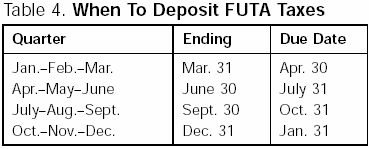 When To Deposit FUTA Taxes Reporting FUTA tax.
Use Form 940 or Form 940-EZ, Employer's Annual Federal Unemployment (FUTA) Tax Return, to report FUTA tax. File Form 940 or Form 940-EZ by January 31. However, if you deposited all FUTA tax when due, you may file on or before March 10. The IRS will mail a preaddressed Form 940 or Form 940-EZ to you if you filed a return for the year before. If you do not receive Form 940 or Form 940-EZ, you can get a form by calling 1-800-TAX-FORM (1-800-829-3676). Form 940-EZ requirements.
You may be able to use Form 940-EZ instead of Form 940 if: (a) you paid unemployment taxes (“contributions”) to only one state, (b) you paid state unemployment taxes by the due date of Form 940 or Form 940-EZ, and (c) all wages that were taxable for FUTA tax purposes were also taxable for your state's unemployment tax. For example, if you paid wages to corporate officers (these wages are subject to FUTA tax) in a state that exempts these wages from its unemployment taxes, you cannot use Form 940-EZ. Household employees.
If you did not report employment taxes for household employees on Form 941 or Form 943, report FUTA tax for these employees on Schedule H (Form 1040), Household Employment Taxes. See Pub. 926 for more information. Electronic and magnetic tape filing by Reporting Agents.
Reporting agents filing Forms 940 for groups of taxpayers can file them electronically or on magnetic tape. See the Reporting Agent discussion in section 7 of Pub. 15-A, Employer's Supplemental Tax Guide, for more information. 16. How To Use the Income Tax Withholding and Advance Earned Income Credit (EIC) Payment Tables There are several ways to figure income tax withholding. The following methods of withholding are based on the information that you get from your employees on Form W-4, Employee's Withholding Allowance Certificate. See section 9 for more information on Form W-4. Under the wage bracket method, find the proper table (on pages 37-56) for your payroll period and the employee's marital status as shown on his or her Form W-4. Then, based on the number of withholding allowances claimed on the Form W-4 and the amount of wages, find the amount of tax to withhold. If your employee is claiming more than 10 withholding allowances, see below. Note:If you cannot use the wage bracket tables because wages exceed the amount shown in the last bracket of the table, use the percentage method of withholding described below. Be sure to reduce wages by the amount of total withholding allowances in Table 5 before using the percentage method tables (pages 35-36). Adjusting wage bracket withholding for employees claiming more than 10 withholding allowances.
The wage bracket tables can be used if an employee claims up to 10 allowances. More than 10 allowances may be claimed because of the special withholding allowance, additional allowances for deductions and credits, and the system itself. To adapt the tables to more than 10 allowances:
This is a voluntary method. If you use the wage bracket tables, you may continue to withhold the amount in the “10” column when your employee has more than 10 allowances, using the method above. You can also use any other method described below. If you do not want to use the wage bracket tables on pages 37 through 56 to figure how much income tax to withhold, you can use a percentage computation based on Table 5 and the appropriate rate table. This method works for any number of withholding allowances the employee claims and any amount of wages. Use these steps to figure the income tax to withhold under the percentage method:
Table 5. Percentage Method—2004 Amount for One Withholding Allowance
Example:
An unmarried employee is paid $600 weekly. This employee has in effect a Form W-4 claiming two withholding allowances. Using the percentage method, figure the income tax to withhold as follows:
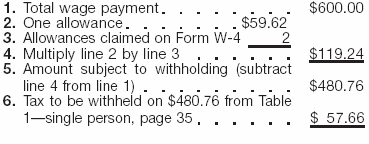 Percentage Method Example To figure the income tax to withhold, you may reduce the last digit of the wages to zero, or figure the wages to the nearest dollar. Annual income tax withholding.
Figure the income tax to withhold on annual wages under the Percentage Method for an annual payroll period. Then prorate the tax back to the payroll period. Example: A married person claims four withholding allowances. She is paid $1,000 a week. Multiply the weekly wages by 52 weeks to figure the annual wage of $52,000. Subtract $12,400 (the value of four withholding allowances for 2004) for a balance of $39,600. Using the table for the annual payroll period on page 36, $4,025 is withheld. Divide the annual tax by 52. The weekly income tax to withhold is $77.40. Alternative Methods of Income Tax Withholding Rather than the Wage Bracket Method or Percentage Method described above, you can use an alternative method to withhold income tax. Pub. 15-A, Employer's Supplemental Tax Guide, describes these alternative methods and contains:
Some of the alternative methods explained in Pub. 15-A are annualized wages, average estimated wages, cumulative wages, and part-year employment. Advance Payment Methods for the Earned Income Credit (EIC) To figure the advance EIC payment, you may use either the Wage Bracket Method or the Percentage Method as explained below. You may use other methods for figuring advance EIC payments if the amount of the payment is about the same as it would be using tables in this booklet. See the tolerances allowed in the chart in section 9 of Pub. 15-A. See also section 10 in this booklet for an explanation of the advance payment of the EIC. The number of withholding allowances that an employee claims on Form W-4 is not used in figuring the advance EIC payment. Nor does it matter that the employee has claimed exemption from income tax withholding on Form W-4. If you use the wage bracket tables on pages 59 through 64, figure the advance EIC payment as follows. Find the employee's gross wages before any deductions using the appropriate table. There are different tables for: (a) single or head of household, (b) married without spouse filing certificate, and (c) married with both spouses filing certificates. Determine the amount of the advance EIC payment shown in the appropriate table for the amount of wages paid. If you do not want to use the wage bracket tables to figure how much to include in an employee's wages for the advance EIC payment, you can use the percentage method based on the appropriate rate table on pages 57 and 58. Find the employee's gross wages before any deductions in the appropriate table on pages 57 and 58. There are different tables for: (a) single or head of household, (b) married without spouse filing certificate, and (c) married with both spouses filing certificates. Find the advance EIC payment shown in the appropriate table for the amount of wages paid. Whole-Dollar Withholding and Paying Advance EIC (Rounding) The income tax withholding amounts in the Wage Bracket Tables (pages 37-56) have been rounded to whole-dollar amounts. When employers use the Percentage Method (pages 35-36) or an alternative method of income tax withholding, the tax for the pay period may be rounded to the nearest dollar. The Wage Bracket Tables for advance EIC payments (pages 59-64) have also been rounded to whole-dollar amounts. If you use the Tables for Percentage Method of Advance EIC Payments (pages 57-58), the payments may be rounded to the nearest dollar. Publications Index | 2003 Tax Help Archives | Tax Help Archives | Home © 2005, UncleFed.com
|
|
|||||||||||||||||||||||||||||||||||||||||||||||||||||||||||||||||||||||||||||||||||||||||||||||||||||||||||||||
