| Publication 526 |
2008 Tax Year |
Publication 526 - Main Contents
Organizations That Qualify To Receive Deductible Contributions
You can deduct your contributions only if you make them to a qualified organization. To become a qualified organization, most
organizations other
than churches and governments, as described below, must apply to the IRS.
Publication 78.
You can ask any organization whether it is a qualified organization, and most will be able to tell you. Or you can
check IRS Publication 78, which
lists most qualified organizations. You may find Publication 78 in your local library's reference section. Or you can find
it on the Internet at
apps.irs.gov/app/pub78. You can also call the IRS to find out if
an organization is qualified. Call 1-877-829-5500. (For TTY/TDD help, call 1-800-829-4059.)
Types of Qualified Organizations
Generally, only the five following types of organizations can be qualified organizations.
-
A community chest, corporation, trust, fund, or foundation organized or created in or under the laws of the United States,
any state, the
District of Columbia, or any possession of the United States (including Puerto Rico). It must be organized and operated only
for one or more of the
following purposes.
-
Religious.
-
Charitable.
-
Educational.
-
Scientific.
-
Literary.
-
The prevention of cruelty to children or animals.
Certain organizations that foster national or international amateur sports competition also qualify.
-
War veterans' organizations, including posts, auxiliaries, trusts, or foundations, organized in the United States or any of
its possessions.
-
Domestic fraternal societies, orders, and associations operating under the lodge system.
Note. Your contribution to this type of organization is deductible only if it is to be used solely for charitable, religious,
scientific, literary, or educational purposes, or for the prevention of cruelty to children or animals.
-
Certain nonprofit cemetery companies or corporations.
Note. Your contribution to this type of organization is not deductible if it can be used for the care of a specific lot or mausoleum
crypt.
-
The United States or any state, the District of Columbia, a U.S. possession (including Puerto Rico), a political subdivision
of a state or
U.S. possession, or an Indian tribal government or any of its subdivisions that perform substantial government functions.
Note. To be deductible, your contribution to this type of organization must be made solely for public purposes.
Example 1. You contribute cash to your city's police department to be used as a reward for information about a crime. The city police
department is a qualified organization, and your contribution is for a public purpose. You can deduct your contribution.
Example 2. You make a voluntary contribution to the social security trust fund, not earmarked for a specific account. Because the trust
fund is part of the U.S. Government, you contributed to a qualified organization. You can deduct your contribution.
Examples.
The following list gives some examples of qualified organizations.
-
Churches, a convention or association of churches, temples, synagogues, mosques, and other religious organizations.
-
Most nonprofit charitable organizations such as the Red Cross and the United Way.
-
Most nonprofit educational organizations, including the Boy (and Girl) Scouts of America, colleges, museums, and daycare centers
if
substantially all the childcare provided is to enable individuals (the parents) to be gainfully employed and the services
are available to the general
public. However, if your contribution is a substitute for tuition or other enrollment fee, it is not deductible as a charitable
contribution, as
explained later under Contributions You Cannot Deduct.
-
Nonprofit hospitals and medical research organizations.
-
Utility company emergency energy programs, if the utility company is an agent for a charitable organization that assists individuals
with
emergency energy needs.
-
Nonprofit volunteer fire companies.
-
Public parks and recreation facilities.
-
Civil defense organizations.
Canadian charities.
You may be able to deduct contributions to certain Canadian charitable organizations covered under an income tax treaty
with Canada.
To deduct your contribution to a Canadian charity, you generally must have income from sources in Canada. See Publication
597, Information on the
United States-Canada Income Tax Treaty, for information on how to figure your deduction.
Mexican charities.
You may be able to deduct contributions to certain Mexican charitable organizations under an income tax treaty with
Mexico.
The organization must meet tests that are essentially the same as the tests that qualify U.S. organizations to receive
deductible contributions.
The organization may be able to tell you if it meets these tests.
If not, you can get general information about the tests the organization must meet by writing to the:
Internal Revenue Service
International Returns Section
P.O. Box 920
Bensalem, PA 19020-8518.
To deduct your contribution to a Mexican charity, you must have income from sources in Mexico. The limits described in Limits on Deductions,
later, apply and are figured using your income from Mexican sources. Those limits also apply to all your charitable contributions,
as described
in that discussion.
Israeli charities.
You may be able to deduct contributions to certain Israeli charitable organizations under an income tax treaty with
Israel. To qualify for the
deduction, your contribution must be made to an organization created and recognized as a charitable organization under the
laws of Israel. The
deduction will be allowed in the amount that would be allowed if the organization was created under the laws of the United
States, but is limited to
25% of your adjusted gross income from Israeli sources.
Contributions You Can Deduct
Generally, you can deduct your contributions of money or property that you make to, or for the use of, a qualified organization.
A gift or
contribution is “for the use of” a qualified organization when it is held in a legally enforceable trust for the qualified organization or in a
similar legal arrangement.
The contributions must be made to a qualified organization and not set aside for use by a specific person.
If you give property to a qualified organization, you generally can deduct the fair market value of the property at the time
of the contribution.
See Contributions of Property, later.
Your deduction for charitable contributions is generally limited to 50% of your adjusted gross income, but in some cases 20%
and 30% limits may
apply. In addition, the total of your charitable contributions deduction and certain other itemized deductions may be limited.
See Limits on
Deductions, later.
Table 1 in this publication lists some examples of contributions you can deduct and some that you cannot deduct.
Contributions From Which You Benefit
If you receive a benefit as a result of making a contribution to a qualified organization, you can deduct only the amount
of your contribution that
is more than the value of the benefit you receive. Also see Contributions From Which You Benefit under Contributions You Cannot
Deduct, later.
If you pay more than fair market value to a qualified organization for merchandise, goods, or services, the amount you pay
that is more than the
value of the item can be a charitable contribution. For the excess amount to qualify, you must pay it with the intent to make
a charitable
contribution.
Example 1.
You pay $65 for a ticket to a dinner-dance at a church. All the proceeds of the function go to the church. The ticket to the
dinner-dance has a
fair market value of $25. When you buy your ticket, you know that its value is less than your payment. To figure the amount
of your charitable
contribution, you subtract the value of the benefit you receive ($25) from your total payment ($65). You can deduct $40 as
a charitable contribution
to the church.
Example 2.
At a fund-raising auction conducted by a charity, you pay $600 for a week's stay at a beach house. The amount you pay is no
more than the fair
rental value. You have not made a deductible charitable contribution.
Athletic events.
If you make a payment to, or for the benefit of, a college or university and, as a result, you receive the right to
buy tickets to an athletic
event in the athletic stadium of the college or university, you can deduct 80% of the payment as a charitable contribution.
If any part of your payment is for tickets (rather than the right to buy tickets), that part is not deductible. In
that case, subtract the price of
the tickets from your payment. 80% of the remaining amount is a charitable contribution.
Example 1.
You pay $300 a year for membership in an athletic scholarship program maintained by a university (a qualified organization).
The only benefit of
membership is that you have the right to buy one season ticket for a seat in a designated area of the stadium at the university's
home football games.
You can deduct $240 (80% of $300) as a charitable contribution.
Example 2.
The facts are the same as in Example 1 except that your $300 payment included the purchase of one season ticket for the stated
ticket price of
$120. You must subtract the usual price of a ticket ($120) from your $300 payment. The result is $180. Your deductible charitable
contribution is $144
(80% of $180).
Charity benefit events.
If you pay a qualified organization more than fair market value for the right to attend a charity ball, banquet, show,
sporting event, or other
benefit event, you can deduct only the amount that is more than the value of the privileges or other benefits you receive.
If there is an established charge for the event, that charge is the value of your benefit. If there is no established
charge, your contribution is
that part of your payment that is more than the reasonable value of the right to attend the event. Whether you use the tickets
or other privileges has
no effect on the amount you can deduct. However, if you return the ticket to the qualified organization for resale, you can
deduct the entire amount
you paid for the ticket.
Even if the ticket or other evidence of payment indicates that the payment is a “ contribution,” this does not mean you can deduct the entire
amount. If the ticket shows the price of admission and the amount of the contribution, you can deduct the contribution amount.
Example.
You pay $40 to see a special showing of a movie for the benefit of a qualified organization. Printed on the ticket is
“Contribution-$40.” If the regular price for the movie is $8, your contribution is $32 ($40 payment - $8 regular price).
Membership fees or dues.
You may be able to deduct membership fees or dues you pay to a qualified organization. However, you can deduct only
the amount that is more than
the value of the benefits you receive. You cannot deduct dues, fees, or assessments paid to country clubs and other social
organizations. They are not
qualified organizations.
Certain membership benefits can be disregarded.
Both you and the organization can disregard certain membership benefits you get in return for an annual payment of
$75 or less to the qualified
organization. The benefits that can be disregarded are:
-
Any rights or privileges, other than those discussed under Athletic events, earlier, that you can use frequently while you are a
member, such as:
-
Free or discounted admission to the organization's facilities or events,
-
Free or discounted parking,
-
Preferred access to goods or services, and
-
Discounts on the purchase of goods and services.
-
Admission, while you are a member, to events that are open only to members of the organization if the organization reasonably
projects that
the cost per person (excluding any allocated overhead) is not more than $8.90.
Token items.
You can deduct your entire payment to a qualified organization as a charitable contribution if both of the following
are true.
-
You get a small item or other benefit of token value.
-
The qualified organization correctly determines that the value of the item or benefit you received is not substantial and
informs you that
you can deduct your payment in full.
The organization determines whether the value of an item or benefit is substantial by using Revenue Procedures 90-12 and 92-49
and the
inflation adjustment in Revenue Procedure 2006-53 .
Written statement.
A qualified organization must give you a written statement if you make a payment to it that is more than $75 and is
partly a contribution and
partly for goods or services. The statement must tell you that you can deduct only the amount of your payment that is more
than the value of the goods
or services you received. It must also give you a good faith estimate of the value of those goods or services.
The organization can give you the statement either when it solicits or when it receives the payment from you.
Exception.
An organization will not have to give you this statement if one of the following is true.
-
The organization is:
-
The type of organization described in (5) under Types of Qualified Organizations, earlier, or
-
Formed only for religious purposes, and the only benefit you receive is an intangible religious benefit (such as admission
to a religious
ceremony) that generally is not sold in commercial transactions outside the donative context.
-
You receive only items whose value is not substantial as described under Token items, earlier.
-
You receive only membership benefits that can be disregarded, as described earlier.
Expenses Paid for Student Living With You
You may be able to deduct some expenses of having a student live with you. You can deduct qualifying expenses for a foreign
or American student
who:
-
Lives in your home under a written agreement between you and a qualified organization (defined later) as part of a program
of the
organization to provide educational opportunities for the student,
-
Is not your relative (defined later) or dependent, and
-
Is a full-time student in the twelfth or any lower grade at a school in the United States.
You can deduct up to $50 a month for each full calendar month the student lives with you. Any month when conditions (1) through
(3) above are met
for 15 or more days counts as a full month.
Qualified organization.
For these purposes, a qualified organization can be any of the organizations described earlier under Organizations That Qualify To Receive
Deductible Contributions, except those in (4) and (5). For example, if you are providing a home for a student through a state or local
government agency, you cannot deduct your expenses as charitable contributions.
Relative.
The term “ relative” means any of the following persons.
-
Your child, stepchild, foster child, or a descendant of any of them (for example, your grandchild). A legally adopted child
is considered
your child.
-
Your brother, sister, half brother, half sister, stepbrother, or stepsister.
-
Your father, mother, grandparent, or other direct ancestor.
-
Your stepfather or stepmother.
-
A son or daughter of your brother or sister.
-
A brother or sister of your father or mother.
-
Your son-in-law, daughter-in-law, father-in-law, mother-in-law, brother-in-law, or sister-in-law.
Qualifying expenses.
Expenses that you may be able to deduct include the cost of books, tuition, food, clothing, transportation, medical
and dental care, entertainment,
and other amounts you actually spend for the well-being of the student.
Expenses that do not qualify.
Depreciation on your home, the fair market value of lodging, and similar items are not considered amounts spent by
you. In addition, general
household expenses, such as taxes, insurance, repairs, etc., do not qualify for the deduction.
Reimbursed expenses.
If you are compensated or reimbursed for any part of the costs of having a student living with you, you cannot deduct
any of your costs. However,
if you are reimbursed for only an extraordinary or a one-time item, such as a hospital bill or vacation trip, that you paid
in advance at the request
of the student's parents or the sponsoring organization, you can deduct your expenses for the student for which you were not
reimbursed.
Mutual exchange program.
You cannot deduct the costs of a foreign student living in your home under a mutual exchange program through which
your child will live with a
family in a foreign country.
Reporting expenses.
For a list of what you must file with your return if you deduct expenses for a student living with you, see Reporting expenses for student
living with you under How To Report, later.
Out-of-Pocket Expenses in Giving Services
Although you cannot deduct the value of your services given to a qualified organization, you may be able to deduct some amounts
you pay in giving
services to a qualified organization. The amounts must be:
-
Unreimbursed,
-
Directly connected with the services,
-
Expenses you had only because of the services you gave, and
-
Not personal, living, or family expenses.
Table 2 contains questions and answers that apply to some individuals who volunteer their services.
Underprivileged youths selected by charity.
You can deduct reasonable unreimbursed out-of-pocket expenses you pay to allow underprivileged youths to attend athletic
events, movies, or
dinners. The youths must be selected by a charitable organization whose goal is to reduce juvenile delinquency. Your own similar
expenses in
accompanying the youths are not deductible.
Conventions.
If you are a chosen representative attending a convention of a qualified organization, you can deduct unreimbursed
expenses for travel and
transportation, including a reasonable amount for meals and lodging, while away from home overnight in connection with the
convention. However, see
Travel, later.
You cannot deduct personal expenses for sightseeing, fishing parties, theater tickets, or nightclubs. You also cannot
deduct travel, meals and
lodging, and other expenses for your spouse or children.
You cannot deduct your expenses in attending a church convention if you go only as a member of your church rather
than as a chosen representative.
You can deduct unreimbursed expenses that are directly connected with giving services for your church during the convention.
Uniforms.
You can deduct the cost and upkeep of uniforms that are not suitable for everyday use and that you must wear while
performing donated services for
a charitable organization.
Foster parents.
You may be able to deduct as a charitable contribution some of the costs of being a foster parent (foster care provider)
if you have no profit
motive in providing the foster care and are not, in fact, making a profit. A qualified organization must designate the individuals
you take into your
home for foster care.
You can deduct expenses that meet both of the following requirements.
-
They are unreimbursed out-of-pocket expenses to feed, clothe, and care for the foster child.
-
They must be mainly to benefit the qualified organization.
Unreimbursed expenses that you cannot deduct as charitable contributions may be considered support provided by you
in determining whether you can
claim the foster child as a dependent. For details, see Publication 501, Exemptions, Standard Deduction, and Filing Information.
Example.
You cared for a foster child because you wanted to adopt her, not to benefit the agency that placed her in your home. Your
unreimbursed expenses
are not deductible as charitable contributions.
Church deacon.
You can deduct as a charitable contribution any unreimbursed expenses you have while in a permanent diaconate program
established by your church.
These expenses include the cost of vestments, books, and transportation required in order to serve in the program as either
a deacon candidate or as
an ordained deacon.
Car expenses.
You can deduct unreimbursed out-of-pocket expenses, such as the cost of gas and oil, that are directly related to
the use of your car in giving
services to a charitable organization. You cannot deduct general repair and maintenance expenses, depreciation, registration
fees, or the costs of
tires or insurance.
If you do not want to deduct your actual expenses, you can use a standard mileage rate of 14 cents a mile to figure
your contribution.
You can deduct parking fees and tolls, whether you use your actual expenses or the standard mileage rate.
You must keep reliable written records of your car expenses. For more information, see Car expenses under Records To Keep,
later.
Travel.
Generally, you can claim a charitable contribution deduction for travel expenses necessarily incurred while you are
away from home performing
services for a charitable organization only if there is no significant element of personal pleasure, recreation, or vacation
in the travel. This
applies whether you pay the expenses directly or indirectly. You are paying the expenses indirectly if you make a payment
to the charitable
organization and the organization pays for your travel expenses.
The deduction for travel expenses will not be denied simply because you enjoy providing services to the charitable
organization. Even if you enjoy
the trip, you can take a charitable contribution deduction for your travel expenses if you are on duty in a genuine and substantial
sense throughout
the trip. However, if you have only nominal duties, or if for significant parts of the trip you do not have any duties, you
cannot deduct your travel
expenses.
Example 1.
You are a troop leader for a tax-exempt youth group and you help take the group on a camping trip. You are responsible for
overseeing the setup of
the camp and for providing adult supervision for other activities during the entire trip. You participate in the activities
of the group and really
enjoy your time with them. You oversee the breaking of camp and you help transport the group home. You can deduct your travel
expenses.
Example 2.
You sail from one island to another and spend 8 hours a day counting whales and other forms of marine life. The project is
sponsored by a
charitable organization. In most circumstances, you cannot deduct your expenses.
Example 3.
You work for several hours each morning on an archeological dig sponsored by a charitable organization. The rest of the day
is free for recreation
and sightseeing. You cannot take a charitable contribution deduction even though you work very hard during those few hours.
Example 4.
You spend the entire day attending a charitable organization's regional meeting as a chosen representative. In the evening
you go to the theater.
You can claim your travel expenses as charitable contributions, but you cannot claim the cost of your evening at the theater.
Daily allowance (per diem).
If you provide services for a charitable organization and receive a daily allowance to cover reasonable travel expenses,
including meals and
lodging while away from home overnight, you must include in income the amount of the allowance that is more than your deductible
travel expenses. You
can deduct your necessary travel expenses that are more than the allowance.
Table 2. Volunteers' Questions and Answers
If you do volunteer work for a qualified organization, the following questions and answers may apply to you. All of the rules
explained in
this publication also apply. See, in particular, Out-of-Pocket Expenses in Giving Services.
| Question |
Answer |
|
I do volunteer work 6 hours a week in the office of a qualified organization. The receptionist is paid $6 an hour to do the
same
work I do. Can I deduct $36 a week for my time?
|
No, you cannot deduct the value of your time or services.
|
The office is 30 miles from my home. Can I deduct any of my car expenses for these trips?
|
Yes, you can deduct the costs of gas and oil that are directly related to
getting to and from the place where you are a volunteer. If you do not
want to figure your actual costs, you can deduct 14 cents for each
mile.
|
|
I volunteer as a Red Cross nurse's aide at a hospital. Can I deduct the cost of uniforms that I must wear?
|
Yes, you can deduct the cost of buying and cleaning your uniforms if
the hospital is a qualified organization, the uniforms are not suitable for
everyday use, and you must wear them when volunteering.
|
|
I pay a babysitter to watch my children while I do volunteer work for a qualified organization. Can I deduct these costs?
|
No, you cannot deduct payments for child care expenses as a
charitable contribution, even if they are necessary so you can do
volunteer work for a qualified organization. (If you have child care
expenses so you can work for pay, get Publication 503, Child and
Dependent Care Expenses.)
|
Deductible travel expenses.
These include:
-
Air, rail, and bus transportation,
-
Out-of-pocket expenses for your car,
-
Taxi fares or other costs of transportation between the airport or station and your hotel,
-
Lodging costs, and
-
The cost of meals.
Because these travel expenses are not business-related, they are not subject to the same limits as business related expenses.
For information
on business travel expenses, see Travel in Publication 463, Travel, Entertainment, Gift, and Car Expenses.
Expenses of Whaling Captains
You may be able to deduct as a charitable contribution the reasonable and necessary whaling expenses paid during the year
in carrying out
sanctioned whaling activities. The deduction is limited to $10,000 a year. To claim the deduction, you must be recognized
by the Alaska Eskimo Whaling
Commission as a whaling captain charged with the responsibility of maintaining and carrying out sanctioned whaling activities.
Sanctioned whaling activities are subsistence bowhead whale hunting activities conducted under the management plan of the
Alaska Eskimo Whaling
Commission.
Whaling expenses include expenses for:
-
Acquiring and maintaining whaling boats, weapons, and gear used in sanctioned whaling activities,
-
Supplying food for the crew and other provisions for carrying out these activities, and
-
Storing and distributing the catch from these activities.
You must keep records showing the time, place, date, amount, and nature of the expenses. For details, see Revenue Procedure
2006-50, 2006-47 I.R.B.
944, which is available at
http://www.irs.gov/irb/2006-47_IRB/ar12.html.
Contributions You Cannot Deduct
There are some contributions you cannot deduct. There are others you can deduct only part of.
You cannot deduct as a charitable contribution:
-
A contribution to a specific individual,
-
A contribution to a nonqualified organization,
-
The part of a contribution from which you receive or expect to receive a benefit,
-
The value of your time or services,
-
Your personal expenses,
-
A qualified charitable distribution from an individual retirement arrangement (IRA),
-
Appraisal fees,
-
Certain contributions to donor advised funds after February 13, 2007, or
-
Certain contributions of partial interests in property.
Detailed discussions of these items follow.
Contributions to Individuals
You cannot deduct contributions to specific individuals, including the following.
-
Contributions to fraternal societies made for the purpose of paying medical or burial expenses of deceased members.
-
Contributions to individuals who are needy or worthy. This includes contributions to a qualified organization if you indicate
that your
contribution is for a specific person. But you can deduct a contribution that you give to a qualified organization that in
turn helps needy or worthy
individuals if you do not indicate that your contribution is for a specific person.
Example. You can deduct contributions for flood relief, hurricane relief, or other disaster relief to a qualified organization. However,
you cannot deduct contributions earmarked for relief of a particular individual or family.
-
Payments to a member of the clergy that can be spent as he or she wishes, such as for personal expenses.
-
Expenses you paid for another person who provided services to a qualified organization.
Example. Your son does missionary work. You pay his expenses. You cannot claim a deduction for your son's unreimbursed expenses related
to his contribution of services.
-
Payments to a hospital that are for a specific patient's care or for services for a specific patient. You cannot deduct these
payments even
if the hospital is operated by a city, state, or other qualified organization.
Contributions to Nonqualified Organizations
You cannot deduct contributions to organizations that are not qualified to receive tax-deductible contributions, including
the following.
-
Certain state bar associations if:
-
The state bar is not a political subdivision of a state,
-
The bar has private, as well as public, purposes, such as promoting the professional interests of members, and
-
Your contribution is unrestricted and can be used for private purposes.
-
Chambers of commerce and other business leagues or organizations.
-
Civic leagues and associations.
-
Communist organizations.
-
Country clubs and other social clubs.
-
Foreign organizations other than:
-
A U.S. organization that transfers funds to a charitable foreign organization if the U.S. organization controls the use of
the funds or if
the foreign organization is only an administrative arm of the U.S. organization, or
-
Certain Canadian, Israeli, or Mexican charitable organizations. See Canadian charities, Mexican charities, and
Israeli charities under Organizations That Qualify To Receive Deductible Contributions, earlier.
-
Homeowners' associations.
-
Labor unions. But you may be able to deduct union dues as a miscellaneous itemized deduction, subject to the 2%-of-adjusted-gross-income
limit, on Schedule A (Form 1040). See Publication 529, Miscellaneous Deductions.
-
Political organizations and candidates.
Contributions From Which You Benefit
If you receive or expect to receive a financial or economic benefit as a result of making a contribution to a qualified organization,
you cannot
deduct the part of the contribution that represents the value of the benefit you receive. See Contributions From Which You Benefit under
Contributions You Can Deduct, earlier. These contributions include:
-
Contributions for lobbying.
This includes amounts that you earmark for use in, or in connection with, influencing specific
legislation.
-
Contributions to a retirement home
that are for room, board, maintenance, or admittance. Also, if the amount of your contribution depends on the
type or size of apartment you will occupy, it is not a charitable contribution.
-
Costs of raffles, bingo, lottery, etc.
You cannot deduct as a charitable contribution amounts you pay to buy raffle or lottery tickets or to play bingo
or other games of chance. For information on how to report gambling winnings and losses, see Deductions Not Subject to the 2% Limit in
Publication 529.
-
Dues to fraternal orders and similar groups. However, see Membership fees or dues under Contributions From Which You
Benefit, earlier.
-
Tuition,
or amounts you pay instead of tuition, even if you pay them for children to attend parochial schools or qualifying
nonprofit day-care centers. You also cannot deduct any fixed amount you may be required to pay in addition to the tuition
fee to enroll in a private
school, even if it is designated as a “donation.”
-
Contributions connected with split-dollar insurance arrangements.
You cannot deduct any part of a contribution to a charitable organization if, in connection
with the contribution, the organization directly or indirectly pays, has paid, or is expected to pay any premium on any life
insurance, annuity, or
endowment contract for which you, any member of your family or any other person chosen by you (other than a qualified charitable
organization) is a
beneficiary.
Example. You donate money to a charitable organization. The charity uses the money to purchase a cash value life insurance policy.
The
beneficiaries under the insurance policy include members of your family. Even though the charity may eventually get some benefit
out of the insurance
policy, you cannot deduct any part of the donation.
Qualified Charitable Distributions
A qualified charitable distribution (QCD) is a distribution made directly by the trustee of your individual retirement arrangement
(IRA), other
than a SEP or SIMPLE IRA, to certain qualified organizations. You must have been at least age 70½ when the distribution was
made. Your
total QCDs for the year cannot be more than $100,000. If all the requirements are met, a QCD is nontaxable, but you cannot
claim a charitable
contribution deduction for a QCD. See Publication 590, Individual Retirement Arrangements (IRAs), for more information about
QCDs.
Value of Time or Services
You cannot deduct the value of your time or services, including:
-
Blood donations
to the Red Cross or to blood banks, and
-
The value of income lost while you work as an unpaid volunteer for a qualified organization.
You cannot deduct personal, living, or family expenses, such as the following items.
-
The cost of meals
you eat while you perform services for a qualified organization, unless it is necessary for you to be away from home
overnight while performing the services.
-
Adoption expenses,
including fees paid to an adoption agency and the costs of keeping a child in your home before adoption is
final. However, you may be able to claim a tax credit for these expenses. Also, you may be able to exclude from your gross
income amounts paid or
reimbursed by your employer for your adoption expenses. See Form 8839, Qualified Adoption Expenses, and its instructions,
for more information. You
also may be able to claim an exemption for the child. See Exemptions for Dependents in Publication 501 for more information.
Fees that you pay to find the fair market value of donated property are not deductible as contributions. You can claim them,
subject to the
2%-of-adjusted-gross-income limit, as a miscellaneous itemized deduction on Schedule A (Form 1040). See Deductions Subject to the 2% Limit
in Publication 529 for more information.
Contributions to Donor Advised Funds
You cannot deduct a contribution to a donor advised fund after February 13, 2007, if:
-
The qualified organization that sponsors the fund is a war veterans' organization, a fraternal society, or a nonprofit cemetery
company,
or
-
You do not have an acknowledgment from that sponsoring organization that it has exclusive legal control over the assets
contributed.
There are also other circumstances in which you cannot deduct your contribution to a donor advised fund.
Generally, a donor advised fund is a fund or account in which a donor can, because of being a donor, advise the fund how to
distribute or invest
amounts held in the fund. For details, see Internal Revenue Code section 170(f)(18).
Partial Interest in Property
Generally, you cannot deduct a contribution of less than your entire interest in property. For details, see Partial Interest in Property
under Contributions of Property, later.
Contributions of Property
If you contribute property to a qualified organization, the amount of your charitable contribution is generally the fair market
value of the
property at the time of the contribution. However, if the property has increased in value, you may have to make some adjustments
to the amount of your
deduction. See Giving Property That Has Increased in Value, later.
For information about the records you must keep and the information you must furnish with your return if you donate property,
see Records To
Keep and How To Report, later.
Contributions Subject to Special Rules
Special rules apply if you contributed:
-
Clothing or household items,
-
A car, boat, or airplane,
-
Taxidermy property,
-
Property subject to a debt,
-
A partial interest in property,
-
A fractional interest in tangible personal property,
-
A qualified conservation contribution,
-
A future interest in tangible personal property,
-
Inventory from your business, or
-
A patent or other intellectual property.
These special rules are described next.
Clothing and Household Items
You cannot take a deduction for clothing or household items you donate unless the clothing or household items are in good
used condition or better.
Household items.
Household items include:
-
Furniture,
-
Furnishings,
-
Electronics,
-
Appliances,
-
Linens, and
-
Other similar items.
Household items do not include:
Appraisal for items more than $500.
You can take a deduction for a contribution of an item of clothing or a household item that is not in good used condition
or better if you deduct
more than $500 for it and include a qualified appraisal of it with your return.
Fair market value.
To determine the fair market value of these items, use the rules under Determining Fair Market Value, later.
Cars, Boats, and Airplanes
The following rules apply to any donation of a qualified vehicle.
A qualified vehicle is:
Deduction more than $500.
If you donate a qualified vehicle to a qualified organization and you claim a deduction of more than $500, you can
deduct the smaller of:
-
The gross proceeds from the sale of the vehicle by the organization, or
-
The vehicle's fair market value on the date of the contribution. If the vehicle's fair market value was more than your cost
or other basis,
you may have to reduce the fair market value to figure the deductible amount, as described under Giving Property That Has Increased in
Value, later.
Form 1098-C.
You must attach to your return the copy of the Form 1098-C, Contributions of Motor Vehicles, Boats, and Airplanes,
(or other statement containing
the same information as Form 1098-C) you received from the organization. The Form 1098-C (or other statement) will show the
gross proceeds from the
sale of the vehicle.
If you do not attach Form 1098-C (or other statement), you cannot deduct your contribution. You must get Form 1098-C
(or other statement) within 30
days of the sale of the vehicle. But if exception 1 or 2 (described next) applies, you must get Form 1098-C (or other statement)
within 30 days of
your donation.
Exceptions.
There are two exceptions to the rules just described for deductions of more than $500.
Exception 1—vehicle used or improved by organization.
If the qualified organization makes a significant intervening use of or material improvement to the vehicle before
transferring it, and you claim a
deduction of more than $500, you generally can deduct the vehicle's fair market value at the time of the contribution. But
if the vehicle's fair
market value was more than your cost or other basis, you may have to reduce the fair market value to get the deductible amount,
as described under
Giving Property That Has Increased in Value, later. The Form 1098-C (or other statement) will show whether this exception applies.
Exception 2—vehicle given or sold to needy individual.
If the qualified organization will give the vehicle, or sell it for a price well below fair market value, to a needy
individual to further the
organization's charitable purpose, and you claim a deduction of more than $500, you generally can deduct the vehicle's fair
market value at the time
of the contribution. But if the vehicle's fair market value was more than your cost or other basis, you may have to reduce
the fair market value to
get the deductible amount, as described under Giving Property That Has Increased in Value, later. The Form 1098-C (or other statement) will
show whether this exception applies.
This exception does not apply if the organization sells the vehicle at auction. In that case, you cannot deduct the
vehicle's fair market value.
Example.
Anita donates a used car to a qualified organization. She bought it 3 years ago for $9,000. A used car guide shows the fair
market value for this
type of car is $6,000. However, Anita gets a Form 1098-C from the organization showing the car was sold for $2,900. Neither
exception 1 nor exception
2 applies. If Anita itemizes her deductions, she can deduct $2,900 for her donation. She must attach Form 1098-C and Form
8283 to her return.
Deduction $500 or less.
If the qualified organization sells the vehicle for $500 or less and exceptions 1 and 2 do not apply, you can deduct
the smaller of:
-
$500, or
-
The vehicle's fair market value on the date of the contribution. But if the vehicle's fair market value was more than your
cost or other
basis, you may have to reduce the fair market value to get the deductible amount, as described under Giving Property That Has Increased in
Value later.
If the vehicle's fair market value is at least $250 but not more than $500, you must have a written statement from
the qualified organization
acknowledging your donation. The statement must contain the information and meet the tests for an acknowledgment described
under Deductions of At
Least $250 But Not More Than $500 under Records To Keep, later.
Fair market value.
To determine a vehicle's fair market value, use the rules described under Determining Fair Market Value, later.
Donations of inventory.
The vehicle donation rules just described do not apply to donations of inventory. For example, these rules do not
apply if you are a car dealer who
donates a car you had been holding for sale to customers. See Inventory, later.
If you donate taxidermy property to a qualified organization, your deduction is limited to your basis in the property or its
fair market value,
whichever is less. This applies if you prepared, stuffed, or mounted the property or paid or incurred the cost of preparing,
stuffing, or mounting the
property.
Your basis for this purpose includes only the cost of preparing, stuffing, and mounting the property. Your basis does not
include transportation or
travel costs. It also does not include direct or indirect costs for hunting or killing an animal, such as equipment costs
and the costs of preparing
an animal carcass for taxidermy.
Taxidermy property means any work of art that:
-
Is the reproduction or preservation of an animal, in whole or in part,
-
Is prepared, stuffed, or mounted to recreate one or more characteristics of the animal, and
-
Contains a part of the body of the dead animal.
Property Subject to a Debt
If you contribute property subject to a debt (such as a mortgage), you must reduce the fair market value of the property by:
-
Any allowable deduction for interest that you paid (or will pay) attributable to any period after the contribution, and
-
If the property is a bond, the lesser of:
-
Any allowable deduction for interest you paid (or will pay) to buy or carry the bond that is attributable to any period before
the
contribution, or
-
The interest, including bond discount, receivable on the bond that is attributable to any period before the contribution,
and that is not
includible in your income due to your accounting method.
This prevents a double deduction of the same amount as investment interest and also as a charitable contribution.
If the debt is assumed by the recipient (or another person), you must also reduce the fair market value of the property by
the amount of the
outstanding debt assumed.
If you sold the property to a qualified organization at a bargain price, the amount of the debt is also treated as an amount
realized on the sale
or exchange of property. For more information, see Bargain Sales under Giving Property That Has Increased in Value, later.
Partial Interest in Property
Generally, you cannot deduct a charitable contribution of less than your entire interest in property.
Right to use property.
A contribution of the right to use property is a contribution of less than your entire interest in that property and
is not deductible.
Example 1.
You own a 10-story office building and donate rent-free use of the top floor to a charitable organization. Since you still
own the building, you
have contributed a partial interest in the property and cannot take a deduction for the contribution.
Example 2.
Mandy White owns a vacation home at the beach that she sometimes rents to others. For a fund-raising auction at her church,
she donated the right
to use the vacation home for 1 week. At the auction, the church received and accepted a bid from Lauren Green equal to the
fair rental value of the
home for 1 week. Mandy cannot claim a deduction because of the partial interest rule. Lauren cannot claim a deduction either,
because she received a
benefit equal to the amount of her payment. See Contributions From Which You Benefit, earlier.
Exceptions.
You can deduct a charitable contribution of a partial interest in property only if that interest represents one of
the following listed items.
-
A remainder interest in your personal home or farm. A remainder interest is one that passes to a beneficiary after the end
of an earlier
interest in the property.
Example. You keep the right to live in your home during your lifetime and give your church a remainder interest that begins upon your
death.
-
An undivided part of your entire interest. This must consist of a part of every substantial interest or right you own in the
property and
must last as long as your interest in the property lasts. But see Fractional Interest in Tangible Personal Property, later.
Example. You contribute voting stock to a qualified organization but keep the right to vote the stock. The right to vote is a
substantial right in the stock. You have not contributed an undivided part of your entire interest and cannot deduct your
contribution.
-
A partial interest that would be deductible if transferred to certain types of trusts.
-
A qualified conservation contribution (defined later).
For information about how to figure the value of a contribution of a partial interest in property, see Partial Interest in Property Not in
Trust in Publication 561.
Fractional Interest in Tangible Personal Property
You cannot deduct a charitable contribution of a fractional interest in tangible personal property unless all interest in
the property is held
immediately before the contribution by:
If you make an additional contribution later, the fair market value of that contribution is the smaller of:
-
The fair market value of the property at the time of the initial fractional contribution, or
-
The fair market value of the property at the time of the additional contribution.
Tangible personal property is defined later under Future Interest in Tangible Personal Property. A fractional interest in property is an
undivided portion of your entire interest in the property.
Example.
An undivided one-quarter interest in a painting that entitles an art museum to possession of the painting for 3 months of
each year is a fractional
interest in the property.
Recapture of deduction.
You must recapture your charitable contribution deduction by including it in your income if both of the following
statements are true.
-
You contributed a fractional interest in tangible personal property after August 17, 2006.
-
You do not contribute the rest of your interest in the property to a qualified organization before the earlier of:
-
The date that is 10 years after the date of the initial contribution, or
-
The date of your death.
Recapture is also required in any case in which the qualified organization has not taken substantial physical possession
of the property and used
it in a way related to its purpose during the period beginning on the date of the initial fractional contribution and ending
on the earlier of:
-
The date that is 10 years after the date of the initial contribution, or
-
The date of your death.
Additional tax.
If you must recapture your deduction, you must also pay interest and an additional tax equal to 10% of the amount
recaptured.
Qualified Conservation Contribution
A qualified conservation contribution is a contribution of a qualified real property interest to a qualified organization
to be used only for
conservation purposes.
Qualified organization.
For purposes of a qualified conservation contribution, a qualified organization is:
-
A governmental unit,
-
A publicly supported charitable, religious, scientific, literary, educational, etc., organization, or
-
An organization that is controlled by, and operated for the exclusive benefit of, a governmental unit or a publicly supported
charity.
The organization also must have a commitment to protect the conservation purposes of the donation and must have the resources
to enforce the
restrictions.
Qualified real property interest.
This is any of the following interests in real property.
-
Your entire interest in real estate other than a mineral interest (subsurface oil, gas, or other minerals, and the right of
access to these
minerals).
-
A remainder interest.
-
A restriction (granted in perpetuity) on the use that may be made of the real property.
Conservation purposes.
Your contribution must be made only for one of the following conservation purposes.
-
Preserving land areas for outdoor recreation by, or for the education of, the general public.
-
Protecting a relatively natural habitat of fish, wildlife, or plants, or a similar ecosystem.
-
Preserving open space, including farmland and forest land, if it yields a significant public benefit. It must be either for
the scenic
enjoyment of the general public or under a clearly defined federal, state, or local governmental conservation policy.
-
Preserving a historically important land area or a certified historic structure.
Building in registered historic district.
If a building in a registered historic district is a certified historic structure, a contribution of a qualified real
property interest that is an
easement or other restriction on the exterior of the building is deductible only if it meets all of the following three conditions.
-
The restriction must preserve the entire exterior of the building (including its front, sides, rear, and height) and must
prohibit any
change to the exterior of the building that is inconsistent with its historical character.
-
You and the organization receiving the contribution must enter into a written agreement certifying, under penalty of perjury,
that the
organization:
-
Is a qualified organization with a purpose of environmental protection, land conservation, open space preservation, or historic
preservation, and
-
Has the resources to manage and enforce the restriction and a commitment to do so.
-
You must include with your return:
-
A qualified appraisal,
-
Photographs of the building's entire exterior, and
-
A description of all restrictions on development of the building, such as zoning laws and restrictive covenants.
If you claimed the rehabilitation credit on Form 3468 for the building for any of the 5 years before the year of the
contribution, your deduction
is reduced. See section 170(f)(14) of the Internal Revenue Code.
If you claim a deduction of more than $10,000, your deduction will not be allowed unless you pay a $500 filing fee.
See Form 8283-V, Payment
Voucher for Filing Fee Under Section 170(f)(13), and its instructions.
More information.
For information about determining the fair market value of qualified conservation contributions, see Publication 561.
For information about the
limits that apply to deductions for this type of contribution, see Limits on Deductions, later. For more information about qualified
conservation contributions, see section 1.170A-14 of the regulations.
Future Interest in Tangible Personal Property
You may be able to deduct the value of a charitable contribution of a future interest in tangible personal property only after
all intervening
interests in and rights to the actual possession or enjoyment of the property have either expired or been turned over to someone
other than yourself,
a related person, or a related organization. But see Fractional Interest in Tangible Personal Property, earlier, and Tangible personal
property put to unrelated use, later.
Related persons include your spouse, children, grandchildren, brothers, sisters, and parents. Related organizations may include
a partnership or
corporation that you have an interest in, or an estate or trust that you have a connection with.
Tangible personal property.
This is any property, other than land or buildings, that can be seen or touched. It includes furniture, books, jewelry,
paintings, and cars.
Future interest.
This is any interest that is to begin at some future time, regardless of whether it is designated as a future interest
under state law.
Example.
You own an antique car that you contribute to a museum. You give up ownership, but retain the right to keep the car in your
garage with your
personal collection. Since you keep an interest in the property, you cannot deduct the contribution. If you turn the car over
to the museum in a later
year, giving up all rights to its use, possession, and enjoyment, you can take a deduction for the contribution in that later
year.
If you contribute inventory (property that you sell in the course of your business), the amount you can claim as a contribution
deduction is the
smaller of its fair market value on the day you contributed it or its basis. The basis of donated inventory is any cost incurred
for the inventory in
an earlier year that you would otherwise include in your opening inventory for the year of the contribution. You must remove
the amount of your
contribution deduction from your opening inventory. It is not part of the cost of goods sold.
If the cost of donated inventory is not included in your opening inventory, the inventory's basis is zero and you cannot claim
a charitable
contribution deduction. Treat the inventory's cost as you would ordinarily treat it under your method of accounting. For example,
include the purchase
price of inventory bought and donated in the same year in the cost of goods sold for that year.
A special rule applies to certain donations of food inventory. See Food Inventory, later.
Patents and Other Intellectual Property
If you donate a patent or other intellectual property to a qualified organization, your deduction is limited to the basis
of the property or the
fair market value of the property, whichever is less. Intellectual property means any of the following:
-
Patents.
-
Copyrights (other than a copyright described in Internal Revenue Code sections 1221(a)(3) or 1231(b)(1)(C)).
-
Trademarks.
-
Trade names.
-
Trade secrets.
-
Know-how.
-
Software (other than software described in Internal Revenue Code section 197(e)(3)(A)(i)).
-
Other similar property or applications or registrations of such property.
Additional deduction based on income.
You also may be able to claim additional charitable contribution deductions in the year of the contribution and years
following, based on the
income, if any, from the donated property.
The following table shows the percentage of the organization's income from the property that you can deduct for each
of your tax years ending on or
after the date of the contribution. In the table, “ tax year 1,” for example, means your first tax year ending on or after the date of the
contribution. However, you can take the additional deduction only to the extent the total of the amounts figured using this
table is more than the
amount of the deduction claimed for the original donation of the property.
After the legal life of the patent or other intellectual property ends or after the 10th anniversary of the donation,
no additional deduction is
allowed.
The additional deductions cannot be taken for patents or other intellectual property donated to certain private foundations.
Reporting requirements.
You are required to inform the organization at the time of the donation that you intend to treat the donation as a
contribution subject to the
provisions discussed above.
The organization is required to file an information return showing the income from the property, with a copy to you.
This is done on Form 8899,
Notice of Income From Donated Intellectual Property.
Determining Fair Market Value
This section discusses general guidelines for determining the fair market value of various types of donated property. Publication
561 contains a
more complete discussion.
Fair market value is the price at which property would change hands between a willing buyer and a willing seller, neither
having to buy or sell,
and both having reasonable knowledge of all the relevant facts.
Used clothing.
The fair market value of used clothing and other personal items is usually far less than the price you paid for them.
There are no fixed formulas
or methods for finding the value of items of clothing.
You should claim as the value the price that buyers of used items actually pay in used clothing stores, such as consignment
or thrift shops.
Also see Clothing and Household Items on page 7.
Household items.
The fair market value of used household items, such as furniture, appliances, and linens, is usually much lower than
the price paid when new. These
items may have little or no market value because they are in a worn condition, out of style, or no longer useful. For these
reasons, formulas (such as
using a percentage of the cost to buy a new replacement item) are not acceptable in determining value.
You should support your valuation with photographs, canceled checks, receipts from your purchase of the items, or
other evidence. Magazine or
newspaper articles and photographs that describe the items and statements by the recipients of the items are also useful.
Do not include any of this
evidence with your tax return.
If the property is valuable because it is old or unique, see the discussion under Paintings, Antiques, and Other Objects of Art in
Publication 561.
Also see Clothing and Household Items on page 7.
Cars, boats, and airplanes.
If you contribute a car, boat, or airplane to a charitable organization, you must determine its fair market value.
Boats.
Except for inexpensive small boats, the valuation of boats should be based on an appraisal by a marine surveyor because
the physical condition is
critical to the value.
Cars.
Certain commercial firms and trade organizations publish used car pricing guides, commonly called “ blue books,” containing complete dealer
sale prices or dealer average prices for recent model years. The guides may be published monthly or seasonally, and for different
regions of the
country. These guides also provide estimates for adjusting for unusual equipment, unusual mileage, and physical condition.
The prices are not
“ official” and these publications are not considered an appraisal of any specific donated property. But they do provide clues for making
an
appraisal and suggest relative prices for comparison with current sales and offerings in your area.
These publications are sometimes available from public libraries, or from the loan officer at a bank, credit union,
or finance company. You can
also find used car pricing information on the Internet.
To find the fair market value of a donated car, use the price listed in a used car guide for a private party sale,
not the dealer retail value.
However, the fair market value may be less than that amount if the car has engine trouble, body damage, high mileage, or any
type of excessive wear.
The fair market value of a donated car is the same as the price listed in a used car guide for a private party sale only if
the guide lists a sales
price for a car that is the same make, model, and year, sold in the same area, in the same condition, with the same or similar
options or accessories,
and with the same or similar warranties as the donated car.
Example.
You donate a used car in poor condition to a local high school for use by students studying car repair. A used car guide shows
the dealer retail
value for this type of car in poor condition is $1,600. However, the guide shows the price for a private party sale of the
car is only $750. The fair
market value of the car is considered to be $750.
Large quantities.
If you contribute a large number of the same item, fair market value is the price at which comparable numbers of the
item are being sold.
Example.
You purchase 500 bibles for $1,000. The person who sells them to you says the retail value of these bibles is $3,000. If you
contribute the bibles
to a qualified organization, you can claim a deduction only for the price at which similar numbers of the same bible are currently
being sold. Your
charitable contribution is $1,000, unless you can show that similar numbers of that bible were selling at a different price
at the time of the
contribution.
Giving Property That Has Decreased in Value
If you contribute property with a fair market value that is less than your basis in it, your deduction is limited to its fair
market value. You
cannot claim a deduction for the difference between the property's basis and its fair market value.
Your basis in property is generally what you paid for it. If you need more information about basis, get Publication 551, Basis
of Assets. You may
want to get Publication 551 if you contribute property that you:
-
Received as a gift or inheritance,
-
Used in a trade, business, or activity conducted for profit, or
-
Claimed a casualty loss deduction for.
Common examples of property that decreases in value include clothing, furniture, appliances, and cars.
Giving Property That Has Increased in Value
If you contribute property with a fair market value that is more than your basis in it, you may have to reduce the fair market
value by the amount
of appreciation (increase in value) when you figure your deduction.
Your basis in property is generally what you paid for it. If you need more information about basis, get Publication 551.
Different rules apply to figuring your deduction, depending on whether the property is:
Property is ordinary income property if its sale at fair market value on the date it was contributed would have resulted in
ordinary income or in
short-term capital gain. Examples of ordinary income property are inventory, works of art created by the donor, manuscripts
prepared by the donor, and
capital assets (defined later, under Capital Gain Property) held 1 year or less.
Property used in a trade or business.
Property used in a trade or business is considered ordinary income property to the extent of any gain that would have
been treated as ordinary
income because of depreciation had the property been sold at its fair market value at the time of contribution. See chapter
3 of Publication 544,
Sales and Other Dispositions of Assets, for the kinds of property to which this rule applies.
Amount of deduction.
The amount you can deduct for a contribution of ordinary income property is its fair market value minus the amount
that would be ordinary income or
short-term capital gain if you sold the property for its fair market value. Generally, this rule limits the deduction to your
basis in the property.
Example.
You donate stock that you held for 5 months to your church. The fair market value of the stock on the day you donate it is
$1,000, but you paid
only $800 (your basis). Because the $200 of appreciation would be short-term capital gain if you sold the stock, your deduction
is limited to $800
(fair market value minus the appreciation).
Exception.
Do not reduce your charitable contribution if you include the ordinary or capital gain income in your gross income
in the same year as the
contribution. See Ordinary or capital gain income included in gross income under Capital Gain Property, next, if you need more
information.
Property is capital gain property if its sale at fair market value on the date of the contribution would have resulted in
long-term capital gain.
Capital gain property includes capital assets held more than 1 year.
Capital assets.
Capital assets include most items of property that you own and use for personal purposes or investment. Examples of
capital assets are stocks,
bonds, jewelry, coin or stamp collections, and cars or furniture used for personal purposes.
For purposes of figuring your charitable contribution, capital assets also include certain real property and depreciable
property used in your
trade or business and, generally, held more than 1 year. (You may have to treat this property as partly ordinary income property
and partly capital
gain property.)
Real property.
Real property is land and generally anything that is built on, growing on, or attached to land.
Depreciable property.
Depreciable property is property used in business or held for the production of income and for which a depreciation
deduction is allowed.
For more information about what is a capital asset, see chapter 2 of Publication 544.
Amount of deduction - general rule.
When figuring your deduction for a gift of capital gain property, you generally can use the fair market value of the
gift.
Exceptions.
However, in certain situations, you must reduce the fair market value by any amount that would have been long-term
capital gain if you had sold the
property for its fair market value. Generally, this means reducing the fair market value to the property's cost or other basis.
You must do this if:
-
The property (other than qualified appreciated stock) is contributed to certain private nonoperating foundations,
-
You choose the 50% limit instead of the special 30% limit for capital gain property, discussed later,
-
The contributed property is qualified intellectual property (as defined earlier under Patents and Other Intellectual Property),
-
The contributed property is certain taxidermy property as explained earlier, or
-
The contributed property is tangible personal property (defined later) that:
-
Is put to an unrelated use (defined later) by the charity, or
-
Has a claimed value of more than $5,000 and is sold, traded, or otherwise disposed of by the qualified organization during
the year in which
you made the contribution, and the qualified organization has not made the required certification of exempt use (such as on
Form 8282, Part IV). See
also Recapture if no exempt use, later.
Contributions to private nonoperating foundations.
The reduced deduction applies to contributions to all private nonoperating foundations other than those qualifying
for the 50% limit, discussed
later.
However, the reduced deduction does not apply to contributions of qualified appreciated stock. Qualified appreciated
stock is any stock in a
corporation that is capital gain property and for which market quotations are readily available on an established securities
market on the day of the
contribution. But stock in a corporation does not count as qualified appreciated stock to the extent you and your family contributed
more than 10% of
the value of all the outstanding stock in the corporation.
Tangible personal property put to unrelated use.
The term “ tangible personal property” means any property, other than land or buildings, that can be seen or touched. It includes furniture,
books, jewelry, paintings, and cars.
Unrelated use.
The term “ unrelated use” means a use that is unrelated to the exempt purpose or function of the charitable organization. For a governmental
unit, it means the use of the contributed property for other than exclusively public purposes.
Example.
If a painting contributed to an educational institution is used by that organization for educational purposes by being placed
in its library for
display and study by art students, the use is not an unrelated use. But if the painting is sold and the proceeds are used
by the organization for
educational purposes, the use is an unrelated use.
Deduction limited.
Your deduction for a contribution of tangible personal property may be limited. See (5) under Exceptions, earlier.
Recapture if no exempt use.
You must recapture part of your charitable contribution deduction by including it in your income if all the following
statements are true.
-
You donate tangible personal property with a claimed value of more than $5,000, and your deduction is more than your basis
in the
property.
-
The organization sells, trades, or otherwise disposes of the property after the year it was contributed but within 3 years
of the
contribution.
-
The organization does not provide a written statement (such as on Form 8282, Part IV), signed by an officer of the organization
under
penalty of perjury, that either:
-
Certifies its use of the property was related to the organization's purpose, or
-
Certifies its intended use of the property became impossible.
If all the preceding statements are true, include in your income:
-
The deduction you claimed for the property, minus
-
Your basis in the property when you made the contribution.
Include this amount in your income for the year the qualified organization disposes of the property. Report the recaptured
amount on Form 1040,
line 21.
Ordinary or capital gain income included in gross income.
You do not reduce your charitable contribution if you include the ordinary or capital gain income in your gross income
in the same year as the
contribution. This may happen when you transfer installment or discount obligations or when you assign income to a charitable
organization. If you
contribute an obligation received in a sale of property that is reported under the installment method, see Publication 537,
Installment Sales.
Example.
You donate an installment note to a qualified organization. The note has a fair market value of $10,000 and a basis to you
of $7,000. As a result
of the donation, you have a short-term capital gain of $3,000 ($10,000 - $7,000), which you include in your income for the
year. Your charitable
contribution is $10,000.
Special rules apply to certain donations of food inventory to a qualified organization. These rules apply if all the following
conditions are met.
-
You made a contribution of apparently wholesome food from your trade or business. Apparently wholesome food is food intended
for human
consumption that meets all quality and labeling standards imposed by federal, state, and local laws and regulations even though
the food may not be
readily marketable due to appearance, age, freshness, grade, size, surplus, or other conditions.
-
The food is to be used only for the care of the ill, the needy, or infants.
-
The use of the food is related to the organization's exempt purpose or function.
-
The organization does not transfer the food for money, other property, or services.
-
You receive a written statement from the organization stating it will comply with requirements (2), (3), and (4).
-
The organization is not a private nonoperating foundation.
-
The food satisfies any applicable requirements of the Federal Food, Drug, and Cosmetic Act and regulations on the date of
transfer and for
the previous 180 days.
If all the conditions above are met, use the following worksheet to figure your deduction.
Worksheet instructions.
Enter on line 8 of the worksheet 10% of your net income for the year from all sole proprietorships, S corporations,
or partnerships (or other
entity that is not a C corporation) from which contributions of food inventory were made. Figure net income before any deduction
for a charitable
contribution of food inventory.
If you made more than one contribution of food inventory, complete a separate worksheet for each contribution. Complete
lines 8 and 9 on only one
worksheet. On that worksheet, complete line 8. Then compare line 8 and the total of the line 7 amounts on all worksheets and
enter the smaller of
those amounts on line 9.
More information.
See Inventory, earlier, for information about determining the basis of donated inventory and the effect on cost of goods sold. For
additional details, see section 170(e)(3) of the Internal Revenue Code.
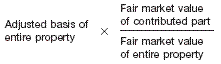
A bargain sale of property to a qualified organization (a sale or exchange for less than the property's fair market value)
is partly a charitable
contribution and partly a sale or exchange.
Part that is a sale or exchange.
The part of the bargain sale that is a sale or exchange may result in a taxable gain. For more information on determining
the amount of any taxable
gain, see Bargain sales to charity in chapter 1 of Publication 544.
Part that is a charitable contribution.
Figure the amount of your charitable contribution in three steps.
Step 1.
Subtract the amount you received for the property from the property's fair market value at the time of sale. This
gives you the fair market value
of the contributed part.
Step 2.
Find the adjusted basis of the contributed part. It equals:
Step 3.
Determine whether the amount of your charitable contribution is the fair market value of the contributed part (which
you found in Step
1) or the adjusted basis of the contributed part (which you found in Step 2). Generally, if the property sold was capital gain
property, your charitable contribution is the fair market value of the contributed part. If it was ordinary income property,
your charitable
contribution is the adjusted basis of the contributed part. See the ordinary income property and capital gain property rules
(discussed earlier) for
more information.
Example.
You sell ordinary income property with a fair market value of $10,000 to a church for $2,000. Your basis is $4,000 and your
adjusted gross income
is $20,000. You make no other contributions during the year. The fair market value of the contributed part of the property
is $8,000 ($10,000 -
$2,000). The adjusted basis of the contributed part is $3,200 ($4,000 × ($8,000 ÷ $10,000)). Because the property is ordinary
income
property, your charitable contribution deduction is limited to the adjusted basis of the contributed part. You can deduct
$3,200.
You may be liable for a penalty if you overstate the value or adjusted basis of donated
property.
20% penalty.
The penalty is 20% of the amount by which you underpaid your tax because of the overstatement, if:
-
The value or adjusted basis claimed on your return is 150% or more of the correct amount, and
-
You underpaid your tax by more than $5,000 because of the overstatement.
40% penalty.
The penalty is 40%, rather than 20%, if:
-
The value or adjusted basis claimed on your return is 200% or more of the correct amount, and
-
You underpaid your tax by more than $5,000 because of the overstatement.
You can deduct your contributions only in the year you actually make them in cash or other property (or in a succeeding carryover
year, as
explained under How To Figure Your Deduction When Limits Apply, later). This applies whether you use the cash or an accrual method of
accounting.
Time of making contribution.
Usually, you make a contribution at the time of its unconditional delivery.
Checks.
A check that you mail to a charity is considered delivered on the date you mail it.
Credit card.
Contributions charged on your bank credit card are deductible in the year you make the charge.
Pay-by-phone account.
If you use a pay-by-phone account, the date you make a contribution is the date the financial institution pays the
amount. This date should be
shown on the statement the financial institution sends to you.
Stock certificate.
The gift to a charity of a properly endorsed stock certificate is completed on the date of mailing or other delivery
to the charity or to the
charity's agent. However, if you give a stock certificate to your agent or to the issuing corporation for transfer to the
name of the charity, your
gift is not completed until the date the stock is transferred on the books of the corporation.
Promissory note.
If you issue and deliver a promissory note to a charitable organization as a contribution, it is not a contribution
until you make the note
payments.
Option.
If you grant an option to buy real property at a bargain price to a charitable organization, you cannot take a deduction
until the organization
exercises the option.
Borrowed funds.
If you make a contribution with borrowed funds, you can deduct the contribution in the year you make it, regardless
of when you repay the loan.
Conditional gift.
If your contribution is a conditional gift that depends on a future act or event that may not take place, you cannot
take a deduction. But if there
is only a negligible chance that the act or event will not take place, you can take a deduction.
If your contribution would be undone by a later act or event, you cannot take a deduction. But if there is only a
negligible chance the act or
event will take place, you can take a deduction.
Example 1.
You donate cash to a local school board, which is a political subdivision of a state, to help build a school gym. The school
board will refund the
money to you if it does not collect enough to build the gym. You cannot deduct your gift as a charitable contribution until
there is no chance of a
refund.
Example 2.
You donate land to a city for as long as the city uses it for a public park. The city does plan to use the land for a park,
and there is no chance
(or only a negligible chance) of the land being used for any different purpose. You can deduct your charitable contribution.
If your total contributions for the year are 20% or less of your adjusted gross income, you do not need to read this section.
The limits discussed
here do not apply to you.
The amount of your deduction is limited to 50% of your adjusted gross income, and may be limited to 30% or 20% of your adjusted
gross income,
depending on the type of property you give and the type of organization you give it to. A different limit applies to certain
qualified conservation
contributions. These limits are described in detail in this section.
Your adjusted gross income is the amount on Form 1040, line 38.
If your contributions are more than any of the limits that apply, see Carryovers under How To Figure Your Deduction When Limits
Apply, later.
Out-of-pocket expenses.
Amounts you spend performing services for a charitable organization, which qualify as charitable contributions, are
subject to the limit of the
organization. For example, the 50% limit applies to amounts you spend on behalf of a church, a 50% limit organization. These
amounts are considered a
contribution to a qualified organization.
Limit on itemized deductions.
For 2007, the total of your charitable contributions deduction and certain other itemized deductions may be limited
if your adjusted gross income
is more than $156,400 ($78,200 if you are married filing separately). This is in addition to the other limits described here.
See the instructions for
Schedule A (Form 1040) for more information about this limit.
The 50% limit applies to the total of all charitable contributions you make during the year. This means that your deduction
for charitable
contributions cannot be more than 50% of your adjusted gross income for the year. But there is a higher limit, discussed later,
for certain qualified
conservation contributions.
Only limit for 50% organizations.
The 50% limit is the only limit that applies to gifts to organizations listed below under 50% Limit Organizations. But there is one
exception.
Exception.
A special 30% limit also applies to these gifts if they are gifts of capital gain property for which you figure your
deduction using fair market
value without reduction for appreciation. (See Special 30% Limit for Capital Gain Property, later.)
You can ask any organization whether it is a 50% limit organization, and most will be able to tell you. Or you may check IRS
Publication 78
(described earlier).
Only the following types of organizations are 50% limit organizations.
-
Churches, and conventions or associations of churches.
-
Educational organizations with a regular faculty and curriculum that normally have a regularly enrolled student body attending
classes on
site.
-
Hospitals and certain medical research organizations associated with these hospitals.
-
Organizations that are operated only to receive, hold, invest, and administer property and to make expenditures to or for
the benefit of
state and municipal colleges and universities and that normally receive substantial support from the United States or any
state or their political
subdivisions, or from the general public.
-
The United States or any state, the District of Columbia, a U.S. possession (including Puerto Rico), a political subdivision
of a state or
U.S. possession, or an Indian tribal government or any of its subdivisions that perform substantial government functions.
-
Corporations, trusts, or community chests, funds, or foundations organized and operated only for charitable, religious, educational,
scientific, or literary purposes, or to prevent cruelty to children or animals, or to foster certain national or international
amateur sports
competition. These organizations must be “publicly supported,” which means they normally must receive a substantial part of their support, other
than income from their exempt activities, from direct or indirect contributions from the general public or from governmental
units.
-
Organizations that may not qualify as “publicly supported” under (6) but that meet other tests showing they respond to the needs of the
general public, not a limited number of donors or other persons. They must normally receive more than one-third of their support
either from
organizations described in (1) through (6), or from persons other than “disqualified persons.”
-
Most organizations operated or controlled by, and operated for the benefit of, those organizations described in (1) through
(7).
-
Private operating foundations.
-
Private nonoperating foundations that make qualifying distributions of 100% of contributions within 2½ months following the
year they receive the contribution. A deduction for charitable contributions to any of these private nonoperating foundations
must be supported by
evidence from the foundation confirming that it made the qualifying distributions timely. Attach a copy of this supporting
data to your tax return.
-
A private foundation whose contributions are pooled into a common fund, if the foundation would be described in (8) above
but for the right
of substantial contributors to name the public charities that receive contributions from the fund. The foundation must distribute
the common fund's
income within 2½ months following the tax year in which it was realized and must distribute the corpus not later than 1 year
after the
donor's death (or after the death of the donor's surviving spouse if the spouse can name the recipients of the corpus).
A 30% limit applies to the following gifts.
-
Gifts to all qualified organizations other than 50% limit organizations. This includes gifts to veterans' organizations, fraternal
societies, nonprofit cemeteries, and certain private nonoperating foundations.
-
Gifts for the use of any organization.
However, if these gifts are of capital gain property, they are subject to the 20% limit, described later, rather than the
30% limit.
Student living with you.
Amounts you spend on behalf of a student living with you are subject to the 30% limit. These amounts are considered
a contribution for the use of a
qualified organization.
Special 30% Limit for Capital Gain Property
A special 30% limit applies to gifts of capital gain property to 50% limit organizations. (For gifts of capital gain property
to other
organizations, see 20% Limit, next.) However, the special 30% limit does not apply when you choose to reduce the fair market value of the
property by the amount that would have been long-term capital gain if you had sold the property. Instead, only the 50% limit
applies. See Capital
Gain Property, earlier, and Capital gain property election under How To Figure Your Deduction When Limits Apply, later.
Also, the special 30% limit does not apply to qualified conservation contributions, discussed later.
Two separate 30% limits.
This special 30% limit for capital gain property is separate from the other 30% limit. Therefore, the deduction of
a contribution subject to one
30% limit does not reduce the amount you can deduct for contributions subject to the other 30% limit. However, the total you
deduct cannot be more
than 50% of your adjusted gross income.
Example.
Your adjusted gross income is $50,000. During the year, you gave capital gain property with a fair market value of $15,000
to a 50% limit
organization. You do not choose to reduce the property's fair market value by its appreciation in value. You also gave $10,000
cash to a qualified
organization that is not a 50% limit organization. The $15,000 gift of property is subject to the special 30% limit. The $10,000
cash gift is subject
to the other 30% limit. Both gifts are fully deductible because neither is more than the 30% limit that applies ($15,000 in
each case) and together
they are not more than the 50% limit ($25,000).
The 20% limit applies to all gifts of capital gain property to or for the use of qualified organizations (other than gifts
of capital gain property
to 50% limit organizations).
Special 50% Limit for Qualified Conservation Contributions
Your deduction for qualified conservation contributions (QCCs) is limited to 50% of your adjusted gross income minus your
deduction for all other
charitable contributions. You can carry over any contributions you are not able to deduct for 2007 because of this limit.
See Carryovers,
later.
100% limit for QCCs of farmers and ranchers.
If you are a qualified farmer or rancher, your deduction for QCCs is limited to 100%, rather than 50%, of your adjusted
gross income minus your
deduction for all other charitable contributions. However, if the donated property is used in agriculture or livestock production
(or is available for
such production), the contribution must be subject to a restriction that the property remain available for such production.
If not, the limit is 50%.
Qualified farmer or rancher.
You are a qualified farmer or rancher if your gross income from the trade or business of farming is more than 50%
of your gross income for the
year.
How To Figure Your Deduction When Limits Apply
If your contributions are subject to more than one of the limits just discussed, you can deduct them as follows.
-
Contributions subject only to the 50% limit, up to 50% of your adjusted gross income.
-
Contributions subject to the 30% limit, up to the lesser of:
-
30% of adjusted gross income, or
-
50% of adjusted gross income minus your contributions to 50% limit organizations, including contributions of capital gain
property subject
to the special 30% limit.
-
Contributions of capital gain property subject to the special 30% limit, up to the lesser of:
-
30% of adjusted gross income, or
-
50% of adjusted gross income minus your other contributions to 50% limit organizations.
-
Contributions subject to the 20% limit, up to the lesser of:
-
20% of adjusted gross income,
-
30% of adjusted gross income minus your contributions subject to the 30% limit,
-
30% of adjusted gross income minus your contributions of capital gain property subject to the special 30% limit, or
-
50% of adjusted gross income minus the total of your contributions to 50% limit organizations and your contributions subject
to the 30%
limit.
-
Qualified conservation contributions (QCCs) subject to the special 50% limit, up to 50% of adjusted gross income minus any
contributions in
(1) through (4) above.
-
QCCs subject to the 100% limit for farmers and ranchers, up to 100% of adjusted gross income minus all your other contributions.
If more than one of the limits described above limit your deduction for charitable contributions, you may want to use Worksheet
2 on page 15 to
figure your deduction and your carryover.
Example.
Your adjusted gross income is $50,000. In May, you gave your church $2,000 cash and land with a fair market value of $28,000
and a basis of
$22,000. You held the land for investment purposes. You do not choose to reduce the fair market value of the land by the appreciation
in value. You
also gave $5,000 cash to a private foundation to which the 30% limit applies.
The $2,000 cash donated to the church is considered first and is fully deductible. Your contribution to the private foundation
is considered next.
Because your contributions to 50% limit organizations ($2,000 + $28,000) are more than $25,000 (50% of $50,000), your contribution
to the private
foundation is not deductible for the year. It can be carried over to later years. See Carryovers, later. The gift of land is considered
next. Your deduction for the land is limited to $15,000 (30% × $50,000). The unused part of the gift of land ($13,000) can
be carried over. For
this year, your deduction is limited to $17,000 ($2,000 + $15,000).
A Filled-In Worksheet 2 on page 16 shows this computation in detail.
Capital gain property election.
You may choose the 50% limit for gifts of capital gain property to 50% limit organizations instead of the 30% limit
that would otherwise apply. If
you make this choice, you must reduce the fair market value of the property contributed by the appreciation in value that
would have been long-term
capital gain if the property had been sold.
This choice applies to all capital gain property contributed to 50% limit organizations during a tax year. It also
applies to carryovers of this
kind of contribution from an earlier tax year. For details, see Carryover of capital gain property, later.
You must make the choice on your original return or on an amended return filed by the due date for filing the original
return.
Example.
In the previous example, if you choose to have the 50% limit apply to the land (the 30% capital gain property) given to your
church, you must
reduce the fair market value of the property by the appreciation in value. Therefore, the amount of your charitable contribution
for the land would be
its basis to you of $22,000. You add this amount to the $2,000 cash contributed to the church. You can now deduct $1,000 of
the amount donated to the
private foundation because your contributions to 50% limit organizations ($2,000 + $22,000) are $1,000 less than the 50%-of-adjusted-gross-income
limit. Your total deduction for the year is $25,000 ($2,000 cash to your church, $22,000 for property donated to your church,
and $1,000 cash to the
private foundation). You can carry over to later years the part of your contribution to the private foundation that you could
not deduct ($4,000).
Instructions for Worksheet 2
You can use Worksheet 2 if you made charitable contributions during the year, and one or more of the limits described in this
publication under
Limits on Deductions apply to you. You cannot use this worksheet if you have a carryover of a charitable contribution from an earlier year.
The following list gives instructions for completing the worksheet.
-
The terms used in the worksheet are explained earlier in this publication.
-
If the result on any line is less than zero, enter zero.
-
For contributions of property, enter the property's fair market value unless you elected (or were required) to reduce the
fair market value
as explained under Giving Property That Has Increased in Value. In that case, enter the reduced amount.
You can carry over your contributions that you are not able to deduct in the current year because they exceed your adjusted-gross-income
limits.
You can deduct the excess in each of the next 5 years until it is used up, but not beyond that time. Your total contributions
deduction for the year
to which you carry your contributions cannot exceed 50% of your adjusted gross income for that year.
A carryover of a qualified conservation contribution can be carried forward for 15 years.
Contributions you carry over are subject to the same percentage limits in the year to which they are carried. For example,
contributions subject to
the 20% limit in the year in which they are made are 20% limit contributions in the year to which they are carried.
For each category of contributions, you deduct carryover contributions only after deducting all allowable contributions in
that category for the
current year. If you have carryovers from 2 or more prior years, use the carryover from the earlier year first.
Note.
A carryover of a contribution to a 50% limit organization must be used before contributions in the current year to organizations
other than 50%
limit organizations. See Example 2 on this page.
Example 1.
Last year, you contributed $11,000 to a 50% limit organization, but because of the limit you deducted only $10,000 and carried
over $1,000 to this
year. This year, your adjusted gross income is $20,000 and you contribute $9,500 to a 50% limit organization. You can deduct
$10,000 (50% of $20,000)
this year. Consequently, in addition to your contribution of $9,500 for this year, you can deduct $500 of your carryover contribution
from last year.
You can carry over the $500 balance of your carryover from last year to next year.
Example 2.
This year, your adjusted gross income is $24,000. You make cash contributions of $6,000 to which the 50% limit applies and
$3,000 to which the 30%
limit applies. You have a contribution carryover from last year of $5,000 for capital gain property contributed to a 50% limit
organization and
subject to the special 30% limit for contributions of capital gain property.
Your contribution deduction for this year is limited to $12,000 (50% of $24,000). Your 50% limit cash contributions of $6,000
are fully deductible.
The deduction for your 30% limit contributions of $3,000 is limited to $1,000. This is the lesser of:
-
$7,200 (30% of $24,000), or
-
$1,000 ($12,000 minus $11,000).
(The $12,000 amount is 50% of $24,000, your adjusted gross income. The $11,000 amount is the sum of your current and carryover
contributions to
50% limit organizations, $6,000 + $5,000.)
The deduction for your $5,000 carryover is subject to the special 30% limit for contributions of capital gain property. This
means it is limited to
the smaller of:
-
$7,200 (your 30% limit), or
-
$6,000 ($12,000, your 50% limit, minus $6,000, the amount of your cash contributions to 50% limit organizations this year).
Since your $5,000 carryover is less than both $7,200 and $6,000, you can deduct it in full.
Your deduction is $12,000 ($6,000 + $1,000 + $5,000). You carry over the $2,000 balance of your 30% limit contributions for
this year to next year.
Carryover of capital gain property.
If you carry over contributions of capital gain property subject to the special 30% limit and you choose in the next
year to use the 50% limit and
take appreciation into account, you must refigure the carryover. You reduce the fair market value of the property by the appreciation
and reduce that
result by the amount actually deducted in the previous year.
Example.
Last year, your adjusted gross income was $50,000 and you contributed capital gain property valued at $27,000 to a 50% limit
organization and did
not choose to use the 50% limit. Your basis in the property was $20,000. Your deduction was limited to $15,000 (30% of $50,000),
and you carried over
$12,000. This year, your adjusted gross income is $60,000 and you contribute capital gain property valued at $25,000 to a
50% limit organization. Your
basis in the property is $24,000 and you choose to use the 50% limit. You must refigure your carryover as if you had taken
appreciation into account
last year as well as this year. Because the amount of your contribution last year would have been $20,000 (the property's
basis) instead of the
$15,000 you actually deducted, your refigured carryover is $5,000 ($20,000 - $15,000). Your total deduction this year is $29,000
(your $24,000
current contribution plus your $5,000 carryover).
Additional rules for carryovers.
Special rules exist for computing carryovers if you:
-
Were married in some years but not others,
-
Had different spouses in different years,
-
Change from a separate return to a joint return in a later year,
-
Change from a joint return to a separate return in a later year,
-
Had a net operating loss,
-
Claim the standard deduction in a carryover year, or
-
Become a widow or widower.
Because of their complexity and the limited number of taxpayers to whom these additional rules apply, they are not discussed
in this
publication. If you need to compute a carryover and you are in one of these situations, you may want to consult with a tax
practitioner.
You must keep records to prove the amount of the contributions you make during the year. The kind of records you must keep
depends on the amount of
your contributions and whether they are:
Note.
An organization generally must give you a written statement if it receives a payment from you that is more than $75 and is
partly a contribution
and partly for goods or services. (See Contributions From Which You Benefit under Contributions You Can Deduct, earlier.) Keep
the statement for your records. It may satisfy all or part of the recordkeeping requirements explained in the following discussions.
Cash contributions include those paid by cash, check, electronic funds transfer, credit card, or payroll deduction.
You cannot deduct a cash contribution, regardless of the amount, unless you keep one of the following.
-
A bank record that shows the name of the qualified organization, the date of the contribution, and the amount of the contribution.
Bank
records may include:
-
A canceled check,
-
A bank or credit union statement, or
-
A credit card statement.
-
A receipt (or a letter or other written communication) from the qualified organization showing the name of the organization,
the date of the
contribution, and the amount of the contribution.
-
The payroll deduction records described next.
Payroll deductions.
If you make a contribution by payroll deduction, you must keep:
-
A pay stub, Form W-2, or other document furnished by your employer that shows the date and amount of the contribution, and
-
A pledge card or other document prepared by or for the qualified organization that shows the name of the organization.
If your employer withheld $250 or more from a single paycheck, see Contributions of $250 or More, next.
Contributions of $250 or More
You can claim a deduction for a contribution of $250 or more only if you have an acknowledgment of your contribution from
the qualified
organization or certain payroll deduction records.
If you made more than one contribution of $250 or more, you must have either a separate acknowledgment for each or one acknowledgment
that lists
each contribution and the date of each contribution and shows your total contributions.
Amount of contribution.
In figuring whether your contribution is $250 or more, do not combine separate contributions. For example, if you
gave your church $25 each week,
your weekly payments do not have to be combined. Each payment is a separate contribution.
If contributions are made by payroll deduction, the deduction from each paycheck is treated as a separate contribution.
If you made a payment that is partly for goods and services, as described earlier under Contributions From Which You Benefit, your
contribution is the amount of the payment that is more than the value of the goods and services.
Acknowledgment.
The acknowledgment must meet these tests.
-
It must be written.
-
It must include:
-
The amount of cash you contributed,
-
Whether the qualified organization gave you any goods or services as a result of your contribution (other than certain token
items and
membership benefits),
-
A description and good faith estimate of the value of any goods or services described in (b) (other than intangible religious
benefits), and
-
A statement that the only benefit you received was an intangible religious benefit, if that was the case. The acknowledgment
does not need
to describe or estimate the value of an intangible religious benefit. An intangible religious benefit is a benefit that generally
is not sold in
commercial transactions outside a donative (gift) context. An example is admission to a religious ceremony.
-
You must get it on or before the earlier of:
-
The date you file your return for the year you make the contribution, or
-
The due date, including extensions, for filing the return.
If the acknowledgment does not show the date of the contribution, you must also have a bank record or receipt, as
described earlier, that does show
the date of the contribution. If the acknowledgment does show the date of the contribution and meets the other tests just
described, you do not need
any other records.
Payroll deductions.
If you make a contribution by payroll deduction and your employer withheld $250 or more from a single paycheck, you
must keep:
-
A pay stub, Form W-2, or other document furnished by your employer that shows the amount withheld as a contribution, and
-
A pledge card or other document prepared by or for the qualified organization that shows the name of the organization and
states the
organization does not provide goods or services in return for any contribution made to it by payroll deduction.
A single pledge card may be kept for all contributions made by payroll deduction regardless of amount as long as it contains
all the required
information.
If the pay stub, Form W-2, pledge card, or other document does not show the date of the contribution, you must also
have another document that does
show the date of the contribution. If the pay stub, Form W-2, pledge card, or other document does show the date of the contribution,
you do not need
any other records except those just described in (1) and (2).
For a contribution not made in cash, the records you must keep depend on whether your deduction for the contribution is:
-
Less than $250,
-
At least $250 but not more than $500,
-
Over $500 but not more than $5,000, or
-
Over $5,000.
Amount of deduction.
In figuring whether your deduction is $500 or more, combine your claimed deductions for all similar items of property
donated to any charitable
organization during the year.
If you got goods or services in return, as described earlier in Contributions From Which You Benefit, reduce your contribution by the
value of those goods or services. If you figure your deduction by reducing the fair market value of the donated property by
its appreciation, as
described earlier in Giving Property That Has Increased in Value, your contribution is the reduced amount.
Deductions of Less Than $250
If you make any noncash contribution, you must get and keep a receipt from the charitable organization showing:
-
The name of the charitable organization,
-
The date and location of the charitable contribution, and
-
A reasonably detailed description of the property.
A letter or other written communication from the charitable organization acknowledging receipt of the contribution and containing
the
information in (1), (2), and (3) will serve as a receipt.
You are not required to have a receipt where it is impractical to get one (for example, if you leave property at a charity's
unattended drop site).
Additional records.
You must also keep reliable written records for each item of donated property. Your written records must include the
following information.
-
The name and address of the organization to which you contributed.
-
The date and location of the contribution.
-
A description of the property in detail reasonable under the circumstances. For a security, keep the name of the issuer, the
type of
security, and whether it is regularly traded on a stock exchange or in an over-the-counter market.
-
The fair market value of the property at the time of the contribution and how you figured the fair market value. If it was
determined by
appraisal, you should also keep a copy of the signed appraisal.
-
The cost or other basis of the property if you must reduce its fair market value by appreciation. Your records should also
include the
amount of the reduction and how you figured it. If you choose the 50% limit instead of the special 30% limit on certain capital
gain property
(discussed under Capital gain property election, earlier), you must keep a record showing the years for which you made the choice,
contributions for the current year to which the choice applies, and carryovers from preceding years to which the choice applies.
-
The amount you claim as a deduction for the tax year as a result of the contribution, if you contribute less than your entire
interest in
the property during the tax year. Your records must include the amount you claimed as a deduction in any earlier years for
contributions of other
interests in this property. They must also include the name and address of each organization to which you contributed the
other interests, the place
where any such tangible property is located or kept, and the name of any person in possession of the property, other than
the organization to which
you contributed.
-
The terms of any conditions attached to the gift of property.
Deductions of At Least $250 But Not More Than $500
If you claim a deduction of at least $250 but not more than $500 for a noncash charitable contribution, you must get and keep
an acknowledgment of
your contribution from the qualified organization. If you made more than one contribution of $250 or more, you must have either
a separate
acknowledgment for each or one acknowledgment that shows your total contributions.
The acknowledgment must contain the information in items (1) through (3) listed under Deductions of Less Than $250, earlier, and your
written records must include the information listed in that discussion under Additional records.
The acknowledgment must also meet these tests.
-
It must be written.
-
It must include:
-
A description (but not necessarily the value) of any property you contributed,
-
Whether the qualified organization gave you any goods or services as a result of your contribution (other than certain token
items and
membership benefits), and
-
A description and good faith estimate of the value of any goods or services described in (b). If the only benefit you received
was an
intangible religious benefit (such as admission to a religious ceremony) that generally is not sold in a commercial transaction
outside the donative
context, the acknowledgment must say so and does not need to describe or estimate the value of the benefit.
-
You must get it on or before the earlier of:
-
The date you file your return for the year you make the contribution, or
-
The due date, including extensions, for filing the return.
Deductions Over $500 But Not Over $5,000
If you claim a deduction over $500 but not over $5,000 for a noncash charitable contribution, you must have the acknowledgment
and written records
described under Deductions of At Least $250 But Not More Than $500. Your records must also include:
-
How you got the property, for example, by purchase, gift, bequest, inheritance, or exchange.
-
The approximate date you got the property or, if created, produced, or manufactured by or for you, the approximate date the
property was
substantially completed.
-
The cost or other basis, and any adjustments to the basis, of property held less than 12 months and, if available, the cost
or other basis
of property held 12 months or more. This requirement, however, does not apply to publicly traded securities.
If you are not able to provide information on either the date you got the property or the cost basis of the property and you
have a reasonable
cause for not being able to provide this information, attach a statement of explanation to your return.
If you claim a deduction of over $5,000 for a charitable contribution of one property item or a group of similar property
items, you must have the
acknowledgment and the written records described under Deductions Over $500 But Not Over $5,000. In figuring whether your deduction is over
$5,000, combine your claimed deductions for all similar items donated to any charitable organization during the year.
Generally, you must also obtain a qualified written appraisal of the donated property from a qualified appraiser. See Deductions of More Than
$5,000 in Publication 561 for more information.
Qualified Conservation Contribution
If the gift was a “qualified conservation contribution,” your records must also include the fair market value of the underlying property
before and after the gift and the conservation purpose furthered by the gift.
For more information see Qualified Conservation Contribution, earlier, and in Publication 561.
If you render services to a qualified organization and have unreimbursed out-of-pocket expenses related to those services,
the following three
rules apply.
-
You must have adequate records to prove the amount of the expenses.
-
You must get an acknowledgment from the qualified organization that contains:
-
A description of the services you provided,
-
A statement of whether or not the organization provided you any goods or services to reimburse you for the expenses you
incurred,
-
A description and a good faith estimate of the value of any goods or services (other than intangible religious benefits) provided
to
reimburse you, and
-
A statement that the only benefit you received was an intangible religious benefit, if that was the case. The acknowledgment
does not need
to describe or estimate the value of an intangible religious benefit (defined earlier under Acknowledgment).
-
You must get the acknowledgment on or before the earlier of:
-
The date you file your return for the year you make the contribution, or
-
The due date, including extensions, for filing the return.
Car expenses.
If you claim expenses directly related to use of your car in giving services to a qualified organization, you must
keep reliable written records of
your expenses. Whether your records are considered reliable depends on all the facts and circumstances. Generally, they may
be considered reliable if
you made them regularly and at or near the time you had the expenses.
Your records must show the name of the organization you were serving and the date each time you used your car for
a charitable purpose. If you use
the standard mileage rate of 14 cents a mile, your records must show the miles you drove your car for the charitable purpose.
If you deduct your
actual expenses, your records must show the costs of operating the car that are directly related to a charitable purpose.
See Car expenses under Out-of-Pocket Expenses in Giving Services, earlier, for the expenses you can deduct.
Report your charitable contributions on lines 16 through 19 of Schedule A (Form 1040).
If you made noncash contributions, you may also be required to fill out parts of Form 8283. See Noncash contributions, later.
Cash contributions and out-of-pocket expenses.
Enter your cash contributions, including out-of-pocket expenses, on Schedule A (Form 1040), line 16.
Reporting expenses for student living with you.
If you claim amounts paid for a student who lives with you, as described earlier under Expenses Paid for Student Living With You, you
must submit with your return:
-
A copy of your agreement with the organization sponsoring the student placed in your household,
-
A summary of the various items you paid to maintain the student, and
-
A statement that gives:
-
The date the student became a member of your household,
-
The dates of his or her full-time attendance at school, and
-
The name and location of the school.
Noncash contributions.
Enter your noncash contributions on Schedule A (Form 1040), line 17.
Total deduction over $500.
If your total deduction for all noncash contributions for the year is over $500, you must complete Section A of Form
8283,
and attach it to your Form 1040. However, do not complete Section A for items you must report on Section B. See
Deduction over $5,000 for one item, next, for the items you must report on Section B.
The Internal Revenue Service can disallow your deduction for noncash charitable contributions if it is more than $500
and you do not submit a
required Form 8283 with your return.
Deduction over $5,000 for one item.
You must complete Section B of Form 8283 for each item or group of items for which you claim a deduction of over $5,000.
(However, if you
contributed certain publicly traded securities, complete Section A instead.) In figuring whether your deduction is over $5,000,
combine the claimed
deductions for all similar items donated to any charitable organization during the year. The organization that received the
property must complete and
sign Part IV of Section B.
Vehicle donations.
If you donated a car, boat, airplane, or other vehicle, you generally must attach a copy of Form 1098-C (or other
statement) to your return. For
details, see Cars, Boats, and Airplanes, earlier.
Clothing and household items not in good used condition.
You must include with your return a qualified appraisal of any single donated item of clothing or any donated household
item that is not in good
used condition or better and for which you deduct more than $500. See Clothing and Household Items, earlier.
Easement on building in historic district.
If you claim a deduction for a qualified conservation contribution for an easement on the exterior of a building in
a registered historic district,
you must include a qualified appraisal, photographs, and certain other information with your return. See Qualified Conservation Contribution,
earlier.
Deduction over $500,000.
If you claim a deduction of more than $500,000 for a contribution of property, you must attach a qualified appraisal
of the property to your
return. This does not apply to contributions of cash, inventory, publicly traded stock, or intellectual property.
In figuring whether your deduction is over $500,000, combine the claimed deductions for all similar items donated
to any charitable organization
during the year.
If you do not attach the appraisal, you cannot deduct your contribution, unless your failure to attach it is due to
reasonable cause and not to
willful neglect.
Form 8282.
If an organization, within 3 years after the date of receipt of a contribution of property for which it was required
to sign a Form 8283, sells,
exchanges, or otherwise disposes of the property, the organization must file an information return with the Internal Revenue
Service on
Form 8282, Donee Information Return, and send you a copy of the form. However, if you have informed the organization
that the appraised value of the donated item, or a specific item within a group of similar items, is $500 or less, the organization
is not required to
make a report on its sale of that item. For this purpose, all shares of nonpublicly traded stock or securities, or items that
form a set, are
considered to be one item.
You can get help with unresolved tax issues, order free publications and forms, ask tax questions, and get information from
the IRS in several
ways. By selecting the method that is best for you, you will have quick and easy access to tax help.
Contacting your Taxpayer Advocate.
The Taxpayer Advocate Service (TAS) is an independent organization within the IRS whose employees assist taxpayers
who are experiencing economic
harm, who are seeking help in resolving tax problems that have not been resolved through normal channels, or who believe that
an IRS system or
procedure is not working as it should.
You can contact the TAS by calling the TAS toll-free case intake line at 1-877-777-4778 or TTY/TDD 1-800-829-4059
to see if you are eligible for
assistance. You can also call or write to your local taxpayer advocate, whose phone number and address are listed in your
local telephone directory
and in Publication 1546, Taxpayer Advocate Service - Your Voice at the IRS. You can file Form 911, Request for Taxpayer Advocate
Service
Assistance (And Application for Taxpayer Assistance Order), or ask an IRS employee to complete it on your behalf. For more
information, go to
www.irs.gov/advocate.
Taxpayer Advocacy Panel (TAP).
The TAP listens to taxpayers, identifies taxpayer issues, and makes suggestions for improving IRS services and customer
satisfaction. If you have
suggestions for improvements, contact the TAP, toll free at 1-888-912-1227 or go to
www.improveirs.org.
Low Income Taxpayer Clinics (LITCs).
LITCs are independent organizations that provide low income taxpayers with representation in federal tax controversies
with the IRS for free or for
a nominal charge. The clinics also provide tax education and outreach for taxpayers with limited English proficiency or who
speak English as a second
language. Publication 4134, Low Income Taxpayer Clinic List, provides information on clinics in your area. It is available
at
www.irs.gov or at your local IRS office.
Free tax services.
To find out what services are available, get Publication 910, IRS Guide to Free Tax Services. It contains a list of
free tax publications and
describes other free tax information services, including tax education and assistance programs and a list of TeleTax topics.
Accessible versions of IRS published products are available on request in a variety of alternative formats for people
with disabilities.
Internet. You can access the IRS website at
www.irs.gov 24 hours a day, 7 days a week to:
-
E-file your return. Find out about commercial tax preparation and e-file services available free to eligible
taxpayers.
-
Check the status of your 2007 refund. Click on Where's My Refund. Wait at least 6 weeks from the date you filed your return (3
weeks if you filed electronically). Have your 2007 tax return available because you will need to know your social security
number, your filing status,
and the exact whole dollar amount of your refund.
-
Download forms, instructions, and publications.
-
Order IRS products online.
-
Research your tax questions online.
-
Search publications online by topic or keyword.
-
View Internal Revenue Bulletins (IRBs) published in the last few years.
-
Figure your withholding allowances using the withholding calculator online at
www.irs.gov/individuals.
-
Determine if Form 6251 must be filed using our Alternative Minimum Tax (AMT) Assistant.
-
Sign up to receive local and national tax news by email.
-
Get information on starting and operating a small business.
Phone. Many services are available by phone.
-
Ordering forms, instructions, and publications. Call 1-800-829-3676 to order current-year forms, instructions, and publications,
and prior-year forms and instructions. You should receive your order within 10 days.
-
Asking tax questions. Call the IRS with your tax questions at 1-800-829-1040.
-
Solving problems. You can get face-to-face help solving tax problems every business day in IRS Taxpayer Assistance Centers. An
employee can explain IRS letters, request adjustments to your account, or help you set up a payment plan. Call your local
Taxpayer Assistance Center
for an appointment. To find the number, go to
www.irs.gov/localcontacts or
look in the phone book under United States Government, Internal Revenue Service.
-
TTY/TDD equipment. If you have access to TTY/TDD equipment, call 1-800-829-4059 to ask tax questions or to order forms and
publications.
-
TeleTax topics. Call 1-800-829-4477 to listen to pre-recorded messages covering various tax topics.
-
Refund information. To check the status of your 2007 refund, call 1-800-829-4477 and press 1 for automated refund information or
call 1-800-829-1954. Be sure to wait at least 6 weeks from the date you filed your return (3 weeks if you filed electronically).
Have your 2007 tax
return available because you will need to know your social security number, your filing status, and the exact whole dollar
amount of your refund.
Evaluating the quality of our telephone services. To ensure IRS representatives give accurate, courteous, and professional answers, we
use several methods to evaluate the quality of our telephone services. One method is for a second IRS representative to listen
in on or record random
telephone calls. Another is to ask some callers to complete a short survey at the end of the call.
Walk-in. Many products and services are available on a walk-in basis.
-
Products. You can walk in to many post offices, libraries, and IRS offices to pick up certain forms, instructions, and
publications. Some IRS offices, libraries, grocery stores, copy centers, city and county government offices, credit unions,
and office supply stores
have a collection of products available to print from a CD or photocopy from reproducible proofs. Also, some IRS offices and
libraries have the
Internal Revenue Code, regulations, Internal Revenue Bulletins, and Cumulative Bulletins available for research purposes.
-
Services. You can walk in to your local Taxpayer Assistance Center every business day for personal, face-to-face tax help. An
employee can explain IRS letters, request adjustments to your tax account, or help you set up a payment plan. If you need
to resolve a tax problem,
have questions about how the tax law applies to your individual tax return, or you're more comfortable talking with someone
in person, visit your
local Taxpayer Assistance Center where you can spread out your records and talk with an IRS representative face-to-face. No
appointment is necessary,
but if you prefer, you can call your local Center and leave a message requesting an appointment to resolve a tax account issue.
A representative will
call you back within 2 business days to schedule an in-person appointment at your convenience. To find the number, go to
www.irs.gov/localcontacts or
look in the phone book under United States Government, Internal Revenue Service.
Mail. You can send your order for forms, instructions, and publications to the address below. You should receive a response within
10
days after your request is received.
National Distribution Center
P.O. Box 8903
Bloomington, IL 61702-8903
CD/DVD for tax products. You can order Publication 1796, IRS Tax Products CD/DVD, and obtain:
-
Current-year forms, instructions, and publications.
-
Prior-year forms, instructions, and publications.
-
Bonus: Historical Tax Products DVD - Ships with the final release.
-
Tax Map: an electronic research tool and finding aid.
-
Tax law frequently asked questions.
-
Tax Topics from the IRS telephone response system.
-
Fill-in, print, and save features for most tax forms.
-
Internal Revenue Bulletins.
-
Toll-free and email technical support.
-
The CD which is released twice during the year.
- The first release will ship the beginning of January 2008.
- The final release will ship the beginning of March 2008.
Purchase the CD/DVD from National Technical Information Service (NTIS) at
www.irs.gov/cdorders for $35 (no handling fee) or call 1-877-CDFORMS (1-877-233-6767) toll free to buy the CD/DVD for $35 (plus a $5
handling fee). Price is subject to change.
CD for small businesses. Publication 3207, The Small Business Resource Guide CD for 2007, is a must for every small business owner or
any taxpayer about to start a business. This year's CD includes:
-
Helpful information, such as how to prepare a business plan, find financing for your business, and much more.
-
All the business tax forms, instructions, and publications needed to successfully manage a business.
-
Tax law changes for 2007.
-
Tax Map: an electronic research tool and finding aid.
-
Web links to various government agencies, business associations, and IRS organizations.
-
“Rate the Product” survey—your opportunity to suggest changes for future editions.
-
A site map of the CD to help you navigate the pages of the CD with ease.
-
An interactive “Teens in Biz” module that gives practical tips for teens about starting their own business, creating a business plan,
and filing taxes.
An updated version of this CD is available each year in early April. You can get a free copy by calling 1-800-829-3676 or
by visiting
www.irs.gov/smallbiz.
Previous | Index | Next
SEARCH:
You can search for information in the entire Tax Prep Help section, or in the entire site. For a more focused search, put your search word(s) in quotes.
Publication Index | Tax Prep Help Main | Home
|
|
 |