| Pub. 80, (Circular SS) |
2005 Tax Year |
Publication 80 - Main Contents
Publication 80 (Circular SS) is for employers whose principal place of business is in the U.S. Virgin Islands, Guam, American
Samoa, or the
Commonwealth of the Northern Mariana Islands, or who have employees who are subject to income tax withholding for any of these
jurisdictions.
Employers and employees in these areas are generally subject to social security and Medicare taxes under the Federal Insurance
Contributions Act
(FICA). This publication summarizes employer responsibilities to collect, pay, and report these taxes.
Whenever the term “United States” is used in this publication, it includes the U.S. Virgin Islands, Guam, American Samoa, and the Commonwealth
of the Northern Mariana Islands.
This publication also provides employers in the U.S. Virgin Islands with a summary of their responsibilities in connection
with the tax under the
Federal Unemployment Tax Act, known as FUTA tax. See section 11.
Except as shown in the table in section 12, social security, Medicare, and FUTA taxes apply to every employer who pays taxable
wages to employees
or who has employees who report tips.
This publication does not include instructions relating to the self-employment tax (for social security and Medicare of self-employed
persons). See
Publication 570, Tax Guide for Individuals With Income From U.S. Possessions, if you need this information.
This publication also does not include instructions relating to income tax withholding. In the U.S. Virgin Islands, Guam,
American Samoa, or the
Commonwealth of the Northern Mariana Islands, contact your local tax department for information about income tax withholding.
See Publication 15
(Circular E), Employer's Tax Guide, for information on U.S. federal income tax withholding.
Note: Employers in the U.S. Virgin Islands may call 1-800-829-4933 for federal employment tax information. If you have access to
TTY/TDD equipment, call
1-800-829-4059 with your tax question or to order forms and publications.
If you are an employer in the Commonwealth of the Northern Mariana Islands, you must contact the Division of Revenue and Taxation,
Capitol Hill,
Saipan, MP 96950, to get Form
W-2CM and the instructions for completing and filing that form.
How To Get Forms and Publications
Internet. You can access the IRS website 24 hours a day, 7 days a week, at
www.irs.gov to:
-
E-file your return. Find out about commercial tax preparation and e-file services available for filing Forms 940 and
941-SS.
-
Download forms, instructions, and publications.
-
Order IRS products online.
-
Research your tax questions online.
-
Search publications online by topic or keyword.
-
View Internal Revenue Bulletins (IRBs) published in the last few years.
-
Send us comments or request help by email.
-
Sign up to receive local and national tax news by email.
-
Get information on starting and operating a small business.
By phone.
U.S. Virgin Islands employers can order forms and publications 24 hours a day, 7 days a week, by calling 1-800-TAX-FORM
(1-800-829-3676). Others
can get IRS forms and publications by writing to the National Distribution Center, P.O. Box 8903, Bloomington, IL 61702-8903.
Comments and Suggestions.
We welcome your comments about this publication and your suggestions for future editions.
You can write to us at the following address:
Internal Revenue Service
TEGE Forms and Publications Branch
SE:W:CAR:MP:T:T
1111 Constitution Ave. NW, IR-6406
Washington, DC 20224
We respond to many letters by telephone. Therefore, it would be helpful if you would include your daytime phone number,
including the area code, in
your correspondence.
You can email us at
*[email protected]. (The asterisk must be included in the
address.) Please put “ Publications Comment” on the subject line. Although we cannot respond individually to each email, we do appreciate your
feedback and will consider your comments as we revise our tax products.
Generally, employees are defined either under common law or under special statutes for certain situations.
Employee status under common law.
Generally, a worker who performs services for you is your employee if you can control what will be done and how it
will be done. This is so even
when you give the employee freedom of action. What matters is that you have the right to control the details of how the services
are performed. See
Publication 15-A, Employer's Supplemental Tax Guide, for more information on how to determine whether an individual providing
services is an
independent contractor or an employee.
Statutory employees.
There are also some special definitions of employees for social security, Medicare, and FUTA taxes.
While the following persons may not be common law employees, they are considered employees for social security and
Medicare purposes if the
conditions under Tests below are met.
a.
An agent (or commission) driver who delivers food or beverages (other than milk) or picks up and delivers laundry
or dry cleaning for someone else.
b.
A full-time life insurance salesperson who sells primarily for one company.
c.
A homeworker who works by the guidelines of the person for whom the work is done, with materials furnished by and
returned to that person or to
someone that person designates.
d.
A traveling or city salesperson (other than an agent-driver or commission-driver) who works full time (except for
sideline sales activities) for
one firm or person getting orders from customers. The orders must be for items for resale or use as supplies in the customer's
business. The customers
must be retailers, wholesalers, contractors, or operators of hotels, restaurants, or other businesses dealing with food or
lodging.
Tests.
Withhold social security and Medicare taxes from statutory employees' wages if all three of the following tests apply.
-
The service contract states or implies that almost all of the services are to be performed personally by them.
-
They have little or no investment in the equipment and property used to perform the services (other than an investment in
transportation
facilities).
-
The services are performed on a continuing basis for the same payer.
Persons in a and d above are also employees for FUTA tax purposes if tests 1 through 3 are met (U.S. Virgin Islands
only).
Publication 15-A gives examples of the employer-employee relationship.
Statutory nonemployees.
Certain direct sellers, real estate agents, and companion sitters are, by law, considered nonemployees. They are generally
treated as self-employed
for employment tax purposes. See Publication 15-A for details.
Treating employees as nonemployees.
If you incorrectly treated an employee as a nonemployee and did not withhold social security and Medicare taxes, you
will be liable for the taxes.
See Internal Revenue Code section 3509 for details.
IRS help.
If you want the IRS to determine if a worker is an employee, file Form
SS-8, Determination of Worker Status for Purposes of Federal Employment Taxes and Income Tax Withholding.
You are an employer of farmworkers if you are a crew leader. A crew leader is a person who furnishes and pays (either on his
or her own behalf or
on behalf of the farm operator) workers to do farmwork for the farm operator. If there is no written agreement between you
and the farm operator
stating that you are his or her employee, and if you pay the workers (either for yourself or for the farm operator), then
you are a crew leader.
2. Employer Identification Number (EIN)
An employer identification number (EIN) is a nine-digit number that the IRS issues. Its format is 00-0000000. It is used to
identify the tax
accounts of employers and certain other organizations and entities that have no employees. Use your EIN on all of the items
that you send to the IRS
and SSA for your business.
If you do not have an EIN, request one on Form
SS-4, Application for Employer Identification Number. Form SS-4 contains information on how to apply for an EIN by
mail, fax, or telephone. You can also apply online at
www.irs.gov/smallbiz.
If you do not have an EIN by the time a return is due and you are filing a paper return, enter “Applied For” and the date that you applied for
it in the space shown for the number. If you took over another employer's business, do not use that employer's EIN.
You should have only one EIN. If you have more than one, write to the IRS at the “without a payment” address in the Instructions for Form
941-SS or Form 943. List the EINs that you have, the name and address to which each number was assigned, and the address of
your principal place of
business. Employers in the U.S. Virgin Islands can call toll-free Business and Specialty Tax Line at 1-800-829-4933 (TTY/TDD
users can call
1-800-829-4059). The IRS will tell you which EIN to use.
For more information, see Publication 1635, Understanding Your EIN, or Publication 583, Starting a Business and Keeping Records.
3. Employee's Social Security Number (SSN)
An employee's social security number (SSN) consists of nine digits separated as follows: 000-00-0000. You must get each employee's
name and SSN
because you must enter them on the employee's wage and tax statement, Form W-2VI, W-2GU, W-2AS, or W-2CM. If you do not report
the employee's correct
name and SSN, you may owe a penalty unless you have reasonable cause. See Publication 1586, Reasonable Cause Regulations and
Requirements for Missing
and Incorrect Name/TINs (including instructions for reading magnetic tape) for more information. You should ask the employee
to show you his or her
social security card. The employee may show the card if it is available. You may, but you are not required to, photocopy the
social security card if
the employee provides it.
If an employee does not have a social security card or needs a new one, the employee should apply for one on Form
SS-5, Application for a Social Security Card, and submit the necessary documentation. See the back cover of this
publication for information on how to get and where to send the form. The employee must complete and sign Form SS-5; it cannot
be filed by the
employer. If your employee has applied for an SSN but has not received the card before you must file your Form W-2 reports
and you are filing your
reports on paper, enter “Applied For” in box d. Enter all zeroes in the SSN block if filing electronically. When the employee receives the SSN,
file Form
W-2c, Corrected Wage and Tax Statement, with SSA to show the employee's SSN.
Verification of social security numbers.
The SSA offers employers and authorized reporting agents several methods for verifying employee SSNs. You can get
more information by visiting
SSA's Employer Reporting Instructions and Information website at
www.socialsecurity.gov/employer and selecting “ Social Security Number Verification.”
Note.
Record the name and number of each employee as they appear on his or her social security card. If the employee does not have
a card, he or she
should apply for one by completing Form SS-5, Application for a Social Security Card. If the name is not correct as shown
on the card (for example,
because of marriage or divorce), the employee should request a corrected card from the SSA. Continue to use the old name until
the employee shows you
the replacement social security card with the corrected name.
Employees who apply for social security cards must supply proof of age, identity, and citizenship. If they are not citizens
of the United States,
they must submit evidence of their alien status.
If SSA issues the employee a replacement card after a name change, or a new card with a different social security number after
a change in alien
work status, file a Form W-2c to correct the name/SSN reported on the most recently filed Form W-2AS, W-2CM, W-2GU, or W-2VI.
It is not necessary to
correct other years if the previous name and SSN were used for years before the most recent Form W-2.
Generally, all wages are subject to social security and Medicare tax (and FUTA tax for U.S. Virgin Islands employers). However,
wages subject to
social security tax and FUTA tax are limited by a wage base amount that you pay to each employee for the year. After you pay
$94,200 to an employee in
2006, including tips, do not withhold social security tax on any amount that you later pay to the employee for the year. The
wage base for FUTA tax is
$7,000 for 2006. All wages are subject to Medicare tax. The wages may be in cash or in other forms, such as an automobile
for personal use. Wages
include salaries, vacation allowances, bonuses, commissions, and fringe benefits. It does not matter how payments are measured
or paid.
See the table in section 12 for exceptions to social security, Medicare, and FUTA taxes on wages. See sections 5 and 6 for
a discussion of how the
rules apply to tips and farmworkers.
Social security and Medicare taxes apply to most payments of sick pay, including payments by third parties such as insurance
companies. Special
rules apply to the reporting of third-party sick pay. For details, see
Publication 15-A.
Determine the value of noncash pay (such as goods, lodging, and meals) by its fair market value. However, see Fringe Benefits below.
Except for farmworkers and household employees, this kind of pay may be subject to social security, Medicare, and FUTA taxes.
Back pay, including retroactive wage increases (but not amounts paid as liquidated damages), is taxed as ordinary wages in
the year paid. For
information on reporting back pay to the Social Security Administration, see
Publication 957, Reporting Back Pay and Special Wage Payments to the Social Security Administration.
Travel and business expenses.
Payments to your employee for travel and other necessary expenses of your business generally are included in taxable
wages if
(a) your employee is not required to or does not substantiate timely those expenses to you with receipts or other documentation,
or (b) you
advance an amount to your employee for business expenses and your employee is not required to or does not return timely any
amount that he or she does
not use for business expenses.
Sick pay.
In general, sick pay is any amount that you pay, under a plan that you take part in, to an employee because of sickness
or injury. These amounts
are sometimes paid by a third party, such as an insurance company. In either case, these payments are subject to social security,
Medicare, and FUTA
taxes (U.S. Virgin Islands only). Sick pay becomes exempt from these taxes after the end of 6 calendar months after the calendar
month the employee
last worked for the employer. Publication 15-A explains the employment tax rules that apply to sick pay, disability benefits,
and similar payments to
employees.
Unless the law provides otherwise, fringe benefits are includible in the gross income of the employee and are subject to employment
taxes. Examples
of fringe benefits include the use of an automobile, aircraft flights that you provide, free or discounted commercial airline
flights, vacations,
discounts on property or services, memberships in country clubs or other social clubs, and tickets to entertainment or sporting
events. In general,
the amount included in the employee's income is the excess of the fair market value of the benefit over the sum of any amount
paid for it by the
employee and any amount excluded by law. For details on fringe benefits, see Publication 15-B, Employer's Tax Guide to Fringe
Benefits.
When fringe benefits are treated as paid.
You can elect to treat taxable noncash fringe benefits (including personal use of an automobile provided by you) as
paid by the pay period,
quarter, or on any other basis that you choose, but they must be treated as paid at least annually. You do not have to make
a formal election of
payment dates or notify the IRS. You do not have to make this election for all employees, and the election can be changed
as often as desired, as long
as all benefits provided in a calendar year are treated as paid no later than December 31 of the calendar year. However, see
Special accounting
rule for fringe benefits provided during November and December below.
You can treat the value of a single taxable noncash fringe benefit as paid on one or more dates in the same calendar
year, even if the employee
gets the entire benefit at one time. However, once you elect the payment dates, you must report the taxes on your return in
the same tax period in
which you treated them as paid. This election does not apply to a fringe benefit where real property or investment personal
property is transferred.
Withholding social security and Medicare taxes on fringe benefits.
You add the value of fringe benefits to regular wages for a payroll period and figure social security and Medicare
taxes on the total.
If you withhold less than the required amount of social security and Medicare taxes from the employee in a calendar
year but report and pay the
proper amount, you may recover the taxes from the employee.
Depositing taxes on fringe benefits.
Once payment dates for taxable noncash fringe benefits are elected, taxes are deposited under the general deposit
rules (discussed in section 8),
including those for timeliness of deposit. You may make a reasonable estimate of the value of the fringe benefits deemed to
be paid on the date(s)
elected, for purposes of meeting the timely deposit requirements. In general, the value of taxable noncash fringe benefits
provided in a calendar year
must be determined by January 31 of the following year.
You may claim a refund of overpayments or elect to have any overpayment applied to the next employment tax return.
If deposits are underpaid, see
Deposit Penalties in section 8.
Valuation of vehicles provided to employees.
If you provide a vehicle to your employees, you may either determine the actual value of the benefit for the entire
calendar year, taking into
account the business use of the vehicle, or consider the entire use for the calendar year as personal and include 100% of
the value of the vehicle in
the employee's income. For reporting information to employees, see the box 14 instructions under Specific Instructions for Forms W-2AS, W-2GU,
and W-2VI on Form W-3SS.
Special accounting rule for fringe benefits provided during November and December.
You may choose to treat the value of taxable noncash fringe benefits provided during November and December as paid
in the next year. However, this
applies only to those benefits that you actually provided during November and December, not to those you merely treated as
paid during those months.
If you use this rule, you must notify each affected employee between the time of the employee's last paycheck of the
calendar year and at or near
the time that you give the employee Form W-2VI, W-2GU, W-2AS, or W-2CM. If you use the special accounting rule, your employee
must also use it for the
same period that you use it. You cannot use this rule for a fringe benefit of real property or tangible or intangible real
property of a kind normally
held for investment that is transferred to your employee.
Tips that your employee receives are generally subject to social security and Medicare withholding. Your employee must report
cash tips to you by
the 10th of the month after the month that the tips are received. The report should include tips that you paid to the employee
from charge receipts.
Also include tips that the employee received directly from customers and other employees, and indirectly (for example, tip
splitting). The report
should not include tips that the employee paid out to other employees. No report is required for months when tips are less
than $20. Your employees
report tips on Form
4070, Employee's Report of Tips to Employer, or on a similar statement. They may also use Form
4070A, Employee's Daily Record of Tips, to keep a record of their tips. Both forms are printed in Publication 1244,
Employee's Daily Record of Tips and Report to Employer, available from the IRS.
The statement must be signed by the employee and must show the following.
-
The employee's name, address, and SSN.
-
The employer's name and address.
-
The month or period that the report covers.
-
The total tips.
You must collect the employee social security and Medicare taxes on the employee's tips. You can also collect these
taxes from the employee's wages
or from other funds that he or she makes available. Stop collecting the employee social security tax when his or her total
wages and tips for 2006
reach $94,200. Collect the employee Medicare tax for the whole year on all wages and tips.
You are responsible for the employer social security tax on wages and tips until the wages (including tips) reach
the wage base limit. You are
responsible for the employer Medicare tax for the whole year on all wages and tips. File Form 941-SS to report withholding
and employer taxes on tips.
If, by the 10th of the month after the month you received an employee's report on tips, you do not have enough employee
funds available to deduct
the employee tax, you no longer have to collect it. Show these tips and any uncollected social security and Medicare taxes
in boxes 1, 5, 7, and 12 on
Forms W-2VI, W-2GU, W-2AS, or W-2CM and on lines 5b, 5c, and 7c of Form 941-SS.
Note: You are permitted to establish a system for electronic tip reporting by employees. See Regulations section 31.6053-1(d).
The table in section 12 shows how tips are treated for FUTA tax purposes.
6. Social Security and Medicare Taxes for Farmworkers
The tests described below apply only to services that are defined as agricultural labor (farmwork). Farmworkers are your employees
if they:
-
Raise or harvest agricultural or horticultural products on your farm (including the raising and feeding of livestock);
-
Work in connection with the operation, management, conservation, improvement, or maintenance of your farm and its tools, equipment,
or
services pertaining to hurricane labor;
-
Handle, process, or package any agricultural or horticultural commodity if you produced over half of the commodity (for an
unincorporated
group of up to 20 operators, all of the commodity); or
-
Do work for you related to cotton ginning, turpentine, gum resin products, or the operation and maintenance of irrigation
facilities.
A “share farmer” working for you is not your employee. However, the share farmer may be subject to self-employment tax. In general, share
farming is an arrangement in which certain commodity products are shared between the farmer and the owner (or tenant) of the
land. For details, see
Regulations section 31.3121(b)(16)-1.
The $150 Test or the $2,500 Test
All cash wages that you pay for farmwork are subject to social security and Medicare taxes if either of the following two
tests is met.
-
You pay cash wages to the employee of $150 or more in a year (count all cash wages paid on a time, piecework, or other basis)
for farmwork.
The $150 test applies separately to each farmworker that you employ. If you employ a family of workers, each member is treated
separately. Do not
count wages paid by other employers.
-
The total that you pay for farmwork (cash and noncash) to all of your employees is $2,500 or more during the year.
Exceptions.
The $150 and $2,500 tests do not apply to wages that you pay to a farmworker who receives less than $150 in annual
cash wages and the wages are not
subject to social security and Medicare taxes even if you pay $2,500 or more in that year to all of your farmworkers if the
farmworker:
-
Is employed in agriculture as a hand-harvest laborer,
-
Is paid piece rates in an operation that is usually paid on a piece-rate basis in the region of employment,
-
Commutes daily from his or her home to the farm, and
-
Had been employed in agriculture less than 13 weeks in the preceding calendar year.
Amounts that you pay to these seasonal farmworkers, however, count toward the $2,500-or-more test to determine whether
wages that you pay to other
farmworkers are subject to social security and Medicare taxes.
7. How To Figure Social Security and Medicare Taxes
For wages paid in 2006, the social security tax rate is 6.2% and the Medicare tax rate is 1.45% for both the employer and
the employee. Multiply
each wage payment by these percentages to figure the tax to withhold from employees. For example, the social security tax
on a wage payment of $355
would be $22.01 ($355 × .062) each. The Medicare tax would be $5.15 ($355 × .0145) each. Employers match these amounts and
report both the
employee and employer shares on Form 941-SS or Form 943 (farm employment). See section 5 for information on tips.
Note: Deduct the employee tax from each wage payment. If you are not sure that the wages that you pay to a farmworker during the
year will be taxable,
you may either deduct the tax when you make the payments or wait until the $2,500 test or the $150 test explained in section
6 has been met.
Employee's portion of taxes paid by employer.
If you pay your employee's social security and Medicare taxes without deducting them from the employee's pay, you
must include the amount of the
payments in the employee's wages for social security and Medicare taxes. This increase in the employee's wage payment for
your payment of the
employee's social security and Medicare taxes is also subject to employee social security and Medicare taxes. This again increases
the amount of the
additional taxes that you must pay.
Note: This discussion does not apply to household and agricultural employers. If you pay a household or agricultural employee's
social security and
Medicare taxes, these payments must be included in the employee's wages. However, this wage increase due to the tax payments
is not subject to social
security or Medicare taxes as discussed in this section. See Publication 15-A for details.
Sick pay payments.
Social security and Medicare taxes apply to most payments of sick pay, including payments made by third parties such
as insurance companies. For
details on third-party payers of sick pay, see Publication 15-A.
You must deposit social security and Medicare taxes if your tax liability (line 8 of Form 941-SS or line 11 of Form 943) is
$2,500 or more for the
tax return period. You make the deposits either electronically or with paper coupons. These methods are discussed later.
You may make a payment with Form 941-SS or Form 943 instead of depositing if one of the following applies.
-
You report less than a $2,500 tax liability during the return period (line 8 of Form 941-SS or line 11 of Form 943) and you
pay in full with
a timely filed return. However, if you are unsure that you will report less than $2,500, deposit under the rules explained
in this section so that you
will not be subject to failure to deposit penalties.
-
You are a monthly schedule depositor and make a payment in accordance with the Accuracy of Deposits Rule on page 11. This payment
may be $2,500 or more.
Only monthly schedule depositors are allowed to make an Accuracy of Deposits Rule payment with the return. Semiweekly schedule
depositors must
timely deposit the amount. See Accuracy of Deposits Rule and How To Deposit later in this section.
Under the rules discussed below, the only difference between farm and nonfarm workers' employment tax deposit rules is the
lookback period.
Therefore, farm and nonfarm workers are discussed together except where noted.
Depending on your total taxes reported during a lookback period (discussed below), you are either a monthly schedule depositor
or a semiweekly
schedule depositor.
The terms “monthly schedule depositor” and “semiweekly schedule depositor” do not refer to how often you pay your employees or how often
you are required to make deposits. The terms identify which set of rules that you must follow when a tax liability arises
(for example, when you have
a payday).
You will need to determine your deposit schedule for a calendar year based on the total employment taxes reported on line
8 of Form 941-SS (line 10
on pre-2005 revisions), line 8 of Form 941 (line 11 on pre-2005 revisions), or line 9 of Form 943 for your lookback period
(defined below). If you
filed both Forms 941-SS and 941 during the lookback period, combine the tax liabilities for these returns for purposes of
determining your deposit
schedule. Determine your deposit schedule for Form 943 separately from Forms 941-SS and 941.
Lookback period for employers of nonfarm workers.
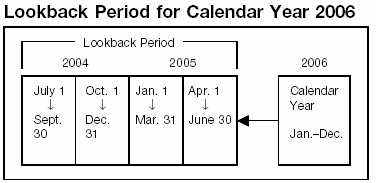
The lookback period for Form 941-SS (or Form 941) consists of four quarters beginning July 1 of the second preceding
year and ending June 30 of the
prior year. These four quarters are your lookback period even if you did not report any taxes for any of the quarters. For
2006, the lookback period
is July 1, 2004, through June 30, 2005.
Lookback period for employers of farmworkers.
The lookback period for Form 943 is the second calendar year preceding the current calendar year. The lookback period
for calendar year 2006 is
calendar year 2004.
Adjustments to lookback period taxes.
To determine your taxes for the lookback period, use only the tax that you reported on the original returns (Forms
941-SS, Forms 941, or Form 943).
Do not include adjustments made on a supplemental return filed after the due date of the return. However, if you make adjustments
on Form 941-SS or
Form 943, the adjustments are included in the total tax for the period in which the adjustments are reported.
Example of adjustments.
An employer originally reported total taxes of $45,000 for the lookback period. The employer discovered during February
2006 that the tax during
the lookback period was understated by $10,000 and corrected this error with an adjustment on the 2006 first quarter Form
941-SS. The employer is a
monthly schedule depositor for 2006 because the lookback period tax liabilities are based on the amounts originally reported,
and they were $50,000 or
less. The $10,000 adjustment is treated as part of the 2006 first quarter tax liability.
If your total tax reported for the lookback period is $50,000 or less, you are a monthly schedule depositor for the current
year. You must deposit
taxes on wage payments made during a calendar month by the 15th day of the following month.
New employers.
Your tax liability for any quarter in the lookback period before the date you started or acquired your business is
considered to be zero.
Therefore, you are a monthly schedule depositor for the first calendar year of your business (but see the $100,000 Next-Day Deposit Rule on
page 10).
Semiweekly Deposit Schedule
If your total tax reported for the lookback period is more than $50,000, you are a semiweekly schedule depositor for the current
year. If you are a
semiweekly schedule depositor, you must deposit on Wednesday and/or Friday, depending on what day of the week that you make
wage payments, as follows.
-
Deposit taxes on wage payments made on Wednesday, Thursday, and/or Friday by the following Wednesday.
-
Deposit taxes on wage payments made on Saturday, Sunday, Monday, and/or Tuesday by the following Friday.
Semiweekly deposit period spanning two quarters.
If you have more than one pay date during a semiweekly period and the pay dates fall in different calendar quarters,
you will need to make separate
deposits for the separate liabilities. For example, if you have a pay date on Saturday, September 30, 2006 (third quarter),
and another pay date on
Tuesday, October 3, 2006 (fourth quarter), two separate deposits will be required even though the pay dates fall within the
same semiweekly period.
Both deposits will be due Friday, October 6, 2006 (three banking days from the end of the semiweekly deposit period).
The term “deposit period” refers to the period during which tax liabilities are accumulated for each required deposit due date. For monthly
schedule depositors, the deposit period is a calendar month. The deposit periods for semiweekly schedule depositors are Wednesday
through Friday and
Saturday through Tuesday.
Examples of Monthly and Semiweekly Schedules
Employers of nonfarm workers.
Rose Co. reported Form 941-SS taxes as follows:
Rose Co. is a monthly schedule depositor for 2005 because its taxes for the four quarters in its lookback period ($48,000
for the 3rd quarter
of 2003 through the 2nd quarter of 2004) were not more than $50,000. However, for 2006, Rose Co. is a semiweekly schedule
depositor because the total
taxes for the four quarters in its lookback period ($51,000 for the 3rd quarter of 2004 through the 2nd quarter of 2005) exceeded
$50,000.
Employers of farmworkers.
Red Co. reported taxes on its 2003 Form 943 (line 9) of $48,000. On its 2004 Form 943 (line 9), it reported taxes
of $60,000.
Red Co. is a monthly schedule depositor for 2005 because its taxes for its lookback period ($48,000 for calendar year
2003) were not more than
$50,000. However, for 2006, Red Co. is a semiweekly schedule depositor because the total taxes for its lookback period ($60,000
for calendar year
2004) exceeded $50,000.
New agricultural employers.
New agricultural employers filing Form 943 are monthly schedule depositors for the first and second calendar years
of their business because their
taxes for the lookback period (2 years) are considered to be zero. However, see the $100,000 Next-Day Deposit Rule below.
Deposits on Banking Days Only
If a deposit due date falls on a day that is not a banking day, the deposit is considered timely if it is made by the close
of the next banking
day. In addition to federal and state bank holidays, Saturdays and Sundays are treated as nonbanking days. For example, if
a deposit is required to be
made on Friday, but Friday is not a banking day, the deposit is considered timely if it is made by the following Monday (if
Monday is a banking day).
Semiweekly schedule depositors will always have at least 3 banking days to make a deposit. That is, if any of the 3 weekdays
after the end of a
semiweekly period is a banking holiday, you will have 1 additional banking day to deposit. For example, if a semiweekly schedule
depositor accumulated
taxes for payments made on Friday and the following Monday is not a banking day, the deposit normally due on Wednesday may
be made on Thursday
(allowing 1 banking day to make the deposit).
Application of Monthly and Semiweekly Schedules
The examples below illustrate the procedure for determining the deposit date under the two different deposit schedules.
Monthly schedule example.
Green, Inc. is a seasonal employer and a monthly schedule depositor. It pays wages each Friday. During January 2006,
it paid wages but did not pay
any wages during February. Green, Inc. must deposit the combined tax liabilities for the January paydays by February 15. Green,
Inc. does not have a
deposit requirement for February (that is, due by March 15) because no wages were paid in February and, therefore, it did
not have a tax liability for
February.
Semiweekly schedule example.
Blue Co., a semiweekly schedule depositor, pays wages on the last day of the month. Blue Co. will deposit only once
a month because it pays wages
only once a month, but the deposit will be made under the semiweekly deposit schedule as follows. Blue Co.'s tax liability
for the April 28, 2006,
(Friday) payday must be deposited by May 3, 2006 (Wednesday).
$100,000 Next-Day Deposit Rule
If you accumulate taxes of $100,000 or more on any day during a deposit period, you must deposit by the close of the next
banking day, whether you
are a monthly or a semiweekly schedule depositor.
For purposes of the $100,000 rule, do not continue accumulating taxes after the end of a deposit period. For example, if a
semiweekly schedule
depositor has accumulated taxes of $95,000 on Tuesday and $10,000 on Wednesday, the $100,000 next-day deposit rule does not
apply because the $10,000
is accumulated in the next deposit period. Thus, $95,000 must be deposited by Friday and $10,000 must be deposited by the
following Wednesday.
In addition, once you accumulate at least $100,000 in a deposit period, stop accumulating at the end of that day and begin
to accumulate anew on
the next day. For example, Fir Co. is a semiweekly schedule depositor. On Monday, Fir Co. accumulates taxes of $110,000 and
must deposit on Tuesday,
the next banking day. On Tuesday, Fir Co. accumulates additional taxes of $30,000. Because the $30,000 is not added to the
previous $110,000 and is
less than $100,000, Fir Co. does not have to deposit the $30,000 until Friday (following the normal semiweekly deposit schedule).
If you are a monthly schedule depositor and you accumulate a $100,000 tax liability on any day during a month, you become
a semiweekly schedule
depositor on the next day and remain so for the remainder of the calendar year and for the following calendar year.
Example of $100,000 next-day deposit rule. Elm, Inc. started business on May 1, 2006. Because Elm, Inc. is a new employer, the taxes for
its lookback period are considered to be zero; therefore, Elm, Inc. is a monthly schedule depositor. On May 12, Elm, Inc.
paid wages for the first
time and accumulated taxes of $60,000. On May 19 (Friday), Elm, Inc. paid wages and accumulated taxes of $50,000, for a total
of $110,000. Because
Elm, Inc. accumulated $110,000 on May 19, it must deposit $110,000 by May 22 (Monday), the next banking day.
Accuracy of Deposits Rule
You are required to deposit 100% of your tax liability on or before the deposit due date. However, penalties will not be applied
for depositing
less than 100% if both of the following conditions are met.
-
Any deposit shortfall does not exceed the greater of $100 or 2% of the amount of taxes otherwise required to be deposited.
-
The deposit shortfall is paid or deposited by the shortfall makeup date as described below.
Makeup date for deposit shortfall:
-
Monthly schedule depositor. Deposit or pay the shortfall by the due date of the Form 941-SS or Form 943 for the period in which
the shortfall occurred. You may pay the shortfall with your return even if the amount is $2,500 or more.
-
Semiweekly schedule depositor. Deposit by the earlier of the following.
-
The first Wednesday or Friday (whichever comes first) that comes on or after the 15th of the month following the month in
which the
shortfall occurred.
-
The return due date for the period in which the shortfall occurred.
For example, if a semiweekly schedule depositor filing Form 941-SS has a deposit shortfall during July 2006, the shortfall
makeup date is August
16, 2006 (Wednesday). However, if the shortfall occurred on the required October 4 (Wednesday) deposit date for a September
29 (Friday) pay date, the
return due date for the September 29 pay date (October 31) would come before the November 15 (Wednesday) shortfall makeup
date. In this case, the
shortfall must be deposited by October 31.
Employers of Both Farm and Nonfarm Workers
If you employ both farm and nonfarm workers, you must treat employment taxes for the farmworkers (Form 943 taxes) separately
from employment taxes
for the nonfarm workers (Form 941-SS taxes). Form 943 taxes and Form 941-SS taxes are not combined for purposes of applying
any of the deposit rules.
If a deposit is due, deposit the Form 941-SS taxes and Form 943 taxes separately, as discussed below.
The two methods of depositing employment taxes are discussed next. See Payment with Return on page 8 for exceptions explaining when
taxes may be paid with the tax return instead of being deposited.
Electronic deposit requirement.
You must make electronic deposits of all depository taxes (such as employment tax, excise tax, and corporate income
tax) using the Electronic
Federal Tax Payment System (EFTPS) in 2006 if:
-
Your total deposits of such taxes in 2004 were more than $200,000 or
-
You were required to use EFTPS in 2005.
If you are required to use EFTPS and fail to do so, you may be subject to a 10% failure-to-deposit penalty. EFTPS
is a free service provided by the
Department of the Treasury. If you are not required to use EFTPS, you may participate voluntarily. To get more information
or to enroll in EFTPS, call
1-800-555-4477. You can also visit the EFTPS website at
www.eftps.gov.
New employers that have a federal tax obligation will be pre-enrolled in EFTPS. Call the toll-free number located
in your Employer Identification
Number (EIN) Package to activate your enrollment and begin making your tax deposit payments.
Depositing on time.
For deposits made by EFTPS to be on time, you must initiate the transaction at least 1 business day before the date
that the deposit is due.
Deposit record.
For your records, an Electronic Funds Transfer (EFT) Trace Number will be provided with each successful payment. The
number can be used as a
receipt or to trace the payment.
Making deposits with FTD coupons.
If you are not making deposits by EFTPS, use Form
8109, Federal Tax Deposit Coupon, to make the deposits at an authorized financial institution.
For new employers, if you would like to receive a Federal Tax Deposit (FTD) coupon booklet, call 1-800-829-4933. Allow
5 to 6 weeks for delivery.
The IRS will keep track of the number of FTD coupons that you use and automatically will send you additional coupons when
you need them. If you do not
receive your resupply of FTD coupons, call 1-800-829-4933. You can have the FTD coupon books sent to a branch office, tax
preparer, or service bureau
that is making your deposits by showing that address on Form
8109-C, FTD Address Change, which is in the FTD coupon book. (Filing Form 8109-C will not change your address of
record; it will change only the address where the FTD coupons are mailed.) The FTD coupons will be preprinted with your name,
address, and EIN. They
have spaces for indicating the type of tax and the tax period for which the deposit is made.
It is very important to clearly mark the correct type of tax and tax period on each FTD coupon. This information is
used by the IRS to credit your
account.
If you have branch offices depositing taxes, give them FTD coupons and complete instructions so that they can deposit
the taxes when due.
Please use only your FTD coupons. If you use anyone else's FTD coupon, you may be subject to a failure to deposit
penalty. This is because your
account will be underpaid by the amount of the deposit credited to the other person's account. See Deposit Penalties on page 12 for
amounts.
How to deposit with an FTD coupon.
Mail or deliver each FTD coupon and a single payment covering the taxes to be deposited to an authorized depositary.
An authorized depositary is a
financial institution (for example, a commercial bank) that is authorized to accept federal tax deposits. Follow the instructions
in the FTD coupon
book. Make your check or money order payable to the depositary. To help ensure proper crediting of your account, include your
EIN, the type of tax
(for example, Form 941-SS), and the tax period to which the payment applies on your check or money order.
Authorized depositaries must accept cash, a postal money order drawn to the order of the depositary, or a check or
draft drawn on and to the order
of the depositary. You may deposit taxes with a check drawn on another financial institution only if the depositary is willing
to accept that form of
payment. Be sure that the financial institution where you make deposits is an authorized depositary. Deposits made at an unauthorized
institution may
be subject to the failure to deposit penalty.
If you prefer, you may mail your coupon and payment to: Financial Agent, Federal Tax Deposit Processing, P.O. Box
970030, St. Louis, MO 63197. Make
your check or money order payable to “ Financial Agent.”
Depositing on time.
The IRS determines whether deposits are on time by the date that they are received by an authorized depositary. To
be considered timely, the funds
must be available to the depositary on the deposit due date before the institution's daily cutoff deadline. However, a deposit
received by the
authorized depositary after the due date will be considered timely if the taxpayer establishes that it was mailed in the United
States (including U.S.
Territories) in a properly addressed, postage prepaid envelope at least 2 days before the due date.
If you hand deliver your deposit to the depositary on the due date, be sure to deliver it before the depositary's
daily cutoff deadline.
Note: If you are required to deposit any taxes more than once a month, any deposit of $20,000 or more must be received by the authorized
depositary by
its due date to be timely. See section 7502(e)(3).
Depositing without an EIN.
If you have applied for an EIN but have not received it and you must make a deposit, make the deposit with the IRS.
Do not make the deposit at an
authorized depositary. Make it payable to the “ United States Treasury” and show on it your name (as shown on Form SS-4), address, kind of tax,
period covered, and the date that you applied for an EIN. Send your deposit with an explanation to your local IRS office or
the IRS service center
where you will file Form 941-SS, Form 943, or Form 940. The service center addresses are provided in the separate instructions
for Forms 941-SS, 943,
and 940 and are also available on the IRS website at
www.irs.gov. Do not use Form
8109-B, Federal Tax Deposit Coupon, in this situation.
Depositing without Form 8109.
If you do not have a preprinted Form 8109, you may use Form 8109-B to make deposits. Form 8109-B is an over-the-counter
FTD coupon that is not
preprinted with your identifying information. You may get this form by calling 1-800-829-4933. Be sure to have your EIN ready
when you call. You will
not be able to obtain Form 8109-B by calling 1-800-TAX-FORM.
Use Form 8109-B to make deposits only if:
-
You are a new employer and you have been assigned an EIN, but you have not received your initial supply of preprinted Forms
8109
or
-
You have not received your resupply of preprinted Forms 8109.
Deposit record.
For your records, a stub is provided with each FTD coupon in the coupon book. The FTD coupon itself will not be returned.
It is used to credit your
account. Your check, bank receipt, or money order is your receipt.
How to claim credit for overpayments.
If you deposited more than the right amount of taxes for a tax period, you can choose on Form 941-SS, Form 941, or
Form 943 for that tax period to
have the overpayment refunded or applied as a credit to your next return. Do not ask the depositary or EFTPS to request a
refund from the IRS for you.
Penalties may apply if you do not make required deposits on time, if you make deposits of less than the required amount, or
if you do not use EFTPS
when required. The penalties do not apply if any failure to make a proper and timely deposit was due to reasonable cause and
not to willful neglect.
For amounts not properly or timely deposited, the penalty rates are as follows.
Note: Late deposit penalty amounts are determined using calendar days, starting from the due date of the liability.
Order in which deposits are applied.
Deposits generally are applied to the most recent tax liability within the return period (quarter or year). However,
if you receive a
failure-to-deposit penalty notice, you may designate how your payment is to be applied in order to minimize the amount of
the penalty. Follow the
instructions on the penalty notice that you received. For more information on designating deposits, see Rev. Proc. 2001-58.
You can find Rev. Proc.
2001-58 on page 579 of Internal Revenue Bulletin 2001-50 at
www.irs.gov/pub/irs-irbs/irb01-50.pdf.
Example.
Cedar, Inc. is required to make a deposit of $1,000 on April 15 and $1,500 on May 15. It does not make the deposit on April
15. On May 15, Cedar,
Inc. deposits $2,000. Under the deposits rule, which applies deposits to the most recent tax liability, $1,500 of the deposit
is applied to the May 15
deposit and the remaining $500 is applied to the April deposit. Accordingly, $500 of the April 15 liability remains undeposited.
The penalty on this
underdeposit will apply as explained above.
Trust fund recovery penalty.
If income, social security, and Medicare taxes that must be withheld are not withheld or are not deposited or paid
to the United States Treasury,
the trust fund recovery penalty may apply. The penalty is the full amount of the unpaid trust fund tax. This penalty may apply
to you if these unpaid
taxes cannot be immediately collected from the employer or business.
The trust fund recovery penalty may be imposed on all persons who are determined by the IRS to be responsible for
collecting, accounting for, and
paying over these taxes, and who acted willfully in not doing so.
A responsible person can be an officer or employee of a corporation, a partner or employee of a partnership, an accountant, a volunteer
director/trustee, or an employee of a sole proprietorship. A responsible person also may include one who signs checks for
the business or otherwise
has authority to cause the spending of business funds.
Willfully means voluntarily, consciously, and intentionally. A responsible person acts willfully if the person knows the required
actions are not taking place.
“Averaged” failure-to-deposit penalty.
IRS may assess an “ averaged” failure-to-deposit (FTD) penalty of 2% to 10% if you are a monthly schedule depositor and did not properly
complete line 15 of Form 941-SS when your tax liability (line 8) shown on Form 941-SS was $2,500 or more. IRS may also assess
this penalty of 2% to
10% if you are a semiweekly schedule depositor and your tax liability (line 8) shown on Form 941-SS was $2,500 or more and
you did any of the
following.
-
Completed line 15 of Form 941-SS instead of Schedule B (Form 941).
-
Failed to attach a properly completed Schedule B (Form 941).
-
Completed Schedule B (Form 941) incorrectly, for example, by entering tax deposits instead of tax liabilities in the numbered
spaces.
IRS figures the penalty by allocating your total tax liability on line 8 of Form 941-SS, equally throughout the tax
period. Your deposits and
payments may not be counted as timely because IRS does not know the actual dates of your tax liabilities.
You can avoid the penalty by reviewing your return before filing it. Follow these steps before filing your Form 941-SS.
-
If you are a monthly schedule depositor, report your tax liabilities (not your deposits) in the monthly entry spaces on line
15.
-
If you are a semiweekly schedule depositor, report your tax liabilities (not your deposits) on Schedule B (Form 941) in the
lines that
represent the dates you paid your employees.
-
Verify that your total liability shown on line 15 of Form 941-SS or the bottom of Schedule B (Form 941) equals your tax liability
shown on
line 8 of Form 941-SS.
-
Do not show negative amounts on line 15 or Schedule B (Form 941). If a prior period adjustment results in a decrease in your
tax liability,
reduce your liability for the day you discovered the error by the tax decrease resulting from the error, but not below zero.
Apply any remaining
decrease to subsequent liabilities.
General instructions.
File Form 941-SS for nonfarm workers and Form 943 for farmworkers. (U.S. Virgin Islands employers may be required
to file Form 940 or Form 940-EZ
for the combined wages of nonfarm workers and farmworkers.)
The IRS sends each employer a form preaddressed with name, address, and EIN. If the form fails to reach you, request
one in time to file. If you
use a form that is not preaddressed, enter your name and EIN exactly as they appeared on previous returns.
Nonfarm employers.
File Form 941-SS for the calendar quarter in which you first pay wages for nonfarm workers and for each quarter thereafter
unless you are a
seasonal employer or file a final return. Due dates for each quarter of the calendar year are as follows.
However, if you deposited all taxes when due for the quarter, you have 10 additional days from the due dates above
to file the return. If the due
date for filing your return falls on a Saturday, Sunday, or legal holiday, you may file on the next business day.
If you closed your business or stopped paying wages and do not have to file returns in the future, check the box on
line 16 of your final Form
941-SS and show the date final wages were paid.
Household employers reporting social security and Medicare taxes.
If you are a sole proprietor and file Form 941-SS for business employees, you may include taxes for household employees
on your Form 941-SS.
Otherwise, report social security and Medicare taxes for household employees on Schedule H
(Form 1040), Household Employment Taxes. See Publication 926, Household Employer's Tax Guide, for
more information.
Note: Household employers must have an EIN. See Employer Identification Number (EIN) on page 5.
Employers of farmworkers.
Every employer of farmworkers must file a Form 943 for each calendar year beginning with the first year the employer
pays $2,500 or more for
farmwork or employs a farmworker who meets the $150 test described in section 6.
File a Form 943 each year for all taxable wages paid for farmwork. You may report household workers in a private home
on a farm operated for profit
on Form 943. Do not report wages for farmworkers on Form 941-SS.
Send Form 943 to the IRS by January 31 of the following year. Send it with payment of any taxes due that you are not
required to deposit. If you
deposited all taxes when due, you have 10 additional days to file.
If you receive a Form 943 for a year in which you are not required to file, write “ NONE” on line 11 of the form, sign the form, and send it
back to the IRS. If at that time you do not expect to meet either test in section 6 in the future, check the final return
box above line 1. If you
later become liable for any of the taxes, notify the IRS.
Penalties.
For each whole or part month that a return is not filed when required (disregarding any extensions of the filing deadline),
there is a
failure-to-file penalty of 5% of the unpaid tax due with that return. The maximum penalty is generally 25% of the tax due.
Also, for each whole or
part month that the tax is paid late (disregarding any extensions of the payment deadline), there is a failure-to-pay penalty
of 0.5% per month of the
amount of tax. For individual filers only, the failure-to-pay penalty is reduced from 0.5% per month to 0.25% per month if
an installment agreement is
in effect. You must have filed your return on or before the due date of the return to qualify for the reduced penalty. The
maximum amount of the
failure-to-pay penalty is also 25% of the tax due. If both penalties apply in any month, the failure-to-file penalty is reduced
by the amount of the
failure-to-pay penalty. The penalties will not be charged if you have a reasonable cause for failing to file or pay. If you
receive a penalty notice,
you can provide an explanation of why you believe reasonable cause exists.
Generally, you can correct errors on a prior return by making an adjustment on Form 941-SS or Form 943 for the tax period
(quarter or year) during
which the error was discovered. For example, if you made an error reporting social security tax on your second quarter 2005
Form 941-SS and discovered
the error during January 2006, correct the error by making an adjustment on your first quarter 2006 Form 941-SS.
The adjustment increases or decreases your tax liability for the period in which it is reported (the quarter or year the error
is discovered) and
is interest free. The net adjustments reported on Form 941-SS (or Form 943) may include any number of corrections for one
or more previous quarters
(or years), including both overpayments and underpayments.
You are required to provide background information and certifications supporting prior period adjustments. File Form
941c, Supporting Statement To Correct Information, with Form 941-SS or Form 943, or attach an equivalent supporting
statement.
Do not file Form 941c separately from Form 941-SS or Form 943. Form 941c is not an amended return. It is used to provide necessary
certification
and background information supporting the adjustments made on Form 941-SS or Form 943.
The instructions for Form 941-SS and Form 943 explain how to correct mistakes in reporting withheld social security and Medicare
taxes, including
the use of Form 941c. You may also make an adjustment for overwithheld social security and/or Medicare taxes or claim a refund
of these taxes on Form
843, Claim for Refund and Request for Abatement. Decreases in tax liability shown on Form 843 will be refunded with
interest.
If you withhold no social security tax, Medicare tax, or less than the right amount of either tax from an employee's wages,
you can make it up from
later pay to that employee. But you are responsible for the underpayment. Any reimbursement from the employee's own funds
for amounts not collected
must be agreed to by you and the employee. (This does not apply to tax on tips. See section 5.)
If you withhold more than the right amount of social security tax or Medicare tax from wages paid, give the employee the amount
overcollected. Be
sure to keep in your records the employee's written receipt showing the date and amount of the repayment. If you do not have
a receipt, you must
report and pay any overcollection when you file the return for the return period in which the overcollection was made.
Special additions to tax liability.
Line 7g of Form 941-SS is reserved for employers with special circumstances. Use this line only if the IRS sent you
a notice instructing you to do
so.
10. Wage and Tax Statements
By January 31, furnish Copies B and C of Form W-2VI, W-2GU, W-2AS, or W-2CM to each employee. If an employee stops working
for you during the year,
furnish the statement at any time after employment ends but no later than January 31 of the next year. However, if the employee
asks you for Form W-2,
furnish it within 30 days of the request or the last wage payment, whichever is later.
Note.
Employers in the Commonwealth of the Northern Mariana Islands should contact their local tax department for instructions
on completing Form W-2CM.
When and where to file electronically.
If you are required to file 250 or more Forms W-2CM, W-2VI, W-2GU, or W-2AS, you must file electronically. See the
instructions for Form W-3SS or
call the Social Security Administration (SSA) at 1-800-772-6270 for more information. You may also visit Social Security's
Employer Reporting
Instructions and Information website at
www.socialsecurity.gov/employer. You must file electronically by the last day of March.
When and where to file paper forms.
By the last day of February (or when filing a final return if you make final payments before the end of the year),
send your completed forms to the
following locations.
-
Employers in the U.S. Virgin Islands, Guam, American Samoa, and the Commonwealth of the Northern Mariana Islands must send
Copy A of Forms
W-2VI, W-2GU, W-2AS, W-2CM, and a Form W-3SS, Transmittal of Wage and Tax Statements, to the SSA at the address shown on Form
W-3SS.
-
Send Copy 1 of Forms W-2VI, W-2GU, W-2AS, and W-3SS to your local tax department. For more information on Copy 1, contact
your local tax
department. Employers in the Commonwealth of the Northern Mariana Islands should contact their local tax department for instructions
on how to file
Copy 1.
If you need copies of Forms W-2VI, W-2GU, W-2AS, W-2CM, and W-3SS, see How To Get Forms and Publications on page 4.
If you need to correct a Form W-2VI, W-2GU, W-2AS, or W-2CM after you have sent Copy A to the SSA, use Form W-2c,
Corrected Wage and Tax Statement.
Furnish employees Copies B and C of Form W-2c. Send Copy A with Form W-3c, Transmittal of Corrected Wage and Tax Statements,
to the SSA at the address
shown on
Form W-3c.
If you go out of business during the year, give your employees their Forms W-2 by the due date of your final Form
941-SS. File Copy A with the SSA
by the last day of the month after that due date.
If an employee loses or destroys his or her copies, furnish that employee copies of Form W-2VI, W-2GU, W-2AS, or W-2CM
marked “ REISSUED
STATEMENT.” Do not send Copy A of the reissued form to the SSA.
If a form is corrected before you send Copy A to the SSA, furnish the employee the corrected copies. Mark the original
Copy A “ Void” in the
proper box and send the new Copy A as explained above. Only send the new Copy A to SSA; do not send the Copy A marked “ Void.” For more
information, see the Instructions for Forms W-2 and W-3.
11. Federal Unemployment (FUTA) Tax—U.S. Virgin Islands Employers Only
The Federal Unemployment Tax Act (FUTA), with state unemployment systems, provides for payments of unemployment compensation
to workers who have
lost their jobs. Most employers pay both a federal and a state unemployment tax. Only the employer pays FUTA tax; it is not
withheld from your
employees' wages. For more information, see the Instructions for Form 940.
You must file Form 940 or Form 940-EZ, Employer's Annual Federal Unemployment (FUTA) Tax Return, if you are subject to FUTA
tax under the following
rules.
In general.
You are subject to FUTA tax in 2006 on the wages you pay employees who are not farmworkers or household workers if:
-
You paid wages of $1,500 or more in any calendar quarter of 2005 or 2006 or
-
You had one or more employees for at least some part of a day in any 20 or more different weeks in 2005 or 20 or more different
weeks in
2006.
Household workers.
You are subject to FUTA tax only if you paid total cash wages of $1,000 or more (for all household workers) in any
calendar quarter in 2005 or
2006.
Farmworkers.
You are subject to FUTA tax on the wages that you pay to farmworkers in 2006 if:
-
You paid total cash wages of $20,000 or more for the farmwork in any calendar quarter to farmworkers during 2005 or 2006 or
-
You employed 10 or more farmworkers during at least some part of a day (whether or not at the same time) during any 20 or
more different
weeks in 2005 or 20 or more different weeks in 2006.
To determine whether you meet either test above, you must count wages paid to aliens admitted on a temporary basis
to the United States to perform
farmwork, also known as “ H-2(A)” visa workers. However, wages paid to “ H-2(A)” visa workers are not subject to the FUTA tax.
In most cases, farmworkers supplied by a crew leader are considered employees of the farm operator for FUTA tax purposes.
However, this is not the
case if either of the following applies and the crew leader is not an employee of the farm operator.
-
The crew leader is registered under the Migrant and Seasonal Agricultural Worker Protection Act.
-
Substantially all of the workers supplied by the crew leader operate or maintain tractors, harvesting or cropdusting machines,
or other
machines provided by the crew leader.
If (1) or (2) applies, the farmworkers are generally employees of the crew leader.
Rate.
The FUTA tax rate for 2005 and 2006 is 6.2% of the first $7,000 of wages that you pay to each employee during the
calendar year. Only the employer
pays this tax. Do not deduct it from employees' wages. Generally, you may take a credit of 5.4% against the FUTA tax for payments
to U.S. Virgin
Islands unemployment funds. Therefore, your actual tax rate is usually 0.8% (6.2% - 5.4%). However, your credit is reduced
if you did not pay
all required U.S. Virgin Islands unemployment tax by the due date of Form 940 or Form 940-EZ. The credit cannot be more than
5.4% of taxable FUTA
wages.
Form 940 or Form 940-EZ.
By January 31, file Form 940 or Form 940-EZ. If you made all FUTA tax deposits on time, you have 10 additional days
to file.
Form 940-EZ is a simpler version of Form 940 for filers with uncomplicated tax situations. You can generally use Form
940-EZ for 2005 if:
-
You are liable for unemployment tax only in the U.S. Virgin Islands,
-
You make all required payments to the U.S. Virgin Islands by the due date of Form 940 or Form 940-EZ, and
-
All wages subject to FUTA tax are also subject to U.S. Virgin Islands unemployment tax.
If you do not meet these conditions, file Form 940 instead. Once you have filed Form 940 or Form 940-EZ, the IRS will
send you a preaddressed form.
Deposits.
If you are not making deposits using EFTPS (see section 8), deposit the FUTA tax with an authorized financial institution.
Send a deposit coupon
(Form 8109) with each payment.
Figure your liability for FUTA tax deposits quarterly. Multiply by .008 (0.8%) the amount of wages paid during the
quarter to employees who have
not exceeded $7,000 in wages for the calendar year. Stop depositing FUTA tax on an employee's wages when his or her wages
exceed $7,000 for the
calendar year. If any part of the first $7,000 paid to employees is exempt from U.S. Virgin Islands unemployment taxes, you
may be required to deposit
an amount in excess of the .008 rate. If this amount (plus any undeposited amount from earlier quarters) is more than $500,
deposit it by the last day
of the first month after the end of the quarter. If the result is $500 or less, add it to the FUTA tax for the next quarter,
and do not make a
deposit. Make this calculation for each of the first 3 quarters of the year.
If the FUTA tax reportable on Form 940 or Form 940-EZ minus the amounts deposited for the first 3 quarters is more
than $500, deposit the tax by
January 31. If the result is $500 or less, you may either deposit the tax or pay it with Form 940 or Form 940-EZ by January
31.
12. Special Rules for Various Types of Employment and Payments
|
The following table summarizes the treatment of special classes of employment and special types of payments.
Employers who need more detailed information should consult their Internal Revenue Service representative or see the Employment
Tax
Regulations.
|
Special Classes of Employment
and Special Types of Payments
|
Treatment Under Employment Taxes
|
Social Security
and Medicare
|
Federal Unemployment
(U.S. Virgin Islands Only)
|
|
Agricultural
labor:
|
|
|
|
1. Service on farm in connection with cultivating soil; raising or harvesting any agricultural or
horticultural commodity; the care of livestock, poultry, bees, fur-bearing animals, or wildlife.
|
Taxable if $150 test or $2,500 test in section 6 is met.
|
Taxable if either test in section 11 is met.
|
|
2. Service in employ of owner or operator of farm if major part of the services are performed on farm, in
management or maintenance, etc., of farm, tools, or equipment, or in salvaging timber, or clearing brush and other debris
left by hurricane.
|
Taxable if $150 test or $2,500 test in section 6 is met.
|
Taxable if either test in section 11 is met.
|
|
3. In connection with the production and harvesting of turpentine and other oleoresinous products.
|
Taxable if $150 test or $2,500 test in section 6 is met.
|
Taxable if either test in section 11 is met.
|
|
4. Cotton ginning.
|
Taxable if $150 test or $2,500 test in section 6 is met.
|
Taxable if either test in section 11 is met.
|
|
5. In connection with hatching of poultry.
|
Taxable (not farmwork if performed off farm).*
|
Taxable if either test in section 11 is met.
|
|
6. In operation or maintenance of ditches, canals, reservoirs, or waterways used only for supplying or storing
water for farming purposes and not owned or operated for profit.
|
Taxable if $150 test or $2,500 test in section 6 is met.
|
Taxable if either test in section 11 is met.
|
|
7. In processing, packaging, delivering, etc., any agricultural or horticultural commodity in its
unmanufactured state:
|
|
|
|
a. In employ of farm operator.
|
If operator produced over half of commodity processed, taxable if $150 test or $2,500 test in section 6 is
met; otherwise taxable (not farmwork).*
|
If employer produced over half of commodity processed, taxable if either test in section 11 is met; otherwise
taxable (not farmwork).
|
b. In employ of unincorporated group of farm
operators (never more than 20).
|
If group produced all commodity processed, taxable if $150 test or $2,500 test in section 6 is met; otherwise
taxable (not farmwork).*
|
If employer produced over half of commodity processed, taxable if either test in section 11 is met; otherwise
taxable (not farmwork).
|
c. In employ of other groups of farm operators
(including cooperative organizations and commercial handlers).
|
Taxable (not farmwork).*
|
If employer produced over half of commodity processed, taxable if either test in section 11 is met; otherwise
taxable (not farmwork).
|
|
8. Handling or processing commodities after delivery to terminal market for commercial canning or
freezing.
|
Taxable (not farmwork).*
|
Taxable (not farmwork).
|
|
Aliens:
|
|
|
|
1. Resident
|
|
|
|
a. Service performed in U.S.**
|
Same as U.S. citizen; exempt if any part of service as crew member of foreign vessel or aircraft is performed
outside U.S.
|
Same as U.S. citizen.
|
|
b. Service performed outside U.S.**
|
Taxable if: (a) working for an American employer or (b) an American employer by agreement with the IRS covers
U.S. citizens and residents employed by its foreign affiliates, or subsidiary of an American employer.
|
Exempt unless on or in connection with an American vessel or aircraft and either performed under contract made
in U.S. or alien is employed on such vessel or aircraft when it touches U.S. port.
|
|
* Wages for services not considered farmwork are reported on Form 941-SS. Other exemptions may apply.
See sections 4 and 9.
|
|
** U.S. includes U.S. Virgin Islands, Guam, American Samoa, and the Commonwealth of the Northern
Mariana Islands.
|
Special Classes of Employment
and Special Types of Payments
|
Treatment Under Employment Taxes
|
Social Security
and Medicare
|
Federal Unemployment
(U.S. Virgin Islands Only)
|
|
Aliens (continued):
|
|
|
|
2. Nonresidents working in U.S.*
|
|
|
a. Workers lawfully admitted under section
101(a)(15)(H)(ii)(a) of the Immigration
and Nationality Act on a temporary
basis to perform agricultural labor
(“H-2(A)” workers).
|
Exempt.
|
Exempt.
|
b. Student, scholar, trainee, teacher, etc.
as nonimmigrant alien under section
101(a)(15)(F),(J), (M), or (Q) or Philippine or
Korean resident admitted to Guam under
section101(a)(15)(H) of the Immigration
andNationality Act or admitted as
contract workers to the Commonwealth
of the Northern Mariana Islands.
|
Exempt if service is performed for purposes specified in section 101(a)(15)(F), (H), (J), (M),
or (Q) of Immigration and Nationality Act. However, these taxes may apply if the employee becomes a resident alien.
|
|
c. All other nonresidents working in U.S.*
|
Same as U.S. citizen; exempt if any part of service as crew member of foreign vessel or aircraft is performed
outside U.S. and employer is not American employer.
|
Same as U.S. citizen.
|
|
3. Nonresident working on American vessel or aircraft outside U.S.*
|
Taxable if under contract made in U.S. or worker is employed on vessel or aircraft when it
touches U.S. port.
|
|
Deceased worker's wages:
|
|
|
|
1. Paid to beneficiary or estate in calendar year of worker's death.
|
Taxable.
|
Taxable.
|
|
2. Paid to beneficiary or estate after the year of worker's death.
|
Exempt.
|
Exempt.
|
| Dependent care assistance programs (limited to $5,000; $2,500 if married filing
separately).
|
Exempt to the extent that it is reasonable to believe that amounts will be excludable from gross
income under Internal Revenue Code (IRC) section 129.
|
|
Disabled worker's wages paid after the year in which worker became entitled to disability insurance
benefits under the Social Security Act.
|
Exempt if worker did not perform any service for employer during period for which payment is made.
|
Taxable.
|
|
Domestic service in college clubs, fraternities, and sororities.
|
Exempt if paid to regular student; also exempt if employee is paid less than $100 in a year by an
income-tax-exempt employer.
|
Taxable if employer paid total cash wages of $1,000 or more (for all household employees) in any
calendar quarter in the current or preceding year.
|
|
Employee achievement awards.
|
Exempt to the extent it is reasonable to believe the amounts will be excludable from
gross income under IRC section 74(c).
|
|
Family employees:
|
|
|
|
1. Child employed by parent (or by partnership in which each partner is a parent of the child).
|
Exempt until age 18.
|
Exempt until age 21.
|
|
2. Child employed by parent for domestic work or not in the course of a trade or business.
|
Exempt until age 21.
|
Exempt until age 21.
|
|
3. Parent employed by child.
|
Taxable if in course of the child's business. For household work in private home of child, see Pub.
926.
|
Exempt.
|
|
4. Spouse employed by spouse.
|
Taxable if in course of spouse's business.
|
Exempt.
|
|
Federal employees:
|
|
|
|
1. Members of uniformed services; Young Adult Conservation Corps, Job Corps, or National Volunteer Antipoverty
Program; Peace Corps volunteers and volunteer leaders.
|
Taxable
|
Exempt.
|
|
2. All others.
|
Taxable if employee is covered by FERS or has a break in service of more than one year (unless the
break in service was for temporary military or reserve duty). Others generally subject to Medicare tax.
|
Exempt unless worker is a seaman performing services on or in connection with American vessel owned
by or chartered to the United States and operated by general agent of Secretary of Commerce.
|
|
* U.S. includes U.S. Virgin Islands, Guam, American Samoa, and the Commonwealth of the Northern Mariana
Islands.
|
Special Classes of Employment
and Special Types of Payments
|
Treatment Under Employment Taxes
|
Social Security
and Medicare
|
Federal Unemployment
(U.S. Virgin Islands Only)
|
|
Fishing and related activities, employment in connection with catching, harvesting, farming, etc.:
|
|
|
|
1. Salmon or halibut.
|
Taxable unless 3 applies.
|
Taxable unless 3 applies.
|
|
2. Other fish and other aquatic forms of animal and vegetable life.
|
Taxable unless 3 applies.
|
Exempt unless on vessel of more than 10 net tons and 3 does not apply.
|
|
3. An arrangement with the owner or operator of the boat by which the individual receives a share of the
boat's catch (or proceeds from the sale of the catch), the share depending on the boat's catch, and operating crew of the
boat is normally fewer than
10 individuals.*
|
Exempt if any cash remuneration is:
(a) $100 or less,
(b) contingent on minimum catch, and
(c) paid solely for additional duties (such as mate, engineer, or cook for which cash
remuneration is traditional).
|
|
Foreign governments and international organizations.
|
Exempt.
|
Exempt.
|
|
Foreign service by U.S. citizens:
|
|
|
|
1. As U.S. Government employee.
|
Same as within U.S.
|
Exempt. See also Federal employees on page 18.
|
|
2. For foreign affiliates or subsidiaries of American employers and other private employers.
|
Exempt unless (a) an American employer by agreement with the IRS covers U.S. citizens employed by its foreign
affiliates or subsidiaries or (b) U.S. citizen works for American employer.
|
Exempt unless (a) on American vessel or aircraft and work is performed under contract made in U.S. or worker
is employed on vessel when it touches U.S. port, or (b) U.S. citizen works for American employer (except in a contiguous country
with which the U.S.
has an agreement for unemployment compensation) or in the U.S. Virgin Islands.
|
|
Fringe benefits.
|
Taxable on excess of fair market value of the benefit over the sum of an amount paid for it by
the employee and any amount excludable by law. However, optional special valuation rules may apply.**
|
| Government
employees (other than federal).
|
Taxable if services are covered by section 218 (Social Security Act) agreement; taxable in certain other
cases.
|
Exempt.
|
| Group-term
life insurance costs. See Pub. 15-B for details.
|
Exempt, except for the cost of premiums that provide more than $50,000 coverage.
|
Exempt.
|
| Homeworkers
(industrial, cottage-industry):
|
|
|
|
1. Common law employees.
|
Taxable.
|
Taxable.
|
|
2. Statutory employees. See section 1.
|
Taxable if paid $100 or more in cash in a year.
|
Exempt.
|
|
Hospital interns.
|
Taxable.
|
Exempt.
|
| Household workers
(domestic service in private homes). Also see Domestic service in college clubs, fraternities, and
sororities on page 18.
|
Taxable if paid $1,500 or more in cash in 2006. Exempt if performed by a individual who is under
age 18 during any part of the calendar year and the work is not the principal occupation of the employee.
|
Taxable if employee paid total cash wages of $1,000 or more (for all household employees) in any
calendar quarter in the current or preceding year.
|
|
Insurance agents
or solicitors:
|
|
|
|
1. Full-time life insurance salesperson.
|
Taxable.
|
Taxable if employee under common law and not paid solely by commissions (applies to
both 1 and 2).
|
|
2. Other salesperson of life, casualty, etc., insurance.
|
Taxable only if employee under common law.
|
| Interest foregone on below-market loans related to compensation and deemed original issue
discount. See IRC section 7872 and its regulations for details.
|
See Pub. 15-A.
|
| Meals and lodging
furnished free or at a discounted price to the employee. For household employees, agricultural labor,
and service not in the course of the employer's trade or business, see Noncash payments on page 20.
|
(a) Meals—Taxable unless furnished for employer's convenience and on the employer's
premises. For information on the de minimis fringe exclusion, see IRC section 132(e).
|
|
(b) Lodging—Taxable unless furnished on employer's premises, for the employer's
convenience, and as condition of employment.
|
|
Ministers
of churches performing duties as such.
|
Exempt.
|
Exempt.
|
|
* Income derived by Native Americans exercising fishing rights is generally exempt
from employment taxes.
|
|
* * Benefits provided under cafeteria plans may qualify for exclusion from wages for social security,
Medicare, and FUTA taxes.
|
Special Classes of Employment
and Special Types of Payments
|
Treatment Under Employment Taxes
|
Social Security
and Medicare
|
Federal Unemployment
(U.S. Virgin Islands Only)
|
|
Moving expense
reimbursement:
|
|
|
1. Qualified expenses.
|
Exempt unless you have knowledge that the employee deducted the expenses in a prior
year.
|
|
2. Nonqualified expenses.
|
Taxable.
|
Taxable.
|
|
Newspaper
carrier under age 18 delivering directly to readers.
|
Exempt.
|
Exempt.
|
|
Newspaper and magazine vendors buying at fixed prices and retaining excess from sales to
customers.
|
Exempt.
|
Exempt.
|
|
Noncash payments:
|
|
|
|
1. For household work, agricultural labor, and service not in the course of the employer's trade or
business.
|
Exempt.
|
Exempt.
|
|
2. To certain retail commission salespersons ordinarily paid solely on a cash commission basis.
|
Taxable.
|
Taxable.
|
|
Nonprofit organizations:
|
|
|
|
1. Religious, educational, charitable, etc., organizations described in IRC section 501(c)(3) exempt from
income tax under IRC 501(a).
|
Taxable if paid $100 or more in a year. (See Form
8274, Certification by Churches and Qualified Church-Controlled Organizations Electing Exemption From Employer Social
Security and Medicare Taxes, for election out of social security and Medicare coverage for certain churches and church-controlled
organizations.)
|
Exempt.
|
|
2. Corporations organized under Act of Congress described in IRC section 501(c).
|
Taxable if employee is paid $100 or more in a year unless services excepted by IRC section 3121(b)(5) or
(6).
|
Taxable if employee is paid $50 or more in a quarter unless services excepted by IRC section
3306(c)(6).
|
|
3. Other organizations exempt under IRC section 501(a) (other than a pension, profit-sharing, or stock bonus
plan described in IRC section 401(a)) or under IRC section 521.
|
Taxable if employee is paid $100 or more in a year.
|
Taxable if employee is paid $50 or more in a quarter.
|
| Partners:
Bona fide members of a partnership.
|
Exempt.
|
Exempt.
|
|
Patients employed by hospitals.
|
Taxable (exempt for state or local government hospitals).
|
Exempt.
|
| Religious orders:
Members who are instructed by the order to perform services:
|
|
|
|
1. For the order, agency of the supervising church, or associated institution.
|
Exempt unless member has taken a vow of poverty and the religious order or its autonomous subdivision
irrevocably elects coverage for entire active membership.
|
Exempt.
|
|
2. For any organization other than those described in 1 above.
|
Taxable.
|
Taxable.
|
|
Retirement and pension plans:
|
See Pub. 15-A for details and information on employer contributions to nonqualified deferred
compensation arrangements.
|
|
1. Employer contributions to a qualified plan.
|
Exempt.
|
Exempt.
|
|
2. Elective employee contributions and deferrals to a plan containing a qualified cash or deferred
compensation arrangement (for example, 401(k)).
|
Taxable.
|
Taxable.
|
|
3. Employee salary reduction contributions to a SIMPLE retirement account.
|
Taxable.
|
Taxable.
|
|
4. Employer contributions to individual retirement accounts under a simplified employee pension (SEP)
plan.
|
Exempt except for amounts contributed under a salary reduction SEP agreement.
|
|
5. Employer contributions to IRC section 403(b) annuity contracts.
|
Taxable if paid through a salary reduction agreement (written or
otherwise).
|
Special Classes of Employment
and Special Types of Payments
|
Treatment Under Employment Taxes
|
Social Security
and Medicare
|
Federal Unemployment
(U.S. Virgin Islands Only)
|
Retirement and pension plans: (continued)
|
|
|
|
6. Distributions from qualified retirement and pension plans and section 403(b) annuities.
|
Exempt.
|
Exempt.
|
|
Salespersons:
|
|
|
|
1. Common law employees.
|
Taxable.
|
Taxable.
|
|
2. Statutory employees (referred to in section 1).
|
Taxable.
|
Taxable except for full-time life insurance sales agents.
|
|
3. Statutory nonemployees (qualified real estate agents and direct sellers).
|
Exempt. Treated as self-employed individuals if substantially all payments directly related to
sales or other output and services performed as nonemployees specified in written contract. Direct sellers must be in the
business of selling consumer
products other than in a permanent retail place of business.
|
| Scholarships
and fellowship grants (includible in income under section 117(c)).
|
Taxability depends on the nature of the employment and the status of the organization. See
Students below.
|
|
Severance or dismissal pay.
|
Taxable.
|
Taxable.
|
| Service not in the course of the employer's trade or business, other than on a farm operated for
profit or for household employment in private homes.
|
Taxable if employee is paid $100 or more in cash in a year.
|
Taxable only if employee is paid $50 or more in cash in a quarter and works on 24 or more different days in
that quarter or in the preceding quarter.
|
|
Sickness or injury
payments under:
|
|
|
|
1. Worker's compensation law.
|
Exempt.
|
Exempt.
|
|
2. Certain employer plans.
|
Exempt after end of six calendar months after calendar
month employee last worked for
employer (applies to both 2 and 3). See Pub. 15-A for details.
|
|
3. No employer plan.
|
|
Students:
|
|
|
|
1. Student enrolled and regularly attending classes (generally, at least half time or equivalent) while
pursuing course of study, performing services for:
|
|
|
|
a. Private school, college, or university.
|
Exempt.
|
Exempt.
|
b. Auxiliary nonprofit organization operated for
and controlled by school, college, or
university.
|
Exempt unless services are covered by a section 218 (Social Security Act) agreement.
|
Exempt.
|
|
c. Public school, college, or university.
|
Exempt unless services are covered by a section 218 (Social Security Act) agreement.
|
Exempt.
|
|
2. Full-time student performing service for academic credit, combining academic instruction with work
experience as an integral part of the program.
|
Taxable.
|
Exempt unless program was established for or on behalf of an employer or group of employers.
|
|
3. Student nurse performing part-time services for nominal earnings at hospital as incidental part of
training.
|
Exempt.
|
Exempt.
|
|
4. Student employed by organized camps.
|
Taxable.
|
Exempt.
|
|
Supplemental unemployment compensation benefits.
|
Exempt under certain conditions. See Pub. 15-A.
|
Exempt under certain conditions. See Pub. 15-A.
|
|
Tips:
|
|
|
|
1. If $20 or more in a month.
|
Taxable.
|
Taxable for all tips reported in writing to employer.
|
|
2. If less than $20 in a month.
|
Exempt.
|
Exempt.
|
|
Worker's compensation.
|
Exempt.
|
Exempt.
|
Previous | First | Next
Publications Index | 2005 Tax Help Archives | Tax Help Archives Main | Home
|